Key facts
- Blue Origin aims to return New Glenn to flight by the close of 2026.
- Under a revised flight preparation process, the company intends to assemble the rocket stages side by side before lifting the vehicle onto the pad with a crane.
- Pad 36A is undergoing restoration after an anomaly earlier this year. Blue Origin described it as the first launch complex rebuilt at Cape Canaveral since the 1960s.
- The company is building LC-36B at Cape Canaveral Space Force Station as the planned primary launch site for the New Glenn 9×4 vehicle.
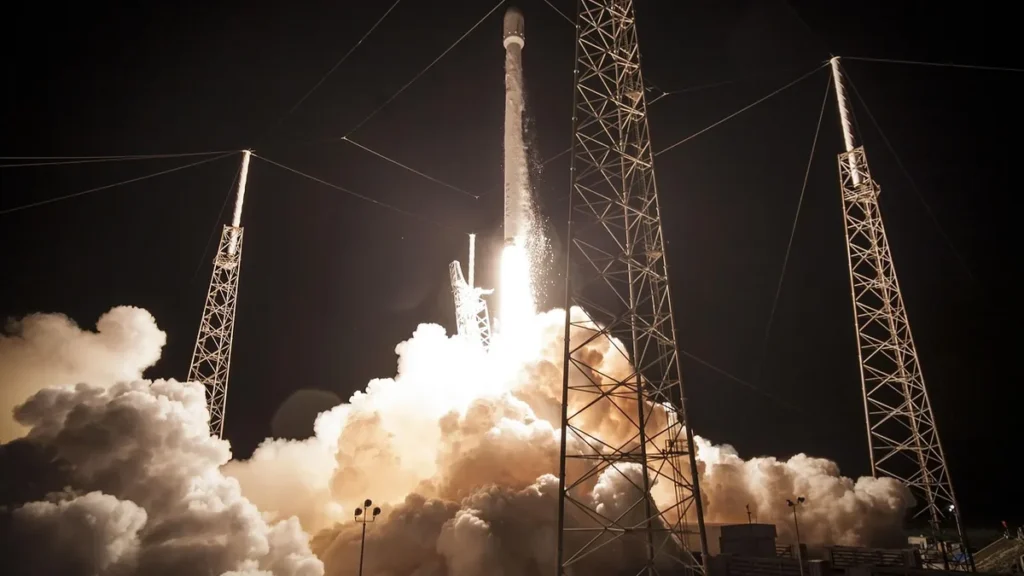
Dave Limp, the company’s chief executive, posted a time-lapse video Oct. 24, 2026, showing Blue Origin’s fully reassembled vehicle access tower at Launch Complex 36 at Cape Canaveral, with every module back in its place after repairs.
Five months after the May 28, 2026, explosion that destroyed a New Glenn rocket at the same Cape Canaveral launch complex, workers finished reassembling the vehicle access tower. Blue Origin said the May 28 test blast caused significant damage at Cape Canaveral, hitting the transporter-erector and a lightning tower, but the company said it could repair the tower. Blue Origin traced the blast to a problem with a main oxygen valve on one of its BE-4 engines. The May 2026 New Glenn hot-fire test blast ranks high among the biggest explosions ever recorded on U.S. soil.
The company is targeting a New Glenn return to flight before the end of 2026. The company’s revised flight preparation process calls for assembling the rocket stages side by side, then lifting the vehicle onto the pad with a crane. The change is part of rebuilding Launch Complex 36 after the May 28 explosion.
Work is underway to restore Pad 36A following an anomaly earlier in 2026, and Blue Origin has called it the first newly rebuilt launch complex at Cape Canaveral since the 1960s. At Cape Canaveral Space Force Station, LC-36B will serve as the planned primary launch site for the company’s New Glenn 9×4 vehicle.
For the New Glenn 7×2 configuration, seven BE-4 engines power the first stage and two power the second, and the vehicle flew three times before exploding on the pad. Blue Origin developed the vehicle as a partially reusable launch vehicle. The New Glenn 9×4 will have nine engines on its first stage and four on its second, generating 4.5 million pounds of first-stage thrust and 400,000 pounds from its upper stage.
Projected 9×4 payload capacity reaches 70 metric tons to low-Earth orbit, 14 metric tons to geosynchronous orbit and 20 metric tons for trans-lunar injection. The rocket’s larger fairing can hold a volume equal to three school buses. The company plans to fly the upgraded New Glenn 9×4 from launch pad 36B and the 7×2 configuration from pad 36A.
Once repairs to pad 36A and upgrades to pad 36B are complete, the company expects New Glenn to return to active service by the close of the year. The company needs to finish work on both pads before the fleet returns to active duty.

The company said it spent more than $3 billion on Florida facilities and infrastructure, supported by more than 5,000 employees and 500 suppliers in the state. The company’s manufacturing and operations reach now covers more than 20 sites across Brevard and Orange counties.
Construction is underway on a $330 million Rocket Park project to support New Glenn 9×4 second-stage production, with completion expected in summer 2027 and room for as many as 150 upper stages each year. The Rocket Park campus spans 1.37 million square feet near the Kennedy Space Center.
The company filed an environmental assessment asking to lift LC-36’s permitted launch rate from 12 to 50 launches each year. The request is part of a broader effort to expand launch capacity at Launch Complex 36 at Cape Canaveral Space Force Station. Beyond the two pads at LC-36, the company intends to build additional New Glenn launch facilities along the Space Coast, modeling them on the LC-36B design and construction approach.
Jacklyn, New Glenn’s sea-based landing platform, operates from Port Canaveral while the company develops two more platforms for recovery capacity. At Cape Canaveral Space Force Station, a vertical integration facility will process recovered first stages, with staff inspecting and readying the boosters for future missions. Built with the U.S. Space Force at Cape Canaveral Space Force Station, a customer integration facility will have four payload bays, two encapsulation bays and a multimanifest processing area for New Glenn 7×2 and 9×4 vehicles. A second vertical integration facility will back New Glenn 9×4 operations and allow simultaneous vehicle and payload preparation.
The company aims to conduct multiple missions per week by the end of the decade as it expands manufacturing, payload processing and launch infrastructure across Florida. The company said it plans to make nearly all components, systems and products in-house while continuing to work with outside suppliers.
Blue Origin has a major part in the Artemis Moon exploration program, with its next mission scheduled for early 2027 and New Glenn set to launch one or both lunar terrain vehicles, Lunar Outpost Pegasus and Astrolab CLV-1, in 2028. The company left its space tourism business in early 2026 to concentrate on the Artemis program. During about five years of operations, New Shepard carried 98 people just beyond Earth’s border and some 200 scientific payloads, with tickets said to cost over $1 million apiece and a final six-person flight at the beginning of the year.




Join the discussion