Key facts
- Total daily capacity will rise from five to eight complete operations spread across both ranges.
- The plan calls for each spaceport to conduct as many as three major operations at the same time, including orbital launches, static firing tests, and vehicle recoveries.
- The plan draws on earlier infrastructure work in which Space Systems Command improved capabilities at the Eastern and Western Ranges.
- The Eastern Range set a yearly launch record under Space Launch Delta 45 as providers flew at a faster pace.
The U.S. Space Force released a plan on Oct. 20, 2026, to modernize the Eastern and Western launch ranges, setting operational targets into the 2030s for as many as eight space missions per day. The document follows earlier infrastructure work by Space Systems Command at both ranges and responds to growing demand from commercial and national security customers. The Space Force says current bottlenecks limit flight operations on both coasts.
Total daily capacity will rise from five to eight complete operations spread across both ranges. The Space Force envisions each spaceport conducting as many as three major operations at the same time, including orbital launches, static firing tests, and vehicle recoveries. The current model governs flight activities sequentially, so the projected increase from five to eight daily operations would apply across Cape Canaveral and Vandenberg combined.
Space Launch Delta 45 oversees the Eastern Range, which set a yearly launch record as providers flew at a faster pace. The Eastern Range record shows how quickly commercial launch cadence is growing. Brigadier General Kristin Panzenhagen, commander of Space Launch Delta 45 and Eastern Range director, said on June 14, 2025, that the Eastern and Western Ranges hold large aging inventories that cost more to run and keep up.
The Florida Space Coast reached 100 orbital launches in 2025 after a Starlink mission on Nov. 20, marking the first time Cape Canaveral and Kennedy Space Center hit triple digits in one year. Col. Brian Chatman, commander of Space Launch Delta 45, called the milestone the new normal and forecast 100 to 115 launches for the following year. Chatman made the remarks on Nov. 25, 2025, as the Space Coast hailed the start of a sustained high tempo. The same rapid growth is pressuring Apollo-era Eastern Range infrastructure.
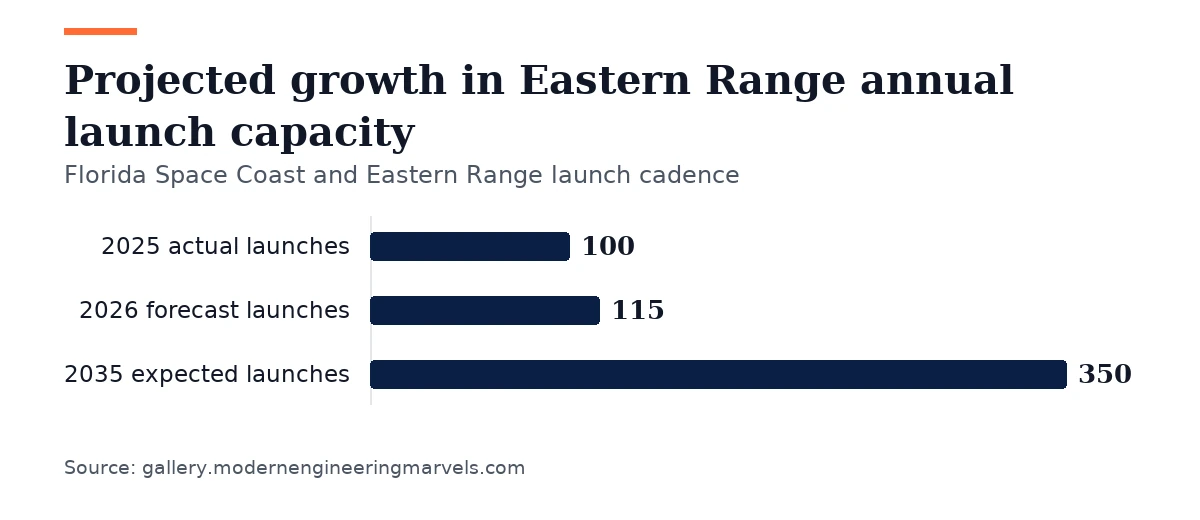
SpaceX’s Falcon 9, powered by Starlink launches, stays the top source of volume on the Eastern Range. United Launch Alliance’s Vulcan and Blue Origin’s New Glenn will increase their flight pace, and SpaceX’s Starship will appear on the Florida schedule between early and middle 2026. Heavy-lift rockets can place more mass per flight but need more complex groundwork. The Eastern Range expects 300 to 350 launches per year by 2035, requiring both infrastructure expansion and operational streamlining.
The 2035 figure depends on both new infrastructure and faster operations, and heavy-lift vehicles such as Vulcan, New Glenn, and Starship will shape that demand.
The Space Force mandated Automated Flight Termination System adoption by Oct. 1, 2025, allowing waivers only for ULA’s retiring Atlas V, NASA’s SLS, and the Navy’s ballistic missile fleet. These systems spot problems on their own and order self-destruct without waiting for ground orders, shortening setup and lowering the time between flights. AFTS has helped SpaceX fly Falcon 9s within hours of each other, and every major provider except the retiring Atlas V uses the system.
Rockets use different radio frequencies, so operators must manage spectrum carefully to avoid interference. Frequency conflicts must be managed between different rockets, and cryogenic propellants, high-pressure gases, and specialized gear also differ by company. Starship’s methalox fuel needs larger blast danger areas than any flying rocket, and the Space Force is using 100 percent TNT equivalence for methalox vehicles until joint tests with SpaceX and Blue Origin produce better data. Unlike SpaceX’s standardized Falcon 9 turns, each provider brings its own radio and propellant requirements to the range.
Starship carries more than 11 million pounds of LOX and methane. Starship, Vulcan, and New Glenn need large cryogenic systems, and tank farms must link LOX, LCH4, and LN2 tanks to subcoolers, pumps, and deluge systems with backup capacity. Methane is cleaner-burning and supports reuse, but mixing with liquid oxygen raises explosion danger. Tank farms would store liquid oxygen, liquid methane, and liquid nitrogen with redundant hardware to handle the different propellant needs of each vehicle.
Work areas are being relocated away from active launch pads to cut evacuation delays, and the Space Force is considering dedicated lanes for slow rocket transporters to reduce congestion. Moving work sites away from pads is meant to shorten evacuation pauses. Transporter lanes would reduce traffic jams on the range as launch volume grows.
Congress and Space Force leaders are looking at Wallops Island, Virginia, and Kodiak Island, Alaska, as backup launch sites to spread out capacity and lower risk from disasters or attacks. A single disaster or attack could disable Cape Canaveral or Vandenberg. Alternate sites would spread out risk and protect access to orbit.
Vandenberg’s Western Range is improving radar, telemetry, and mission networks for remote operation and fast reconfiguration. The range is placing engineers, operators, and acquisition specialists in Integrated Product Teams to fix gaps quickly. The upgrades let the range switch quickly between hypersonic tests and satellite launches, bringing together engineering, operations, and acquisition staff.
The Space Force Range Contract, worth $4 billion, puts commercial launch firms in charge of all maintenance, sustainment, and engineering work through direct task orders to turn the Eastern and Western Ranges into high-capacity, multi-user spaceports. Space Systems Command awarded Jacobs Solutions a potential $4 billion contract for Eastern and Western range operations and maintenance on May 31, 2025, and the deal runs through March 31, 2035. Space Systems Command chose Jacobs from four bidders for work through 2035.
The contract lets commercial launch companies pay directly for the services they need through task orders, replacing the older system where the government paid upfront for commercial launch support. The approach eases the government’s financial and administrative load while making range support more responsive and flexible. Planned work includes wider roads, backup power, secure communications, and bigger payload processing buildings.
Changes will roll out step by step during the 2030s while the Space Force works with industry, civil agencies, and defense partners to put concurrent safety rules in place so both coasts can handle more launches without delays. The aim is to keep both coasts operating as launch volume grows.
The Space Force is studying changes to spaceport financing, including how commercial launch companies pay the government for range use, direct support, and shared facility upkeep. The goal is to share sustainment costs among commercial tenants while keeping money available for modernizing radar, telemetry, and ground facilities. Officials are studying new ways to pay for spaceport financing, and the move will happen step by step across the 2030s. The proposal does not set a final price or completion date for the new effort.
Space Systems Command handles space acquisition for the U.S. Space Force and manages a yearly budget of $15.6 billion. The command oversees space acquisition for the service, and its budget helps fund industry partnerships to preserve U.S. space advantages.



Join the discussion