Key facts
- In 96 synthetic scenes, the combined gas, vegetation, and mineral component shows an information gain of 1.52 plus or minus 0.03 nats once cloud and calibration or response parameters are marginalized.
- A separate continuum calculation spanning 0.40 to 20 micrometers estimates absolute photon rates and required observing time for an Earth-sized planet at 30 parsecs, viewed from 650 astronomical units.
- Applying a reconstruction-covariance bracket cuts the 8 by 8 coadd gain from 7.77 down to 3.00, which raises required exposure by a factor of 6.7 when statistical noise dominates.
- Under fixed Gaussian hypotheses, disk integration loses expected log-likelihood-ratio equal to one half of the squared whitened contrast thrown away by the projection.
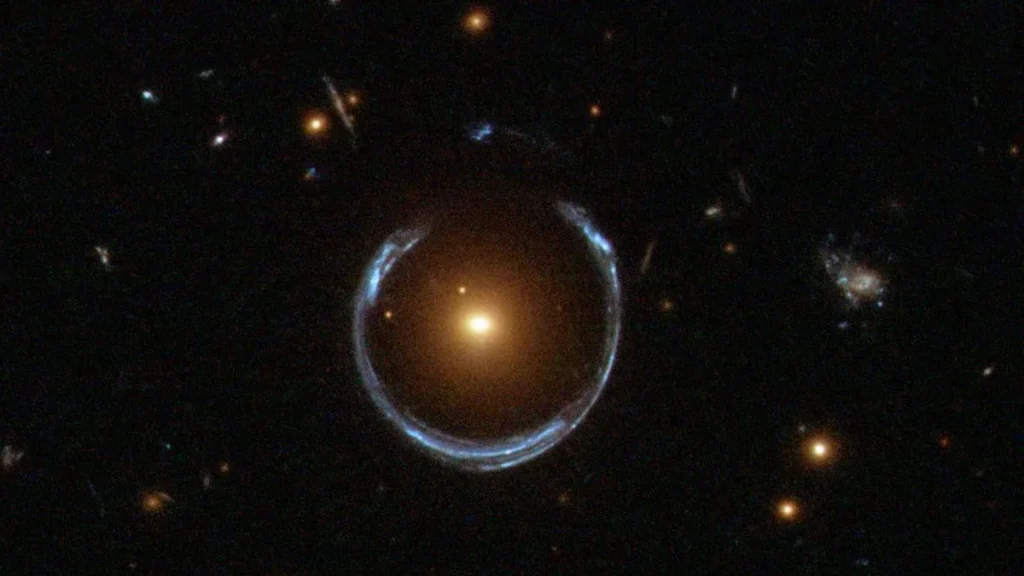
Slava G. Turyshev submitted a covariance-aware Solar Gravitational Lens framework to arXiv as arXiv:2606.29138 on June 28, 2026. Astrobiology Web published a news article about the framework on October 28, 2026. The Solar Gravitational Lens uses the Sun’s gravity to focus light from distant exoplanets, and an Einstein-ring is the ring of light formed when gravity bends starlight around a massive object. The paper’s abstract says evaluating extraterrestrial life demands spatial, spectral, temporal, and environmental context, motivating work built around reconstructed Einstein-ring measurements instead of disk-integrated spectra alone.
The submission carries arXiv:2606.29138 and runs 43 pages with 13 figures and 15 tables across the astro-ph.IM and gr-qc categories. The framework links regional spectroscopy and co-location tests to physical and instrumental validation needed to assess exoplanet biospheres and possible biological activity. The authors position the framework as a bridge between raw measurement and interpretation, tying regional spectroscopy to the checks required to evaluate possible biological activity on distant worlds. This places reconstructed Einstein-ring data at the center of regional inference rather than whole-disk averages.
A controlled experiment spanning 0.45 to 2.40 micrometers in Stokes-I uses ten illuminated cells, 128 channels, and spectral resolution R=70 to contrast resolved spectra with exactly projected disk spectra under shared parameters and priors. Stokes-I is the total intensity of light. Keeping parameters and priors identical across both setups ensures that any added information comes from spatial resolution alone.
In 96 synthetic scenes, the combined gas, vegetation, and mineral component shows an information gain of 1.52 plus or minus 0.03 nats once cloud and calibration or response parameters are marginalized. Nats are a unit of information based on natural logarithms. The gain describes the combined component rather than individual gases or minerals taken separately.
Adding independently trained surrogate-discrepancy covariance gives a joint block gain of 1.49 plus or minus 0.03 nats. The independently trained surrogate-discrepancy covariance term slightly lowers the gain from 1.52 to 1.49 nats, indicating the penalty for model mismatch while remaining statistically similar within uncertainty. This term accounts for imperfect models without erasing the measured advantage of spatial resolution. The two gains fall inside each other’s stated uncertainty ranges.
When tested on held-out scenes, mismatch drives linearized shifts as large as 6.08 posterior standard deviations, meaning that preserved precision alone does not establish unbiased recovery or evidence for life. Posterior standard deviations quantify the uncertainty in the model’s parameters. A tight posterior distribution can still center on the wrong value.
Under fixed Gaussian hypotheses, disk integration loses expected log-likelihood-ratio equal to one half of the squared whitened contrast thrown away by the projection. Whitened contrast is a measure of signal after noise normalization. When a planet’s disk is integrated without spatial resolution, the analysis discards whitened contrast, and the expected log-likelihood-ratio loss quantifies that discarded information as half the squared contrast. Collapsing the disk to a single spectrum therefore throws away diagnostic information that spatial resolution would preserve.

Applying a reconstruction-covariance bracket cuts the 8 by 8 coadd gain from 7.77 down to 3.00, which raises required exposure by a factor of 6.7 when statistical noise dominates. Coadd gain refers to the improvement from combining multiple exposures. In the statistical-noise limit, enforcing the reconstruction-covariance bracket cuts the coadd gain by more than half but multiplies required exposure time by 6.7, showing the cost of conservative uncertainty accounting. The bracket makes the analysis pay for reconstruction uncertainty with longer observing time.
A separate continuum calculation spanning 0.40 to 20 micrometers estimates absolute photon rates and required observing time for an Earth-sized planet at 30 parsecs, viewed from 650 astronomical units. The calculation folds in source-averaged lens amplification, extraction through a finite aperture, photons from the corona and host star, detector noise, and a stated calibration floor.
The scalar reference cube uses channel centers closest to 0.76, 1.25, and 2.20 micrometers, presenting source S, measurement HS +ε, and Wiener reconstruction Sb on one shared radiance scale. The scalar test uses three channel centers in the near-infrared and compares true source radiance, noisy measurement, and Wiener reconstruction on identical 128 by 128 pixel grids, with outlines marking the limb and 60 degree terminator. Wiener reconstruction is a standard method for estimating a signal from noisy measurements. The shared scale lets a reader compare truth, noise, and reconstruction directly.
The authors say this scalar test differs from the ten-cell Fisher reference and cannot demonstrate wave-optical Solar Gravitational Lens reconstruction performance. Wave-optical reconstruction models the full diffraction effects of the lens. Because the scalar test uses a simplified blur and noise model rather than full wave optics, the authors explicitly separate it from the Fisher reference. The simplified setup illustrates reconstruction quality but stops short of proving wave-optical performance.
Version history shows v1 on June 28, 2026 at 00:55:47 UTC (4,533 KB), v2 on October 7, 2026 at 02:16:52 UTC (4,534 KB), and v3 on October 24, 2026 at 19:33:16 UTC (623 KB). Three arXiv versions track the paper’s revision over four months, with the final version posted just days before the Astrobiology Web article appeared. Each version carries its own timestamp and file size in the submission record. The version history spans from June to October 2026.
The Interstellar Research Group listed the paper in its July 2, 2026 updates. The group’s update list includes the paper alongside other recent astrophysics and planetary science preprints, signaling early community notice. The listing came before the Astrobiology Web article appeared in October.

Join the discussion