Key facts
- Hydrogen leaks at the tail service mast umbilical where fueling lines connect to the SLS core stage delayed pre-launch testing for Artemis I and Artemis II.
- Prickett said more testing of the new interface is planned at Stennis Space Center in Mississippi, with a start expected soon but no date set.
- NASA engineers and leaders identified the quick-disconnect fittings as the source of hydrogen leaks during pre-launch testing for Artemis I and Artemis II, leading to launch delays lasting several weeks.
- The agency replaced the seal following the initial rehearsal, and a different NASA official later said the new seal sharply reduced leakage after the second rehearsal.
NASA has begun testing a redesigned two-seal quick-disconnect at the tail service mast umbilical where fueling lines connect to the SLS core stage to stop hydrogen leaks that delayed Artemis I and II, and plans to fit the hardware to the Artemis III core stage and solid rocket boosters for testing at Launch Complex 39B in Florida in the first half of 2027.
The agency has begun testing the new interface, said Terry Prickett, NASA’s chief engineer for the SLS core stage. He said the old fitting used one seal and a spring-loaded bellows, and it required exact alignment to seal properly. “In that case, any misalignment could cause you problems,” Prickett said.
Prickett said the replacement hardware comprises two new bolt-in pieces that fit into the current structure, and teams can go back to the earlier design if necessary. The setup puts one pipe inside another and uses two seals of different sizes in a step-seal arrangement, which Prickett said adds redundancy and sealing benefits. NASA plans more testing of the new interface at Stennis Space Center in Mississippi, with a start expected soon but no date set. Testing at Stennis comes before installation on the Artemis III vehicle.
Two tail service masts, each about three stories tall, sit on the launch platform to supply cryogenic propellant and power to the SLS core stage. They tilt away before launch, and their quick disconnects separate at liftoff. Investigators traced the fueling trouble to ground support equipment where launch-platform lines meet the base of the core stage, and the two Tail Service Mast Umbilicals carry liquid hydrogen and liquid oxygen during the countdown.
NASA engineers and leaders traced the hydrogen leaks during pre-launch testing for Artemis I and Artemis II to the quick-disconnect fittings, and those delays set the schedules back by weeks. Leaks at the tail service mast umbilical, where fueling lines meet the SLS core stage, held up pre-launch testing for both missions.
In February 2026, technicians spotted high hydrogen levels at the tail service mast umbilical during an Artemis II wet dress rehearsal (a fueling practice), and NASA stopped the test early. The issue surfaced during fueling operations, so the rehearsal ended before completion. Following the Feb. 3, 2026, wet dress rehearsal, crews replaced two seals in the area showing excessive hydrogen gas, and engineers are examining the parts they removed. Workers put in a new seal after the first rehearsal, and another NASA official said the replacement sharply cut leakage during the second rehearsal.
At a March 30, 2026, pre-launch press conference, SLS program manager John Honeycutt said the leakiness might have come from Teflon creep, meaning a seal could have deformed after staying in the interface for 10 months. The rocket lifted off on April 1, 2026, after teams completed a second wet dress rehearsal.
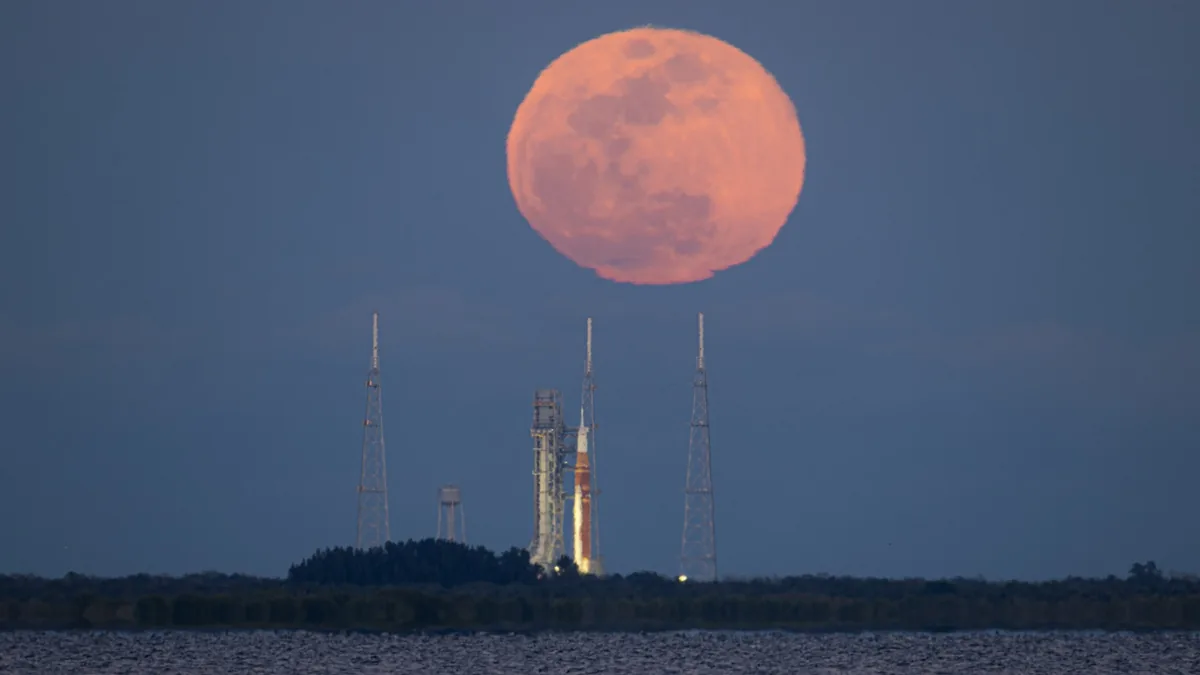
Crews aimed to finish reconnecting the interfaces by Monday, Feb. 9, 2026, and set up Stennis Space Center testing in Bay St. Louis, Mississippi, to check how the plates perform. For the following Artemis II rehearsal, the agency added 30 minutes to each of two planned tanking holds, which stretched the total countdown by one hour. The agency was looking at March 2026 as the next possible Artemis II launch date and would not choose a target date until it finished a successful rehearsal and reviewed the data, while astronauts continued training in quarantine.
The Artemis II rocket remained at Kennedy Space Center in Florida after missing its February 2026 launch window. The agency scheduled another rehearsal for the following week to confirm that engineers had repaired the hydrogen leak that cut short the Feb. 2, 2026, practice run. Artemis II will be the first crewed flight for the SLS rocket and Orion, a mission of nearly 10 days that will carry four astronauts around the far side of the Moon and back to Earth.
A similar hydrogen leak delayed the first SLS test flight for months in 2022, and the issue came back on Feb. 2, 2026, even after teams changed how they load super-cold propellant into the core stage. NASA Administrator Jared Isaacman said on Feb. 14, 2026, that the agency is working on ways to stop Space Launch System fueling problems before the Artemis III mission, in an update on X. “I am impressed with the NASA team and our contractors working diligently through the campaign,” Isaacman said.
NASA calls Artemis III the first crewed lunar landing since the Apollo program ended more than five decades ago. NASA plans to fly the Artemis III demonstration mission in 2027 before crewed landings in 2028, giving teams a chance to rehearse rendezvous and docking between commercial landers and Orion. On Artemis III, the crew will ride to low Earth orbit in Orion on top of the SLS rocket while SpaceX and Blue Origin fly test versions of their crewed landers on commercial rockets. The agency is targeting a mid-2027 launch for Artemis III.




Join the discussion