
Key facts
- The SETI Institute installed and commissioned two LaserSETI optical sensors at AlUla Manara in Saudi Arabia on August 19, 2026, making it the first LaserSETI site in Asia and the fifth globally.
- LaserSETI’s two sensors in AlUla use commercially available cameras and off-the-shelf solid-state detectors, with only the transmission grating and enclosure custom-made, reducing costs.
- The AlUla Manara site, located 74 km north of AlUla, hosts the LaserSETI sensors and is part of Saudi Arabia’s first major astronomical observatory, designated a Dark Sky Park.
- The LaserSETI sensors in AlUla operate continuously, analyzing data in real-time to eliminate the need for expensive storage and enable rapid alerts for unusual events.
The SETI Institute installed and commissioned two LaserSETI optical sensors at AlUla Manara in Saudi Arabia on August 19, 2026, making the location the network’s fifth site worldwide and its first in Asia. The SETI Institute installed the two LaserSETI stations at the AlUla Manara ASM Site, and they are now fully operational and actively collecting astronomical data.
AlUla Manara sits 74 km north of AlUla and forms part of Saudi Arabia’s first major astronomical observatory, designated a Dark Sky Park. The remote plateau is about 380 kilometers from Medina, and its protected dark skies provide favorable conditions for detecting faint optical phenomena. Its Asian location extends LaserSETI’s coverage into a new region, improving the network’s ability to monitor transient optical events continuously.
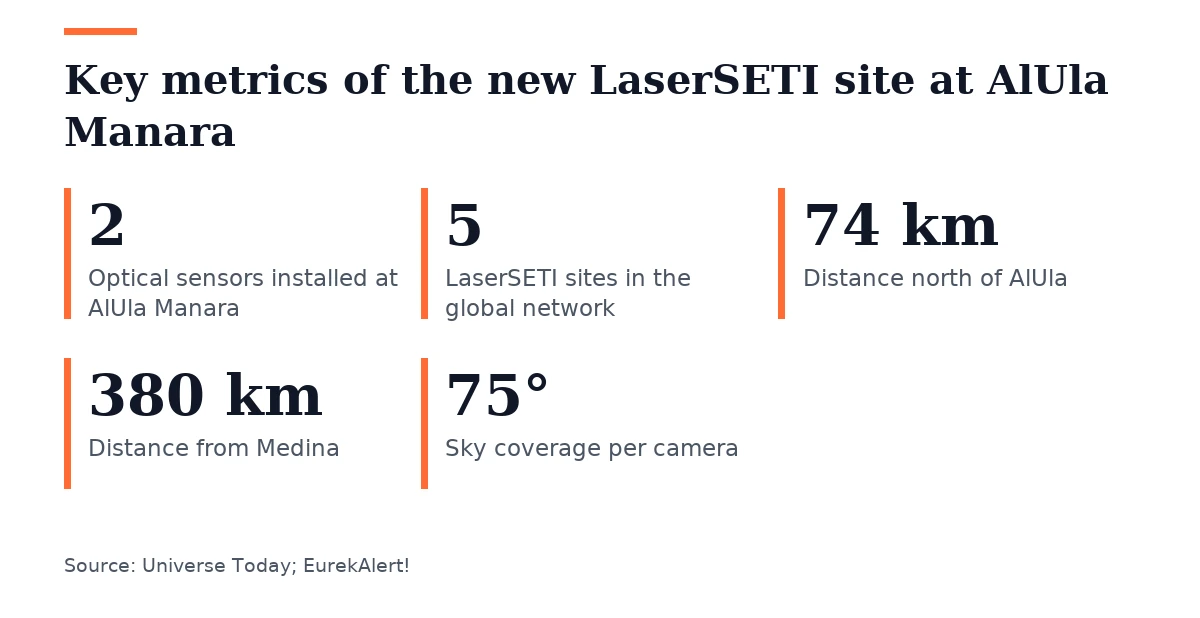
LaserSETI is a network of optical detectors designed to scan the sky for rapid laser pulses, which could indicate technosignatures, or signs of technology from beyond Earth. The two sensors in AlUla use commercially available cameras and off-the-shelf solid-state detectors, with only the transmission grating and enclosure custom-made. Their lenses image about 75 degrees of sky, and a grating behind each lens separates starlight’s full spectrum from a laser’s characteristic wavelength.
The sensors operate continuously, analyzing data in real time to remove the need for expensive storage and to enable rapid alerts for unusual events. LaserSETI can watch the entire sky continuously to catch rare transient events, while most other SETI efforts are slower or target specific sky targets. Most telescopes observe one object or a small sky area at a time, but LaserSETI uses wide-field cameras and diffraction gratings to watch large areas continuously.
The network looks for brief flashes of light from short-lived cosmic events, unusual astronomical phenomena, or potentially laser technology beyond Earth. Most LaserSETI detections will be flashes from cosmic events, though the network hopes to detect a laser from another extraterrestrial intelligence, with odds improving as sky coverage expands.
Dr. Franck Marchis, senior planetary astronomer at the SETI Institute, said, “AlUla gives LaserSETI an important new geographic vantage point and connects this remarkable astronomical site to a growing global network.” Eliot Gillum said LaserSETI serves as a global observatory rather than a single telescope, and adding AlUla extends the network into a new geographic region for continuous monitoring. Naif Al Malik said commissioning the sensors at AlUla Manara is an important milestone in the RCU-SETI collaboration, connecting dark skies to global research and outreach.
The Royal Commission for AlUla and the SETI Institute signed a 2024 agreement to develop AlUla Manara Observatory and install LaserSETI instruments, with a focus on astronomy research and public engagement. The Royal Commission for AlUla and the SETI Institute announced the RCU-SETI partnership in August 2024 to support astronomy research, technology, education and public involvement in AlUla.
The Royal Commission for AlUla was established by royal decree in July 2017 to preserve and develop AlUla, supporting Saudi Vision 2030 objectives. The SETI Institute was founded in 1984 as a nonprofit multidisciplinary research and education organization dedicated to understanding life and intelligence in the universe.
The SETI Institute searches for alien signals using the Allen Telescope Array and other ground-based facilities and has also used the Hubble and other space telescopes. LaserSETI has been under development since 2024. Marchis said the institute announced its intention to bring LaserSETI to AlUla two years ago, and the instruments are now installed, commissioned and observing.
The SETI Institute will run and maintain the AlUla stations for three years together with the Royal Commission for AlUla. AlUla Manara and LaserSETI are adjusting data products to support analysis, upcoming research and science communication. The collaboration calls for published research and for using findings in education and outreach.
The next phase will focus on analyzing AlUla data, developing further research and international partnerships, demonstrating dark-sky quality, and strengthening AlUla Manara’s astronomy program. AlUla is Saudi Arabia’s first UNESCO World Heritage Site and has hosted civilizations from the Neolithic through Roman and Ottoman times. Plans call for AlUla Manara to eventually host a 4-meter telescope and a pair of 2-meter telescopes if plans succeed.
Saudi Arabia’s participation in LaserSETI marks a shift toward scientific investment, following decades of prioritizing cultural and economic initiatives like hosting international events and establishing King Abdullah University of Science and Technology in 2009. KAUST, founded in 2009, hosted the fastest supercomputer in the Middle East and is the highest-ranked university in the Arab World. The country has sought to host international sporting and cultural events and to use its wealth for scientific endeavors. Saudi Arabia hosts Islam’s two holiest cities, Mecca and Medina, sites of Islamic pilgrimages.


Join the discussion