
Key facts
- HWO is a proposed mission intended to observe and directly image Earth-like exoplanets.
- HWO development has continued for about 10 years, and launch is not slated until sometime in the 2040s.
- The first confirmed exoplanet was discovered in 1995, and ground- and space-based telescopes including the James Webb Space Telescope have advanced exoplanet search since then.
- The study discussed the first three of five Exploratory Analytic Cases for HWO architecture, covering telescope type, size, and axis design.
NASA’s Systems Engineering Team, made up of members from across NASA centers and JPL, finished design work on the first three Exploratory Analytic Cases and built end-to-end models for the first case in a June 2026 study. Researchers published the study in the Journal of Astronomical Telescopes, Instruments, and Systems. The cases are engineering concepts meant to balance science goal demands with engineering needs for the observatory’s architecture.
The Habitable Worlds Observatory is a proposed mission that would observe Earth-like exoplanets and capture direct images of them beyond the solar system. The mission’s main objective is to capture direct images of Earth-like exoplanets to find out whether Earth is the only habitable world and whether humanity is alone. Work on HWO has gone on for about 10 years, and launch is not scheduled until sometime in the 2040s. HWO is slated to take the place of the James Webb Space Telescope, its science goals remain unchanged despite the launch slip, and it could advance progress toward not only observing but directly imaging Earth-like worlds beyond the solar system, according to the study.
Astronomers confirmed the first exoplanet in 1995, and ground- and space-based telescopes such as the James Webb Space Telescope have pushed the exoplanet search forward since then. Imaging an exoplanet directly remains out of reach mostly because it is technologically difficult to capture a distant point of light. Despite advances from ground- and space-based telescopes, resolving a point of light so far away is still an enormous technological challenge. The design calls for HWO to gaze at extremely bright stars for long periods to try resolving companion planets by blocking starlight to focus on planet light.
Researchers discussed new engineering concepts in the June 2026 study published in the Journal of Astronomical Telescopes, Instruments, and Systems. The study introduced Exploratory Analytic Cases to balance science goal demands with engineering needs as part of HWO’s architecture design work. It covered the first three of five cases for the observatory’s architecture, focusing on telescope type, size, and axis design. The study’s purpose was to determine whether HWO needs an on-axis or off-axis design.
The cases describe specific telescope configurations. EAC1 pairs a 6-m inscribed aperture with a 7.2-m circumscribed one in an off-axis layout; EAC2 is a 6-m round off-axis layout; EAC3 is an 8-m outer diameter on-axis layout. Inscribed covers the inner baseline measurement, circumscribed covers the outer region holding a set of mirrors, a round mirror is circular, and outer diameter marks the edge-to-edge span. With an on-axis design, all components sit inside the incoming light’s field of view and block part of it; with an off-axis design, all components sit outside that field of view and leave it open, a distinction central to choosing between the two.
Researchers favored the off-axis design because it allows greater light-gathering operations, and they focused on a larger aperture size for greater light-collecting area. That preference came from evaluating the first three Exploratory Analytic Cases for telescope type, size, and axis design. The team also recommended temperature properties as a design factor because they influence light-collecting and telescope operations. Temperature effects matter especially for the coronagraph instrument, where they affect light-collecting and telescope operations.
The Systems Engineering Team uses model-driven practices based on James Webb Space Telescope experience strengthened by Nancy Grace Roman Space Telescope work to build tools for parametric design studies and trades. This approach supports the team’s mandate to explore designs and set technology requirements for HWO. The team also shared models with industry partners to aid technology maturation and independent architecture studies, sharing them alongside internal design work so industry can mature technologies.
The coronagraph instrument aims to cut starlight to 10-10, even close to the star, so it can directly image orbiting exoplanets by blocking out the star’s glare. Blocking the glare is especially important for temperature-sensitive light-collecting operations. The design calls for the observatory to look at extremely bright stars for long stretches to resolve companion planets by suppressing starlight and isolating planet light.
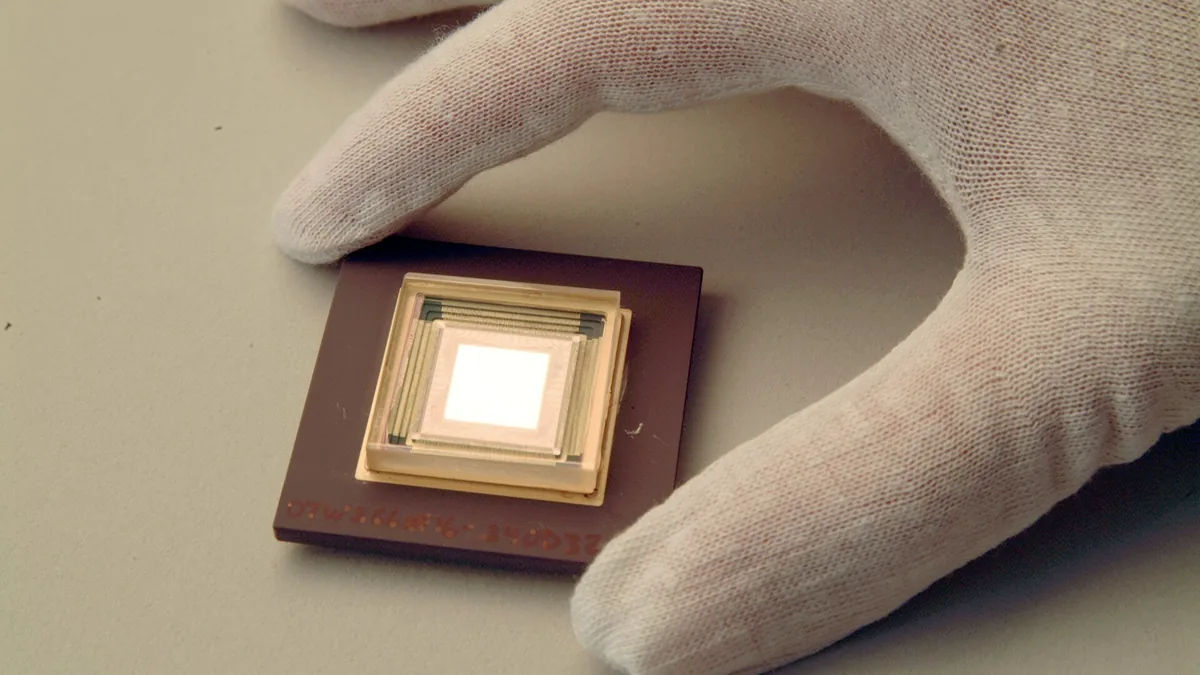
The coronagraph system will use a deformable mirror worked by 96×96 linear actuators that shape the mirror surface with picometer-level precision. These actuators need extreme reliability, extremely high positional resolution, and the ability to withstand driver electronics failure amid harsh space radiation. After the deformable mirrors, ultrasensitive photon-counting detectors capture the light; options include electron-multiplying charge-coupled devices or potentially superconducting quantum sensors, which offer high quantum efficiency and near-zero background noise.
Scientists expect HWO observations to last hours or days, so the telescope has to hold its positional accuracy throughout. If the telescope cannot match the coronagraph’s positional accuracy, the instrument’s performance does not matter. Thermal expansion happens when components expand or contract in creeps or lurches as temperatures shift, and it ranks among the hardest pointing challenges to account for.
HWO will counter thermal expansion using a massive active thermal control system and low-coefficient-of-thermal-expansion materials such as Corning ULE or Schott Zerodur, which resist dimensional change as temperatures shift. Microthrusters, vibration isolation, and standalone mirrors will also help keep the spacecraft steady and pointed. These measures address thermal expansion and provide the pointing accuracy required for long observations.
Astro2020 report requirements demand sensitivity in wavelengths from near-infrared down to far-ultraviolet, and HWO must meet them. HWO is intended as both an exoplanet hunter and a next-generation astrophysics observatory, and it is meant to look at and characterize potentially habitable exoplanets as the next Great Observatory while meeting Astro2020 wavelength sensitivity requirements. It also requires fresh mirror coatings spread evenly over every mission mirror, plus improved technologies including large-format UV detectors, Next Generation Microshutter Arrays, and Digital Micromirror Devices; all need significant development.
In August 2024, NASA created the HWO Technology Maturation Project Office to coordinate the mission’s technological and scientific development. That office put out a comprehensive plan on the arXiv preprint server that lays out requirements ahead of the Mission Concept Review at the end of the decade. Matthew Bolcar et al wrote that plan, The Habitable Worlds Observatory Technology Development Plan, which appeared on arXiv in 2026 under DOI 10.48550/arxiv.2607.02773.
Its report arranges development around three technology tracks, all targeted to reach Technology Readiness Level 5 before the Mission Concept Review. Technology Readiness Level 5 describes technology proven in a relevant environment, a step the report treats as essential before the review. Constructing a space-relevant setting on Earth is difficult, even though TRL 5 demands proof that the system works in a relevant environment. HWO engineers plan to use advanced testbeds to meet this challenge while working toward Technology Readiness Level 5.
HWO engineers intend to test the observatory’s interconnected systems using the Exoplanet Imaging Coronagraph testbed and the custom-built Habitable Worlds Observatory Systems Testbed. These testbeds matter for showing that systems work in a relevant environment, as required for Technology Readiness Level 5. The paper describes a crawl-walk-run method as the path to getting the technology ready for prime time. The work also builds on James Webb Space Telescope development and delays, along with the coming Nancy Grace Roman Space Telescope.
A few years remain before the critical Mission Concept Review, at which point NASA and its partners can cancel the project if milestones go unmet. Teams are also beginning international collaboration on the mission’s design, and a conference set for later in 2026 will focus on HWO technologies. The report organizes development around technology readiness levels and identifies tracks that must mature before NASA and partners can cancel the project if milestones fail. The engineering and science teams are working toward this review after creating the Technology Maturation Project Office in 2024.

Join the discussion