Key facts
- Researchers are building a computer model from Hubble's sharp images to analyze dark-matter-induced distortions for Roman's large images, and Hubble will follow up on interesting lenses that Roman detects.
- The background galaxy appears as an arc-counterarc pair, with one large arc to the upper left and a smaller flipped image to the lower right of the foreground galaxy.
- Gravitational lensing occurs when a foreground mass such as a galaxy warps spacetime, bending and magnifying light from behind it, and requires a precise alignment.
- Roman was two days from launch on August 28, 2026, and its science operations are expected to start in January 2027.
NASA’s Hubble Space Telescope has taken gravitational lensing images to prepare for science with the Nancy Grace Roman Space Telescope.
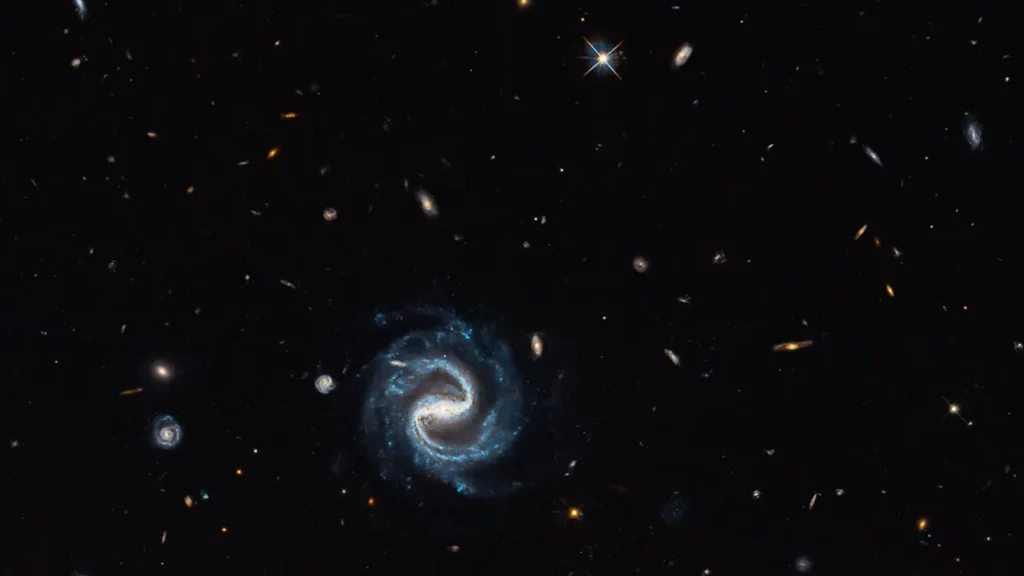
The Hubble image features a foreground elliptical galaxy 4.5 billion light-years away and a background galaxy eight billion light-years away. In the image, the background galaxy forms an arc-counterarc pair: one large arc sits to the upper left, and a smaller flipped image appears to the lower right of the foreground galaxy. That configuration happens when light from the background galaxy curves around the foreground galaxy because of a precise chance alignment between the two galaxies. The light Hubble captured from that foreground elliptical galaxy left its source while the solar system was still taking shape.
Gravitational lensing happens when a foreground mass like a galaxy curves spacetime, bending and magnifying light coming from behind it, and it depends on a precise alignment. NASA compares the effect to a giant lens in space, explaining that the gravity of the closer object distorts and brightens light passing around it when the two galaxies line up closely enough. A heavier foreground galaxy produces a stronger lens and bends more light, and studying the distortion lets researchers calculate the galaxy’s total mass and dark matter content.
NASA explains that visible matter alone cannot account for the distortion seen in the background galaxy, so the difference shows how much dark matter the foreground galaxy holds. Dark matter accounts for most of the mass in the universe. Almost everything in the Hubble image is a galaxy, except for a few scattered foreground stars. The dominant barred spiral galaxy displays arms extending from a central bar of stars, and astronomers believe the Milky Way shares that shape.
The barred spiral galaxy pictured is about the size of the Milky Way, and a smaller spiral nearby could be a satellite galaxy like the Magellanic Clouds. Astronomers consider the Milky Way a barred spiral like the large galaxy pictured, and the Large and Small Magellanic Clouds orbit the Milky Way. While Roman detects chiefly infrared wavelengths along with some visible light, Hubble observes visible and ultraviolet light with some infrared coverage. They complement each other because Hubble delivers high-resolution views of individual objects whereas Roman’s larger field of view suits panoramic surveys.
Roman’s wide field of view will produce a much larger sample than Hubble, which can study gravitational lenses only one at a time. NASA says this difference shapes how the missions will work together, because Hubble will follow up on interesting lenses that Roman detects. Researchers are building a computer model from Hubble’s sharp images to analyze distortions caused by dark matter in Roman’s large images. This combined approach aims to give astronomers a more comprehensive picture of the cosmos by pairing Hubble’s detailed views with Roman’s wide panoramic capability.
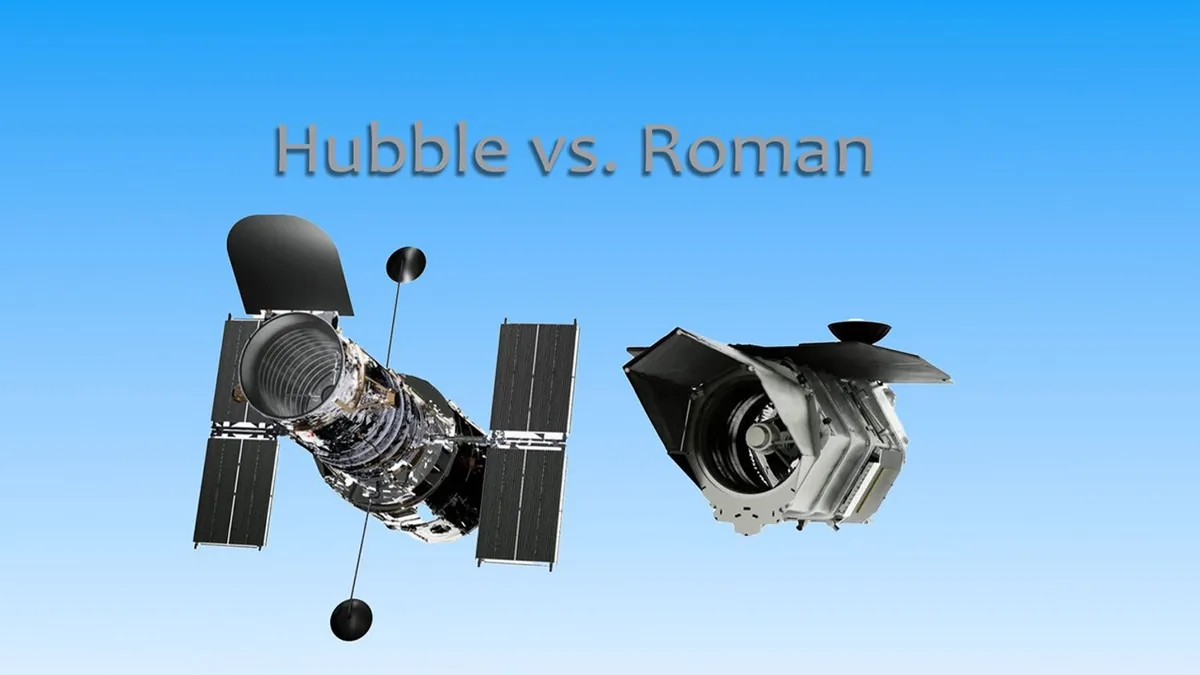
Roman combines Hubble-like detail with a field of view 100 times larger and could reveal hidden planets, billions of cosmic objects, and more about dark matter and dark energy. Roman carries a 7.9-foot primary mirror matching Hubble’s diameter and two major instruments: a Coronagraph Instrument and a Wide Field Instrument. The coronagraph will block and filter starlight to study exoplanets and surrounding disks, while the wide field instrument will match Hubble camera sensitivity across an area 100 times larger.
Over more than 30 years, Hubble studied roughly 0.1% of the night sky, while Roman might survey the full sky at the same resolution. Roman stood two days from launch on August 28, 2026, and Roman will begin science operations in January 2027. According to a University of Arizona release dated August 28, 2026, Roman is the agency’s next flagship astrophysics mission following the James Webb Space Telescope. University of Arizona faculty and students plan to watch from Cape Canaveral as Roman heads toward science operations expected in January 2027.
While the James Webb Space Telescope studies small regions in depth, Roman will survey broad areas of the sky quickly. Both Roman and the James Webb Space Telescope detect infrared light, letting astronomers compare and combine their observations. The James Webb Space Telescope and Roman together could show more about the universe than either mission alone.
Roman’s Wide Field Instrument will match Hubble camera sensitivity across a field 100 times larger. The wide field should reveal rare objects nearby and across enormous cosmic distances. Roman will look at dying stars, newly found worlds, galaxy clusters and many more objects.
Dark matter and dark energy make up nearly all the universe; dark matter exerts gravity but emits no light, while dark energy correlates with accelerating expansion. NASA selected the University of Arizona’s Arizona Cosmology Lab to support two Roman efforts: a wide-field science team and a project infrastructure team. University of Arizona astronomy and physics professor Elisabeth Krause leads the Kinematic Lensing with the Roman Space Telescope team.
The University of Arizona’s Arizona Cosmology Lab received $2 million to develop kinematic lensing, a method that combines Roman images with spectroscopy for more precise dark matter and dark energy studies. The NASA Roman Project gave Tim Eifler’s University of Arizona lab $800,000 for computing resources as part of a new university-wide high-performance computer arriving this fall. Tim Eifler’s University of Arizona lab will receive $2.4 million over five years to support Roman cosmology science work.
Tim Eifler leads a University of Arizona working group that interprets Roman’s cosmological observations for the Roman High Latitude Imaging Survey infrastructure project. Eifler co-chairs a worldwide cosmology group with more than 1,000 scientists. Eifler said organizing the community around this science case is a dream job and a fantastic way to rally researchers.
Roman’s coronagraph will detect planets 100 million times fainter than their host stars and perform 100 to 1,000 times better than existing space-based coronagraphs. Roman’s coronagraphic instrument will use self-flexing mirrors, filters, detectors, prisms, and masks to test starlight-suppression technology. The University of Arizona release dated August 28, 2026, says reducing a host star’s glare allows direct imaging of nearby planets and disks that would otherwise be too difficult to see.
Schuyler Wolff, an associate research professor of astronomy leading Roman’s coronagraph observation planning group, called the instrument a crucial pathfinder for the future Habitable Worlds Observatory. The Habitable Worlds Observatory is a proposed observatory meant to look for evidence of life beyond our solar system. University of Arizona researchers such as Mark Marley, Ewan S. Douglas, Ramya Anche, and Justin Hom helped develop the Roman Coronagraph Instrument and will plan observations through its working group.
Marley, Ty Robinson, and Zarah Brown will use coronagraph data to study exoplanet atmospheres. Anche’s team will examine extrasolar system structure. Zarah Brown models climates and spectra of self-luminous giant planets, predicting temperature, composition, clouds and infrared output for planning faint-target observations. Infrared observations have never captured most self-luminous giant planets in Zarah Brown’s climate and spectral models.
Justin Hom oversees efforts to find the best stars for calibrating the coronagraph and runs precursor ground-based observing programs to confirm targets for future Roman science. Ground-based precursor work is essential to select targets that should be included in future Roman science programs. The coronagraph team must book enough observing time to spot a candidate while avoiding excess use of the mission’s limited time.
The University of Arizona will lead nine NASA-approved Roman investigations backed by more than $2 million, covering supermassive black holes, galaxy formation, reionization, cosmic dust and gravitational lenses. Once Roman starts science operations in January, researchers throughout the scientific community will be able to access its data.

Join the discussion