Key facts
- On December 18, 2019, astronomers observed a star in the Large Magellanic Cloud brighten gradually for about one hour before it faded back to its normal appearance.
- The change was smooth and symmetrical and involved no sudden explosion or flare, and the star later returned to normal with no additional changes in brightness.
- Passing asteroids, stellar flares, and variable stars cause brightness changes, yet microlensing shows a different pattern.
- Astronomers at Swinburne University in Melbourne found the signal in observations from a survey that regularly watched stars in the Large Magellanic Cloud, and the pattern convinced the team the detection was genuine.
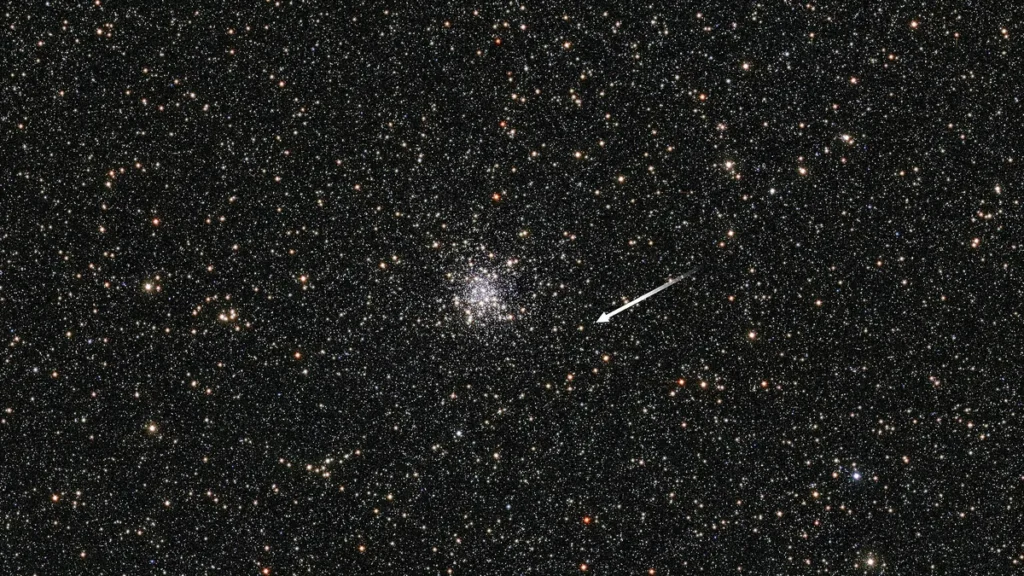
Astronomers at Swinburne University in Melbourne observed a star in the Large Magellanic Cloud, a satellite galaxy of the Milky Way, brighten gradually for about one hour on December 18, 2019, before it faded back to normal, ScienceDaily reported.
ScienceDaily reported that the brightening was smooth and symmetrical and involved no sudden explosion or flare, and that the star later returned to normal with no additional changes in brightness. Researchers described the event as an invisible object moving between Earth and the star and bending the star’s light toward Earth, consistent with gravitational microlensing predicted by Einstein’s general theory of relativity. In such an event, a massive compact object passing between Earth and a distant star bends the star’s light and briefly magnifies its brightness. Passing asteroids, stellar flares and variable stars cause brightness changes, yet microlensing shows a different pattern.
The Swinburne team found the signal in observations from a survey that regularly watched stars in the Large Magellanic Cloud, and the pattern convinced the team the detection was genuine. The signal sat close to the detection limit of current surveys. Microlensing events depend partly on the intervening object’s mass, and lighter objects generally produce shorter events, though speed and position also affect duration.
Researchers estimated Phoebe’s mass at about three times the mass of the Moon, deriving the figure from how long the brightening lasted and from their models of the event. The estimate puts the object below every solar-system planet’s mass. Ordinary black holes develop when massive stars collapse, which is why a very low-mass black hole would be unexpected, and a black hole from stellar collapse typically starts at around five solar masses, a threshold enormously higher than Phoebe’s estimated mass. If the object is truly a black hole, a tiny mass would suggest formation in the early universe rather than death of a star.
Astronomers nicknamed the object Phoebe, but its true identity remains unknown. One possibility is a rogue planet expelled from its original solar system that now travels alone through the Milky Way. Another is a wandering planet located within the Large Magellanic Cloud, which would make Phoebe the first planet found through microlensing beyond our galaxy. A third is a primordial black hole, an object that might have formed from extremely dense regions of space in the first fractions of a second following the Big Bang, before the first stars appeared.
The researchers compared the odds that Phoebe came from Milky Way stars, Large Magellanic Cloud stars, or objects in the surrounding dark matter halo. Their calculations put Phoebe at roughly 100,000 times more likely to belong to the dark matter halo than to a population tied to ordinary stellar matter. The team calls that gap particularly intriguing but says the primordial interpretation is not established and does not claim Phoebe is a primordial black hole; a confirmed link to the halo would offer clues about dark matter.
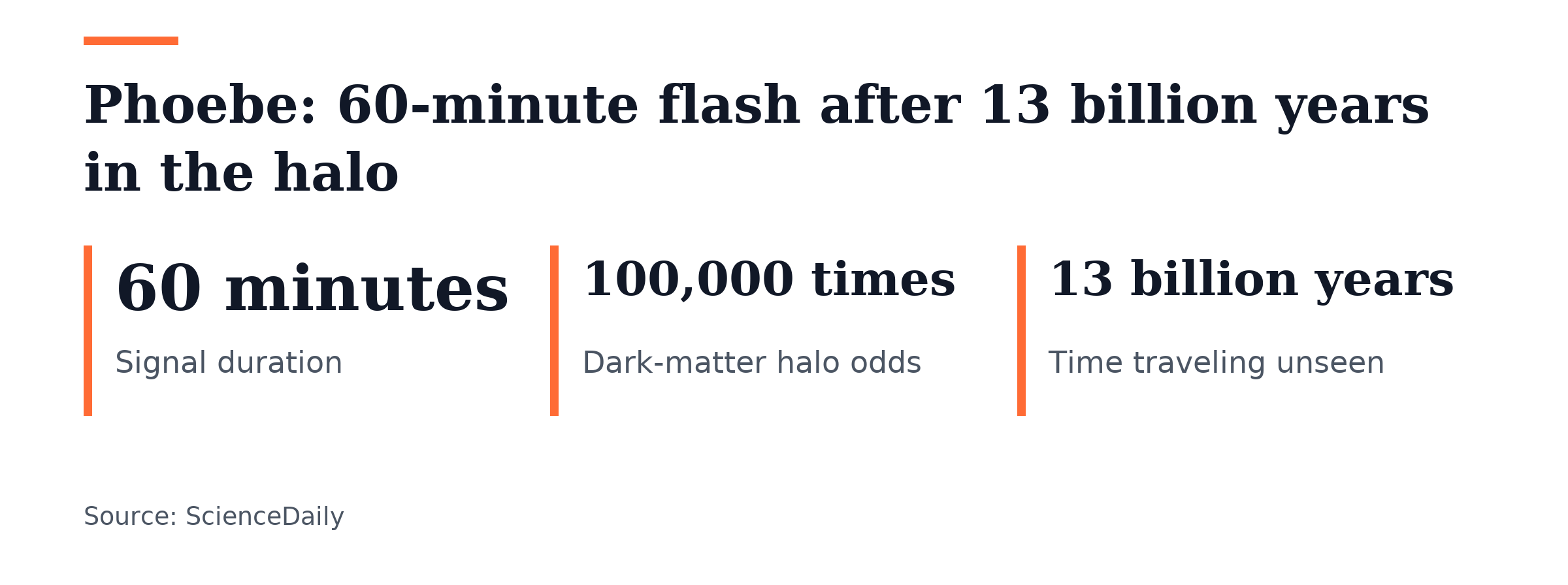
If correct, the primordial interpretation would rank Phoebe among the oldest objects ever found, and its formation would predate the first atoms and stars while the universe still experienced extreme conditions following the Big Bang. It could have traveled unseen through space for roughly 13 billion years, leaving virtually no trace, before briefly magnifying the light of a distant star on one night in December 2019.
The research appears in “AMPM II. A Lunar-Mass Primordial Black Hole Microlensing Candidate in the Milky Way Halo” by Renee Key, Edward N. Taylor, Ken C. Freeman, Jeremy Mould, Abhijit Saha, Anais Möller, Timothy M. C. Abbott and Alan R. Duffy, posted to arXiv on May 19, 2026. The paper is the second AMPM study and concerns a microlensing candidate in the Milky Way halo.

Join the discussion