Key facts
- Researchers studying 257 black hole mergers from the LIGO, Virgo, and KAGRA network over the past decade found black holes around 10 solar masses turn up often, showing up in roughly three-quarters of the mergers.
- The same survey found a clear shortage of black holes between 12 and 16 solar masses, which the source describes as the first distinct gap of its kind in the mass distribution.
- Katerina Chatziioannou, the Caltech physics professor who led the research, says most merging black holes are about 10 solar masses and may form a single group that did not explode as supernovae.
- One possible explanation is that many of these objects trace back to massive stars that collapsed straight into black holes with no supernova explosion.
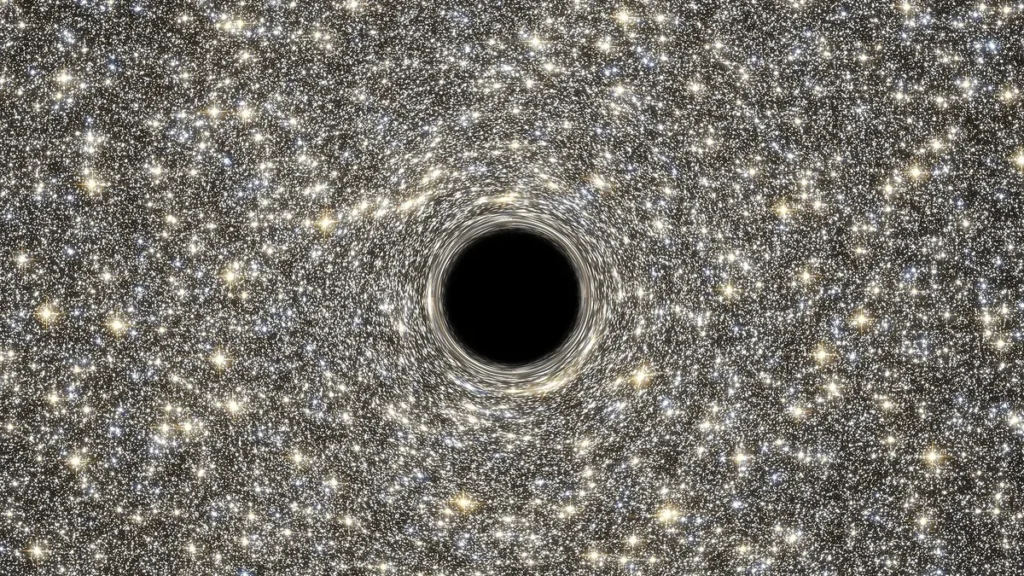
A team led by Caltech physics professor Katerina Chatziioannou published a study on 10 November 2026 examining 257 black hole mergers detected by the LIGO, Virgo, and KAGRA network over the past decade and found a shortage of black holes between 12 and 16 solar masses, pointing to quiet stellar collapse as a possible explanation.
Black holes near 10 solar masses appeared in roughly three-quarters of the mergers, making them the most common mass in the sample. Heavier black holes showed up much less often, and the analysis treats the pile-up at 10 solar masses and the empty range above it as parts of a single pattern.
The shortage covers objects from 12 to 16 solar masses and appeared alongside the strong concentration at 10 solar masses. The researchers describe it as the first distinct gap of its kind in the black hole mass distribution and say it raises questions about what sets black hole sizes when they form.
Chatziioannou says most merging black holes have a mass of about 10 solar masses and may belong to one group that did not explode as supernovae. “A vast majority of the merging black holes in the universe are about 10 times the mass of our Sun,” she says. She says the measurements point to a shared beginning for this group and link gravitational-wave observations to the astrophysics researchers want to understand.
Isaac Legred, the study’s lead author and a former Caltech researcher now at the University of Illinois Urbana-Champaign, says 14-solar-mass black holes are rare. He links the gap to a special cocktail of internal physics and notes that 10-solar-mass black holes merge constantly while 14-solar-mass ones rarely appear, framing the gap as a clue to formation physics.
The researchers examined black hole spin rates because spins preserve clues about how the objects formed. Black holes near 10 solar masses have spins concentrated in a narrower range than the wider population, and spin rates are also shaped by how black holes formed. The narrow spin range, presented alongside the mass pattern, serves as evidence of one shared history.
The mass pile-up, the empty range from 12 to 16 solar masses, and the similar spins together suggest these black holes form one group with a common origin. The Caltech team set out to test whether existing gravitational-wave observations back the possibility of such quiet collapses.
One possible explanation is that many of these objects trace back to massive stars that collapsed straight into black holes with no supernova explosion. “they may be a distinct subpopulation that failed to go supernova,” Chatziioannou says. The source contrasts this quiet collapse route with ordinary supernovae, which blast material into space and leave behind cores that become neutron stars or black holes.
Legred says massive stars that failed to explode simply vanish without exploding, leaving a dark patch in the sky. Researchers have proposed that many merging black holes of roughly 10 solar masses may come from stars that collapsed without exploding, with either the heavier black hole or both forming this way. Legred says researchers can check old sky records for stars that failed to explode, but those stars just disappear.
Despite decades of searching, no specific failed supernova has been confirmed, although the idea rests on a strong scientific foundation. Ordinary supernovae create brilliant flashes seen across vast cosmic distances, while failed supernovae may leave almost no visible trace, so silent stellar deaths are hard to spot with standard observations; that is why gravitational-wave data are being used instead.
The results do not directly prove that failed supernovae happened, but they closely match theoretical predictions for how such black holes should be spread across masses. The researchers stress that the outcome fits theory rather than amounting to a direct detection of failed supernovae, so the case remains open.
Gravitational waves from merging black holes show how certain objects formed even when their birth produced little or no visible explosion. The result adds evidence that massive stars can end their lives in different ways, potentially explaining how a large share of the universe’s black holes came into being.
The work appeared in Physical Review D listing Isaac Legred as lead author and Katerina Chatziioannou among the authors. The paper is listed in Physical Review D, 2026; 114 (10), with DOI 10.1103/mnzq-w1b5.
Isaac Legred completed the work while at Caltech and is now a postdoctoral researcher at the University of Illinois Urbana-Champaign, having carried out the research during his time at Caltech. Jacob Golomb, described as a former member of Chatziioannou’s research group, now works at Asari AI and coauthored the paper.
LIGO, the Laser Interferometer Gravitational-wave Observatory, is funded by the National Science Foundation and runs detectors in Louisiana and Washington. The work received funding from the National Science Foundation, the U.S. Department of Energy, and the Simons Foundation. It recorded the first direct gravitational-wave detection in 2015 from two colliding black holes and is operated by Caltech and MIT.
Since the first direct detection in 2015, LIGO has partnered with Virgo in Italy and KAGRA in Japan, and the network has logged more than 300 black hole collisions. The observatory’s detectors in Louisiana and Washington record gravitational waves from these collisions.
Massive stars typically end their lives when their cores collapse and trigger supernova explosions that eject much material into space, leaving cores that can become neutron stars or black holes. The finding could help explain the origins of a large population of black holes throughout the universe by pointing to quiet stellar collapse as a formation channel. The result potentially reveals how a substantial fraction of the universe’s black holes came into existence.
Legred says the gravitational-wave data fit most binary black holes forming from a special kind of failed supernova, but he adds that more research is needed. He calls black holes products of extreme environments and says better understanding how they form is exciting.

Join the discussion