Key facts
- Both APOGEE-2 Orion studies applied TONALLI, MARCS and BACCHUS to slow rotators (≤30 km s−1) across Orion A, B, OB1 and λOri and report abundances consistent across subgroups—a chemically homogeneous complex.
- Abundances came from MARCS model atmospheres, with atmospheric parameters from TONALLI and the BACCHUS code.
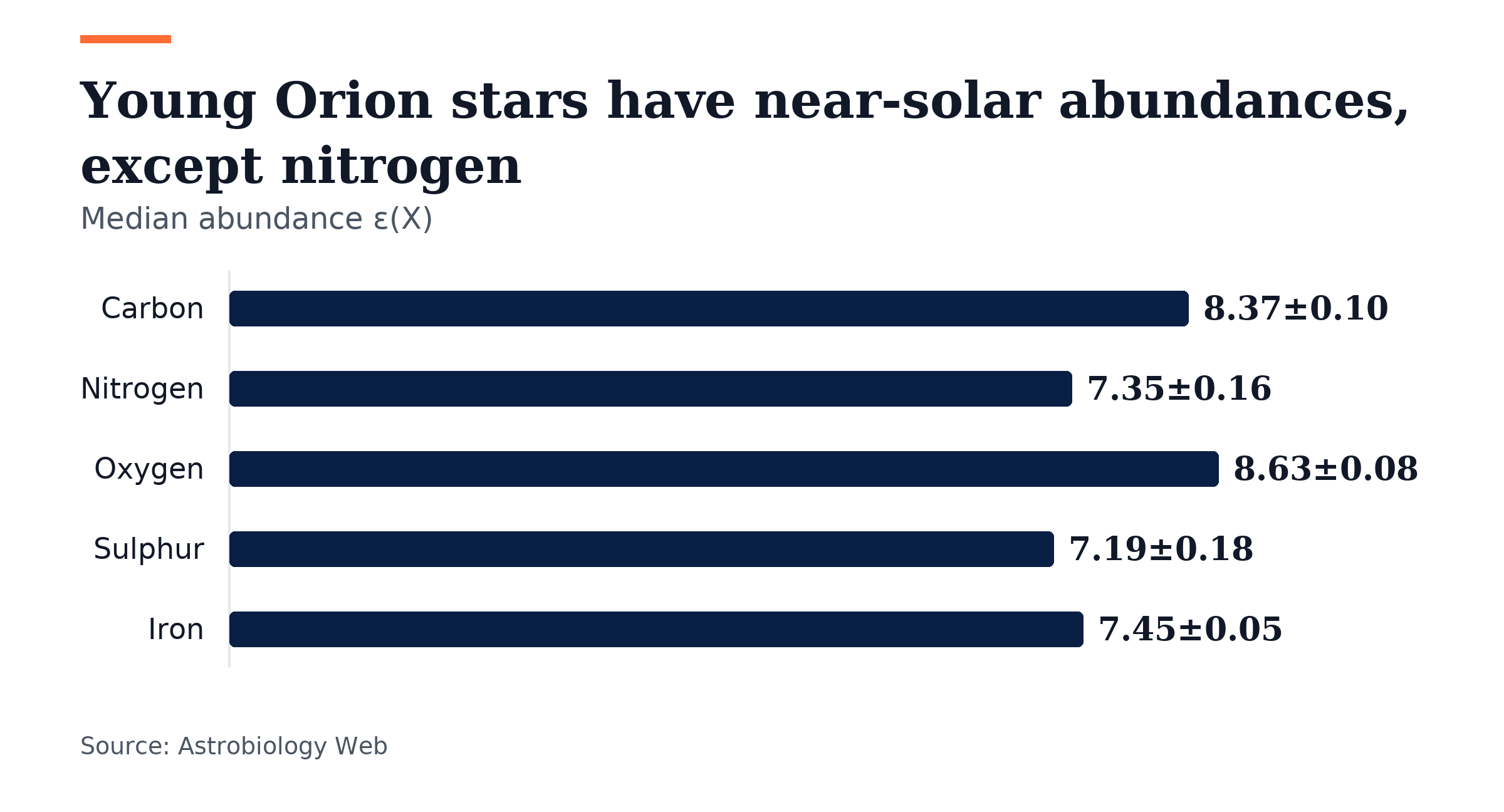
- Median abundances are ε(C)=8.37±0.10, ε(N)=7.35±0.16, ε(O)=8.63±0.08, ε(S)=7.19±0.18 and ε(Fe)=7.45±0.05.
- Nitrogen is subsolar at [N/H]=−0.48, while carbon, oxygen, sulphur and iron sit within 0.1 dex of solar.
Ricardo López-Valdivia led an 18-person team that used APOGEE-2 infrared spectra to measure carbon, nitrogen, oxygen, sulphur and iron in 195 young slow rotators across Orion A, Orion B, Orion OB1 and λOri; the work was submitted as arXiv:2611.27952 on Nov. 20, 2026 and accepted in Monthly Notices of the Royal Astronomical Society.
The team also includes Carlos G. Román-Zúñiga, Lucía Adame, Keivan G. Stassun and Jonathan C. Tan among its 18 authors. All targets were slow rotators with projected rotational velocity of 30 kilometers per second or less, drawn from young G-, K- and M-type stars between 3,500 and 5,900 kelvin. APOGEE-2 observes in the H band at roughly 1.5–1.7 μm. Optical light suffers more from interstellar extinction and continuum veiling than this band, so the H band suits young-star photospheres.
Abundances came from MARCS model atmospheres, with atmospheric parameters from TONALLI and the BACCHUS code. Median values were ε(C)=8.37±0.10, ε(N)=7.35±0.16, ε(O)=8.63±0.08, ε(S)=7.19±0.18 and ε(Fe)=7.45±0.05. Nitrogen was subsolar at [N/H]=−0.48, while carbon, oxygen, sulphur and iron sat within 0.1 dex of solar.
The researchers detected no spatial structure within the Orion subgroups. The sole significant offset was nitrogen, which ran 0.29 dex lower in Orion A than in Orion OB1, a difference not found for the other elements. Relative to 430 nearby main-sequence stars analyzed identically, Orion carbon, nitrogen and oxygen were 0.1–0.2 dex lower within errors, while sulphur and iron differed by under 0.07 dex.
Oxygen, sulphur and iron in stars exceeded nebular abundances in HII regions and star-forming galaxies, with iron showing the largest offset of the elements compared. Abundance-ratio agreement improved when temperature inhomogeneities and dust depletion were included, according to the authors, bringing stellar values closer to nebular measurements.
A predecessor study published in 2025 established the earlier part of this series. López-Valdivia et al. (2025) appeared in Monthly Notices of the Royal Astronomical Society 543(1):420–434, with advance access on Sept. 1, 2025, after acceptance on Aug. 26, 2025, receipt on Aug. 12, 2025, and original submission on June 7, 2025.
The earlier paper derived atmospheric parameters and elemental abundances for young stars of G, K and M spectral types from 3,100 to 6,500 kelvin, using infrared APOGEE-2 spectra and TONALLI to set parameters for 548 Orion stars. Among 340 slow rotators, the team measured carbon, magnesium, silicon, potassium, titanium and iron using 19 spectral lines with MARCS and BACCHUS. It had removed infrared-excess stars flagged by 2MASS and WISE. The results showed subsolar [X/H] ratios that stayed consistent across elements and all four Orion groups, supporting a chemically homogeneous complex.
The 2025 working sample held 559 young stars drawn from 1,861 Orion members in APOGEE-2 DR17: 228 in Orion OB1, 116 in λOri, 112 in Orion A and 103 in Orion B. The team retrieved epoch-combined one-dimensional infrared spectra from the APOGEE-2 DR17 public database using apStar spectra from the SDSS-IV science archive webapp. To limit circumstellar discs and accretion-related veiling, it excluded stars with infrared excess identified through 2MASS and WISE photometry. To set the expected photospheric level, the team grouped bright main-sequence stars below J = 13 into 15 magnitude bins, matched a Gaussian to the (K − W3) colour distributions, found constant flux at 0.267 mag below J = 8, and characterized 8 < J < 13 using a fourth-degree polynomial.
The median carbon-to-hydrogen ratio from the 2025 study agreed with earlier estimates based on the ionized gas of the Orion nebula. Chemical homogeneity in Orion remains an open question after ongoing debate. Cunha & Lambert (1994) found oxygen and silicon up to 40 per cent higher in the youngest of 18 B-type stars, attributing the trend to type II supernova ejecta rich in oxygen and silicon. Cunha, Smith & Lambert (1998) saw a similar trend in F and G stars.

Simón-Díaz (2010) showed silicon and oxygen abundances of B stars in four subgroups of Orion OB1 consistent with solar values. D’Orazi et al. (2009) found lower iron abundance in Orion OB1 than in younger, more embedded regions such as the Orion nebula cluster. Work by Biazzo et al. in 2011 and 2012 confirmed that Orion fits a thin-disc population. Kos et al. (2021) found no self-enrichment in lambda-Ori relative to Orion B and Orion OB groups, using about 300 GALAH stars across 15 clusters.
The TONALLI code derives atmospheric parameters through an asexual genetic algorithm that interpolates the Jönsson et al. (2020) synthetic grid and rotationally broadens the spectrum with a Gray (2008) kernel, choosing the best fit by chi-squared comparison. The synthetic grids, based on MARCS model atmospheres, match APOGEE’s average resolution and were computed at five microturbulence velocities; the 2025 study used the grid at xi = 2.4 km/s. The team constrained projected rotational velocity to between 0 and 50 kilometers per second because faster pre-main-sequence rotators blend spectral lines and complicate abundance determination.
The team repeated TONALLI 30 times for each star, adopting the median posterior value and interquartile range as the error. For surface gravity, it used TEPITZIN, a photometric module in the TONALLI ecosystem matching observed 2MASS and Gaia colors to theoretical PARSEC pre-main-sequence evolutionary models with a flat prior of one dex width. The MASSAGE code determined visual extinction by comparing observed colors with expected intrinsic colors from Marigo et al. (2017), using temperature, Gaia Gp/Rp/Bp and 2MASS J/H photometry.
The team cut five stars with effective-temperature interquartile range above 500 kelvin and six with rotational-velocity interquartile range above 5 kilometers per second. That left 548 young Orion stars, most with effective temperatures between 3,200 and 6,000 kelvin, spectral types M5/M4 through F9, and some reaching about 6,400 kelvin. TONALLI recovers reliable parameters below about 6,200 kelvin, while hotter stars have scarcer spectral features and greater sensitivity to grid degeneracies.
Pre-main-sequence stars younger than 300 Myr present high rotation, magnetic activity and variability that complicate direct property determination from spectra. The 2025 study aimed to present chemical abundances of young stars in four Orion groups through a homogeneous, consistent method to aid understanding of star-forming-region chemical evolution. It also indicated that studying stars with higher rotational velocities and circumstellar material should improve insight into chemical evolution in Orion and the Milky Way.
The two APOGEE-2 Orion studies both used TONALLI, MARCS and BACCHUS on slow rotators across Orion A, Orion B, Orion OB1 and λOri, and they report abundances consistent across the subgroups. The studies describe the complex as chemically homogeneous. Part I framed the homogeneous result as a constraint on chemical-evolution models and as a basis for later work on stars with circumstellar material and faster rotation.
“MNRAS 543, 420–434 (2025) https://doi.org/10.1093/mnras/staf1445 Advance Access publication 2025 September 01” — López-Valdivia et al. (2025).
The 2025 paper appeared in Monthly Notices of the Royal Astronomical Society 543(1):420–434 with DOI 10.1093/mnras/staf1445. Oxford University Press published it on behalf of the Royal Astronomical Society under a Creative Commons Attribution License, and the authors hold the 2025 copyright.

Join the discussion