Key facts
- Researchers have identified gaseous titanium oxide surrounding a massive young star, a detection reported for the first time.
- The finding marks the first region outside the solar system where researchers can work out what solid matter is made of without retrieving a sample and returning it to Earth.
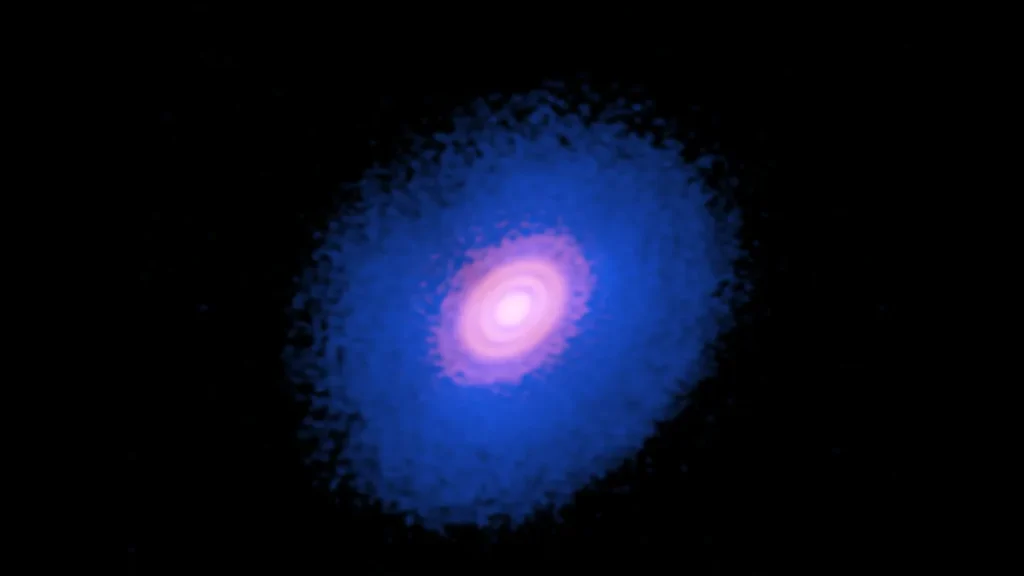
- The Atacama Large Millimeter/submillimeter Array observed the disk around Orion Source I.
- Adam Ginsburg, a University of Florida associate professor of astronomy with a Ph.D., identified the system studied by the research team and helped develop some of the analytical techniques.
Researchers have identified gaseous titanium oxide surrounding the massive young star Orion Source I, the first detection of the compound in the disk of a young star, in a dusty cloud behind the Orion Nebula.
The Atacama Large Millimeter/submillimeter Array observed material in the disk around Orion Source I. Orion Source I is a massive young star inside a dusty cloud placed behind the Orion Nebula. The array’s measurement of that disk produced the spectral signature of titanium oxide gas.
Solid rocks in space mainly reflect light, so researchers cannot identify them through spectroscopy, the study of light used to identify chemical makeup. Only gas molecules supply the spectral data needed to study composition in space. Until this discovery, there was no method to examine rocky objects in space.
Orion Source I provides enough luminosity to evaporate nearby rocky material. Researchers observe rock evaporating from solid into gas around the star. Adam Ginsburg said the star’s luminosity drives the evaporation, which converts solid rock into gas so spectroscopy can reveal its composition.
On Earth, researchers normally bring space rocks into a physical laboratory. There they blast the material with heat. They evaporate the material and analyze the resulting gas through spectroscopy to identify its molecules. That process is how scientists have long studied rocky material from our own solar system.
Adam Ginsburg, a University of Florida associate professor of astronomy with a Ph.D., said nature is now doing that evaporation around Orion Source I without any physical retrieval. “We basically have been unable to study solids like this in the interstellar medium,” Ginsburg said. The interstellar medium is the matter and radiation between stars. The star acts as a space laboratory that performs the heating and measurement steps researchers usually carry out on Earth.
The detection makes Orion Source I the first region outside the solar system where researchers can work out what solid matter is made of without retrieving a sample and returning it to Earth. In the solar system, scientists can collect rocks and bring them into a lab. That access lets them measure ratios between different types of rocks and different elements.
Before this finding, gaseous titanium oxide had only been found naturally on the surfaces of stars. It had not previously been detected as a gas in a disk around a young star. Gaseous salt is rare but possible.
Titanium oxide is a compound of titanium and oxygen. The detection paper describes it as a dust-seeding molecule.
Astromineralogy examines the minerals composing cosmic dust and other solids. Until this result, the field had been limited to the solar system. Ginsburg said the findings extend astromineralogy from our own solar system into extrasolar environments.
Adam Ginsburg helped identify the system studied by the research team and helped develop some of the analytical techniques used in the work. Ginsburg is a University of Florida associate professor of astronomy with a Ph.D. The detection paper, “Dust-seeding Molecules in a Massive Protostar – Detection of TiO in Orion Source I” by Ziwei E. Zhang et al., appeared in The Astrophysical Journal Letters in 2026.
Earlier work by Ginsburg and other researchers found salty compounds in gas coming from the disk around Orion Source I. That earlier discovery means the disk already had a known gaseous detection before titanium oxide was found there. The two findings now give researchers two gaseous detections in the same disk.
The result enables researchers to infer the composition of solid extrasolar material in the disk around a massive protostar without physically retrieving a sample. That creates a basis for comparing extrasolar rock chemistry with the inventory measured from rocks collected in the solar system. Ginsburg said the contrast shows why the measurement matters: it enables comparable compositional analysis for extrasolar solids without physical retrieval.
Because only gases yield usable spectra in space, turning solid rock into vapor around the star removes the barrier that previously confined solid composition studies to our own solar system. Researchers can now examine rocky material in another star system by measuring the gas the star has evaporated.

Join the discussion