Key facts
- Tech Times reports ozone can accumulate through photolysis without biology, and methane can seep from geological vents.
- Tech Times says LIFE would measure mid-infrared thermal emission to detect methane while HWO would detect ozone in reflected ultraviolet and visible light.
- Tech Times says detecting ozone alone in HWO's ultraviolet range would not suffice to claim life because photolysis can produce ozone abiotically.
- The study's authors say that finding oxygen, methane, or other commonly discussed biosignatures by itself does not prove a biosphere exists.
A paper in Astrobiology from 2026 sets reflected-light spectroscopy wavelength requirements for NASA’s Habitable Worlds Observatory (HWO). The paper’s authors say the observatory’s main aim is to look for evidence of life on rocky exoplanets, and they submitted an arXiv preprint on Aug. 17, 2026.
The authors say finding oxygen or methane alone, or other commonly discussed biosignatures, does not prove a biosphere exists. They make this limitation the opening caveat of the paper.
Tech Times says detecting ozone alone in HWO’s ultraviolet range would not suffice to claim life because photolysis can produce ozone abiotically. On Earth, ozone is mainly a byproduct of photosynthesis but can arise abiotically around certain star types, the outlet notes.
The authors say life detection requires confidently ruling out photochemical or geological processes that mimic life. They also say researchers must assess whether organisms could plausibly create a specific biosignature while evaluating the wider physicochemical setting for habitability.
The authors say false-positive evaluation might call for observatory specifications unlike those used in biosignature detection surveys. They raise this point before analyzing coronagraph requirements for assessing habitability and excluding oxygen and methane false positives and false negatives.
The study finds that HWO needs coverage spanning 0.26 to 1.7 micrometers to contextualize potential oxygen and methane biosignatures. This range extends across the near ultraviolet and the near infrared, the authors say, and the recommendation comes from the paper’s examination of coronagraph requirements for assessing habitability and excluding oxygen and methane false positives and false negatives.
Identifying Proterozoic-like biospheres through ozone drives the short-wavelength cutoff at 0.26 micrometers, according to the authors. Constraining carbon-bearing species to contextualize oxygen and methane drives the long-wavelength cutoff at 1.7 micrometers, rather than detecting those gases directly.
Spectra must achieve signal-to-noise ratios from 20 to 40 across the 0.26 to 1.7 micrometer range, the study says, at R=7 UV, R=140 VIS, and R=70 NIR. The authors say this performance level is required in addition to the 0.26 to 1.7 micrometer wavelength span.
The authors say these capabilities cannot unambiguously identify every Earth-analog biosignature or false positive. Searching broadly for Earth-like life would become possible if these minimal spectral recommendations are met for enough HWO targets, the authors state, though the conclusion depends on observations being achievable for a meaningful number of targets.
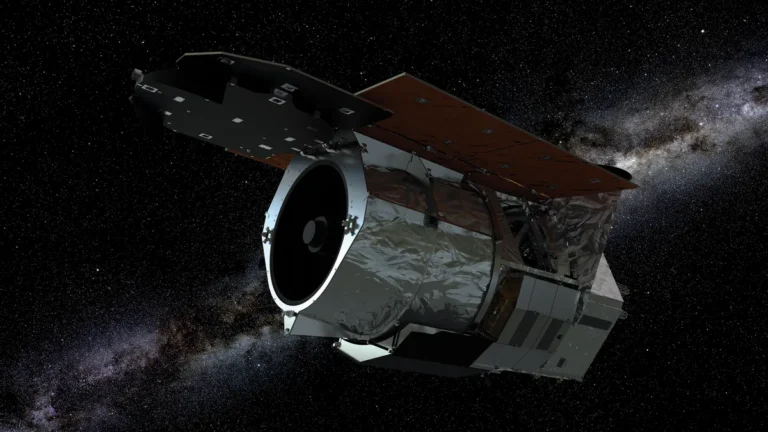
The Habitable Worlds Observatory is meant to serve as both an exoplanet hunter and a next-generation astrophysics observatory under the Astro2020 vision. HWO must be sensitive from the near-infrared down to the far-ultraviolet to meet Astro2020 requirements, Phys.org says.
NASA and its partners might cancel HWO at the Mission Concept Review at decade’s end if milestones are missed, Phys.org reports. The review is described as critical.
Phys.org reports that the TMPO plan targets Technology Readiness Level 5 for three technology tracks by the time of the Mission Concept Review. Phys.org explains TRL 5 as validation in a relevant environment. The TMPO report will guide discussions at an international conference on HWO technologies set for later in 2026, Phys.org says.
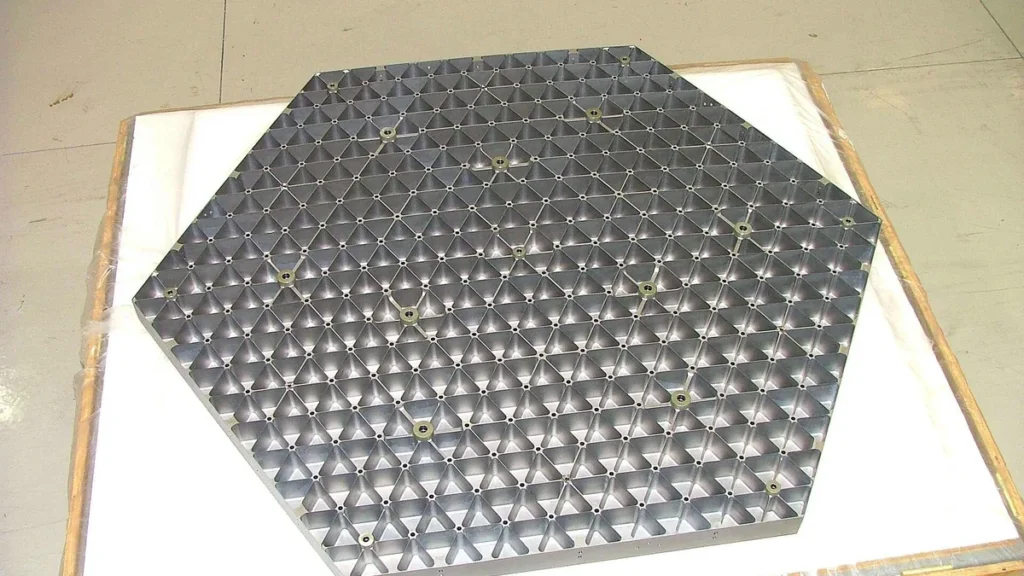
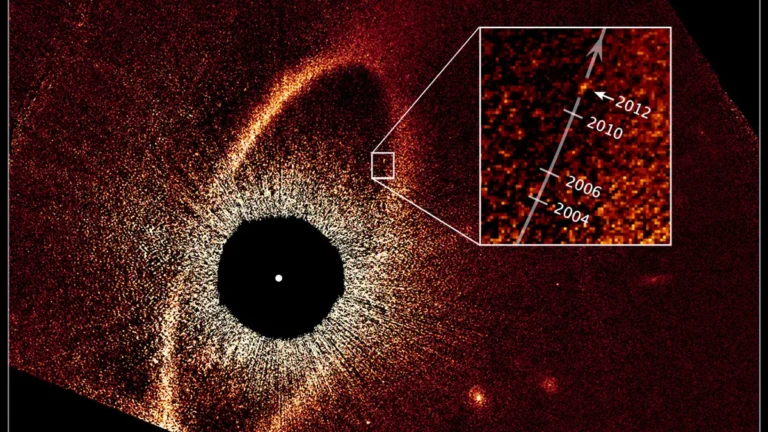
The coronagraph instrument on HWO aims to reduce starlight to 10^-10 in regions very close to the star, Phys.org says. The coronagraph relies on a deformable mirror with a 96×96 actuator array and picometer-level surface precision, and the actuators must be reliable, finely resolved, and radiation-hardened, so driver electronics do not fail in space.
Phys.org says photon-counting detectors, for example electron-multiplying charge-coupled devices or superconducting quantum sensors, would capture light efficiently with minimal background noise. The outlet describes these detector options as ultrasensitive.
Active thermal control, low-CTE materials including Corning ULE and Schott Zerodur, microthrusters, and vibration isolation will be used by HWO to counter thermal expansion, Phys.org says. The outlet ties this hardware to the need to hold positional accuracy for hours- or days-long observations.
Phys.org says HWO requires sensitivity spanning the near-infrared to the far-ultraviolet to satisfy Astro2020 requirements. Significant development before flight is still needed for new all-mirror coatings, large-format UV detectors, Next Generation Microshutter Arrays, and Digital Micromirror Devices, Phys.org adds.
Engineers plan to test HWO hardware on two testbeds: the Exoplanet Imaging Coronagraph (EPIC-5) and the Habitable Worlds Observatory Systems Testbed (HOST), Phys.org says. The testbeds connect to a crawl-walk-run development approach informed by JWST and Roman Space Telescope experience, according to Phys.org.
The Keck Institute roadmap, covered by Tech Times, proposes LIFE as five untethered spacecraft employing nulling interferometry to detect heat signatures from rocky planets. Published in June 2026, the roadmap frames LIFE as a 2040s-era international partnership with ESA as the natural primary partner under Voyage 2050.
According to Tech Times, JWST is unable to gather a usable atmospheric signal from temperate rocky planets at habitable-zone distances around Sun-like stars. The outlet attributes the limitation to transit geometry, which favors close-in planets around small, cool red dwarfs.
Tech Times says LIFE would detect methane through mid-infrared thermal emission, while HWO would spot ozone in reflected ultraviolet and visible light. LIFE would operate in the mid-infrared band spanning roughly 4 to 18.5 micrometers, according to the outlet.
Tech Times says the brightness gap between star and planet in mid-infrared is roughly ten billion to one in visible light, shrinking to about ten million to one. The outlet calls the remaining contrast enormous but tractable with nulling interferometry.
By shifting one path half a wavelength while planet light passes through, nulling interferometry cancels starlight on the star’s axis, Tech Times explains. The method dates to a 1978 proposal by astronomer Ronald N. Bracewell that called for canceling starlight through destructive interference.
Tech Times describes LIFE as four telescope spacecraft with baselines adjustable from 10 to 600 meters feeding a fifth beam-combiner, suppressing starlight below one part in 100,000. The outlet says the architecture applies Bracewell’s principle at scale with an effective aperture of hundreds of meters.
Tech Times says stable nulling implementation was not yet achievable when NASA’s Terrestrial Planet Finder Interferometer and ESA’s Darwin were cancelled in the mid-2000s. The article says implementation, not the optical principle, killed the earlier concepts.
Tech Times credits astrophotonic chip-scale optics and formation-flying heritage from SunRISE, targeting summer 2026, along with SEIRIOS, for underpinning confidence in LIFE. Below one part in 100,000 at ambient conditions, repeatable nulls were demonstrated by ETH Zurich’s Nulling Interferometry Cryogenic Experiment, Tech Times reports. The outlet says NICE demonstrated the most critical optical threshold and that a cryogenic phase at 15 Kelvin is next.
Tech Times reports that ozone can build up through photolysis without biology and that methane can escape from geological vents. Ozone and methane together signal chemical disequilibrium that needs an ongoing source, the outlet says, since the gases rapidly destroy each other without biology.
Tech Times says the same planet must be observed at multiple wavelengths at the same time to build a picture inconsistent with abiotic explanations. The outlet presents simultaneous multi-wavelength observation as the only way past the abiotic-mimicry impasse.
The Keck Institute report frames LIFE and the Habitable Worlds Observatory as scientific partners rather than competitors, Tech Times says. This framing supports the argument that neither observatory can confirm alien life alone.
Tech Times reports that LIFE targets rocky, temperate planets orbiting stars within roughly 65 light-years of the Sun at distances that could permit liquid water. The article defines this group as the solar neighborhood target population for LIFE.
Statistical modeling indicates LIFE might characterize 30 to 50 terrestrial exoplanets, a sample large enough for meaningful population statistics, according to Tech Times.
Tech Times reports that LIFE’s design timeline targets a launch in the 2040s as an international partnership with ESA as the natural primary partner under Voyage 2050. The outlet adds that ESA adopted the mid-infrared interferometry concept under Voyage 2050 and is the natural primary partner.
Tech Times says simultaneous observation of ultraviolet-visible and mid-infrared emission from the same nearby Earth-like planets could occur in the 2040s if both missions fly. The outlet calls this the first telescope fleet whose explicit combined purpose is determining whether life exists in the solar neighborhood.
Tech Times says a LIFE survey finding no biosignature pair across 30 to 50 rocky planets would constrain life’s prevalence as tightly as a detection. The outlet presents a null result as scientifically profound, capable of constraining life’s prevalence.


Join the discussion