Key facts
- Once a primordial black hole reaches a star's center, only a few million years pass before the object consumes about 1% of the star's mass.
- Surviving primordial black holes are predicted to be atom-sized objects with asteroid-scale masses, roughly one millionth of the mass of Earth.
- The hypothesis holds that primordial black holes formed immediately after the Big Bang as dense pockets of matter collapsed directly, and that the smallest would not have survived because of Hawking radiation.
- Dark matter is hypothetical matter that accounts for most of the Universe's matter and remains unseen because it does not interact with light, according to Universe Today.
A team led by Ore Gottlieb, an assistant professor of physics at MIT, proposes detecting primordial black holes by the flare given off when an atom-sized captured hole reaches a star’s center and spins up to blow the star apart, according to the team’s paper in The Astrophysical Journal. Co-authors include Matteo Cantiello of the Flatiron Institute, Cameron Norton and Matthew Kleban of New York University, and Ken Van Tilburg of Stanford University.
The research team proposes that primordial black holes formed immediately after the Big Bang as dense pockets of matter collapsed directly under their own gravity. The smallest of these objects would not have survived to the present because of Hawking radiation, a quantum effect in which black holes slowly emit energy and shrink, with the lightest evaporating over cosmic epochs while heavier ones did not have time to disappear.
The researchers predict that surviving primordial black holes are atom-sized objects with asteroid-scale masses, roughly one millionth of the mass of Earth. Those in the 1017–1023 g asteroid mass window remain viable dark matter candidates that stars can capture, while the lightest evaporated and more massive ones could still be around. They would be far older than ordinary black holes, forming in dense volumes immediately after the Big Bang before the first stars and galaxies, according to Tech Explorist.
Dark matter is hypothetical matter that accounts for most of the Universe’s matter and remains unseen because it does not interact with light, according to Universe Today. Scientists have proposed that primordial black holes could account for some or all of this unseen matter.
The researchers say spotting unusual stellar explosions that match the predictions could let astronomers constrain primordial black hole abundance and estimate their share of dark matter. Tech Explorist says future detections could test whether primordial black holes endured the universe’s initial instants and whether they account for some dark matter, though the work supplies no evidence that primordial black holes exist and instead proposes a new observational strategy.
The authors say a lone star is unlikely to capture a passing primordial black hole, so trapping the hole requires a companion such as a second star or planet to supply the gravitational interactions needed to trap it. Tech Explorist says a three-body system can do this, and once a companion is present the hole passes repeatedly through the star’s outer envelope. Friction from each crossing drains orbital energy and shrinks the orbit over thousands to millions of years until the black hole sinks into the stellar center, after which the star cannot survive.
The authors say that once the hole reaches the core it grows efficiently because most accretion energy vanishes into the hole instead of heating the surrounding gas. The black hole consumes about 1% of the star’s mass in only a few million years and expands to several meters across, with stellar rotation dictating the infall geometry.
The researchers combined analytic calculations with three-dimensional simulations grounded in particle physics, stellar evolution, hydrodynamics, and general relativity. BIOENGINEER.ORG explains that the growth rate depends on how much accretion energy is returned to the surrounding gas, where it heats the medium and resists further infall, and that growth outpaces earlier estimates.
The star’s spin determines which of two fates follows once that mass is consumed. If the star spins fast enough, gas cannot fall directly into the hole and instead piles into a rotating accretion disk, a swirling disk of gas and debris, inside the star. Ore Gottlieb said the spinning hole twists space and time, distorts the star’s magnetic fields, and launches powerful electromagnetic jets from the poles once the disk has formed, an arrangement he compared to processes around supermassive black holes. Gottlieb described an accretion disk inside the star as an almost unimaginable scenario that the research shows is possible.
On the explosive path, once the disk has formed, the jets tear through the star and blow it up within a few dozen seconds, an outcome Gottlieb described as effectively a death sentence.
If no disk forms, the system dies quietly. The hole consumes the star with almost no bright disk-powered emission and leaves a remnant whose mass is about that of the consumed star, making it indistinguishable from other stellar-mass black holes.
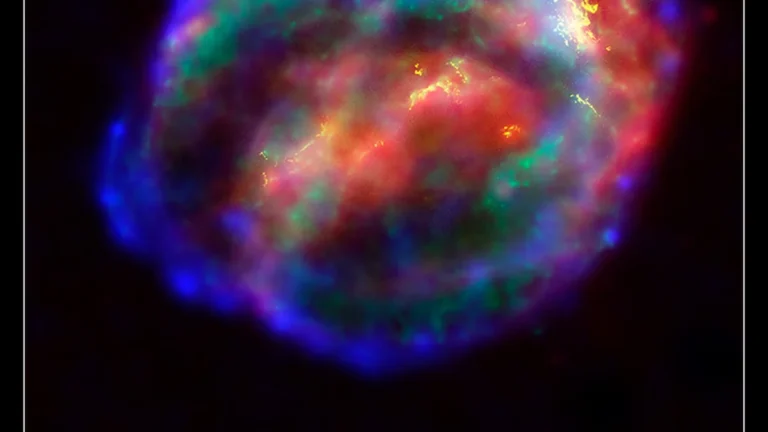
The rapid destruction creates a bright transient, a short-lived flash, emitting electromagnetic radiation across multiple wavelengths that telescopes could detect at long distances, similar to supernovae. The emission begins with blue and ultraviolet light together with high-energy X-rays and gamma rays, then shifts to optical and infrared radiation, and ends with lingering radio emissions. The researchers’ calculations indicate current observatories could record the flash across cosmological distances, including in distant galaxies rather than only nearby.
Hawking stars are stars that have engulfed a microscopic primordial black hole, a name honoring Stephen Hawking, who first proposed the idea in the 1970s. Gravitational-wave detections would be highly diagnostic if found, but they are likely rare and a subdominant discovery channel because they require the remnant to form a compact binary with another compact object. Spotting Hawking stars one by one could give independent limits on the primordial black hole population, while finding no such transients or persuasive subsolar merger candidates could limit their dark-matter share.
Distinguishing these blasts from other cosmic explosions is necessary, and one clue is the type of star involved, because an outburst in a star not expected to explode could signal a primordial black hole consuming it from within. Around Prague warns that different cosmic events can create comparable flashes, so any detection would require additional clues before being blamed on a primordial black hole.
Around Prague says it is still unknown whether these explosions occur at all, and the study predicts what would happen if asteroid-mass primordial black holes exist while offering astronomers a concrete target to search for. The work rests on theoretical calculations and three-dimensional simulations rather than on any observed stellar explosion, Around Prague reports, citing MIT News. Gottlieb said current telescopes could see the flash, and that the blast could take place in distant galaxies rather than only nearby.


Join the discussion