Key facts
- On September 26, 2022, DART struck Dimorphos at roughly 22,530 kilometers per hour after more than 10 months of travel.
- Dimorphos is about 151 meters across and circles its companion Didymos, about 730 meters across (2,395 feet); the two form a near-Earth pair now around 193.5 million kilometers from Earth that does not threaten Earth.
- Michael Küppers of ESA said the DART-struck side is blanketed by a crater that looks as though a chunk was sliced off, while no major changes are evident on the far side, a combination he called surprising.
- LICIACube, a small Italian spacecraft sent along with DART to photograph the impact, failed to observe the damage because an enormous cloud of debris was in the way, and the craft had left before the dust cleared.
The European Space Agency released new Hera imagery of asteroid Dimorphos on Nov. 25, 2026, showing a stadium-sized crater on the face NASA’s DART spacecraft struck on Sept. 26, 2022.
DART hit Dimorphos at roughly 22,530 kilometers per hour after more than 10 months of travel, striking about 11 million kilometers from Earth. The spacecraft was destroyed in the collision, which sent dust spewing from the asteroid. Until Hera arrived, it was unclear whether DART had left a small crater or reshaped Dimorphos entirely.
The crater covers the asteroid’s full width, resolving a debate over whether Dimorphos kept a crater, changed shape, or stayed the same, according to Hera principal investigator Patrick Michel of the CNRS’s Observatoire de la Côte d’Azur. “The face struck by DART has been flattened into an impact crater the size of a sports stadium,” Michel said at a press conference on Nov. 25, 2026.
Michel called Dimorphos the solar system’s most chaotically rotating object, and ESA Hera mission scientist Michael Küppers said the moonlet is now tumbling in a chaotic way around its companion Didymos. Before the impact, the moonlet was thought to be tidally locked to Didymos, keeping one face toward the larger body.
Küppers said the DART-struck side is blanketed by a crater that looks as though a chunk was sliced off, while no major changes are evident on the far side, a combination he called surprising. “We do not see evidence for major changes on the site opposite to the DART impact,” Küppers said. Researchers comparing the new Hera images with pre-collision DART views spotted single boulders that appear undisturbed in areas away from the strike.
Patrick Michel said it is strange to see a big crater while the rest of Dimorphos seems not really perturbed, and Ian Carnelli agreed at the Nov. 25, 2026 press event, adding that scientists were perturbed. “It’s really strange because you have a big crater, and the rest seems not really perturbed,” Michel said.
Hera has found hundreds of boulders only a few meters across orbiting the two asteroids, and the team will take account of them as the spacecraft moves closer for higher-resolution images. The Hubble Space Telescope revealed a swarm of 37 boulders apparently dislodged by the impact in 2023, and simulations suggested some ejected rocks could remain gravitationally bound long enough for Hera to encounter them.
The impact altered Dimorphos’s path around Didymos and changed the binary pair’s orbit around the Sun. NASA’s minimum success threshold was a 73-second cut to Dimorphos’s orbital period around Didymos, while the measured reduction reached 33 minutes.
Dimorphos is about 151 meters across and circles Didymos, which is about 730 meters across, or 2,395 feet. The near-Earth pair is now around 193.5 million kilometers from Earth and does not threaten the planet. Because Dimorphos is the smaller member of the gravitationally bound pair, a shift in its path around Didymos should be detectable from telescopes on Earth.
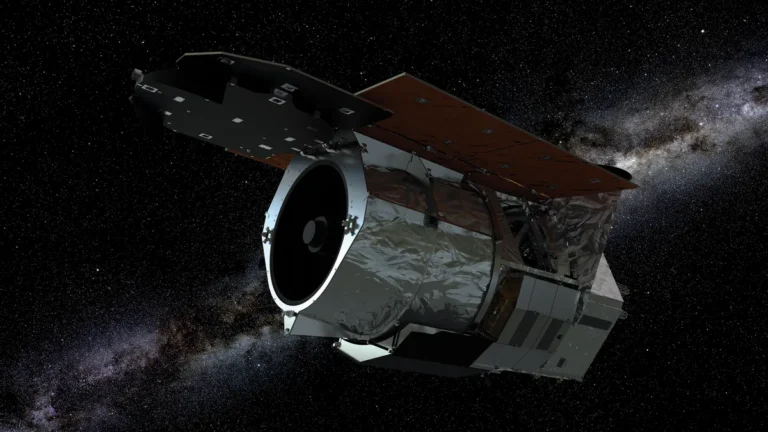
Hera launched in October 2024 and reached Dimorphos on Nov. 4, 2026. It is presently observing the pair from about 25 to 30 kilometers (16 to 19 miles) away and will move to within 13 kilometers in December 2026 to capture progressively higher-resolution views. The spacecraft is roughly car-sized and carries two CubeSats for the next stage of the investigation.
In January 2027, Hera is due to release two small satellites called Juventas and Milani. Juventas plans to conduct radar soundings of an asteroid’s interior for the first time, while Milani measures the external environment. Figuring out Dimorphos’s mass and structure should show how well DART passed momentum to the rock and how other bodies might react to a comparable blow, which matters for using kinetic impactors against a future Earth-threatening asteroid.
A small Italian spacecraft called LICIACube traveled with DART to photograph the impact but failed to observe the damage because an enormous cloud of debris blocked the view, and the craft had left before the dust cleared. The marks Dimorphos might have kept were unknown until a spacecraft could visually confirm them, which is Hera’s role.
At a press briefing on Nov. 25, 2026, ESA published the fresh imagery and officials spoke about ancient catastrophic impacts, notably the strike 66 million years ago that wiped out nonavian dinosaurs. ESA’s mission manager showed the pictures in a dinosaur hall at Berlin’s Museum für Naturkunde, framing the images as a warning about asteroid strikes.
Dimorphos is a rubble-pile asteroid made of smaller rocks held together by exceedingly weak mutual gravity, and simulations published in 2024 suggested DART might not leave a distinct crater but instead reorganize the asteroid’s rocks into an entirely different shape. That weak gravity makes it hard to forecast how this kind of asteroid would react to a hit.
NASA footage showed the impact as it happened in 2022, and the latest pictures reveal how badly Dimorphos was damaged; the moonlet was not a danger to Earth. Mission planners picked Dimorphos as DART’s target because it is the smaller of the two, making it easier to move.
Join the discussion