Key facts
- NASA’s Hubble Space Telescope observed 37 nearby dwarf galaxies and found significantly less oxygen than simulations predicted, challenging models of how small galaxies retain heavy elements.
- Simulations predict dwarf galaxies should retain far more oxygen than observed, as oxygen is a tracer for heavy elements produced by stars and distributed within galaxies.
- Researchers propose that supernova-driven galactic winds ejected oxygen from dwarf galaxies, leaving only a small fraction of the oxygen produced by stars.
- The Galaxies Losing Oxygen via Winds (GLOW) project traced oxygen distribution in stars, gas, and intergalactic space to understand how dwarf galaxies lose heavy elements.
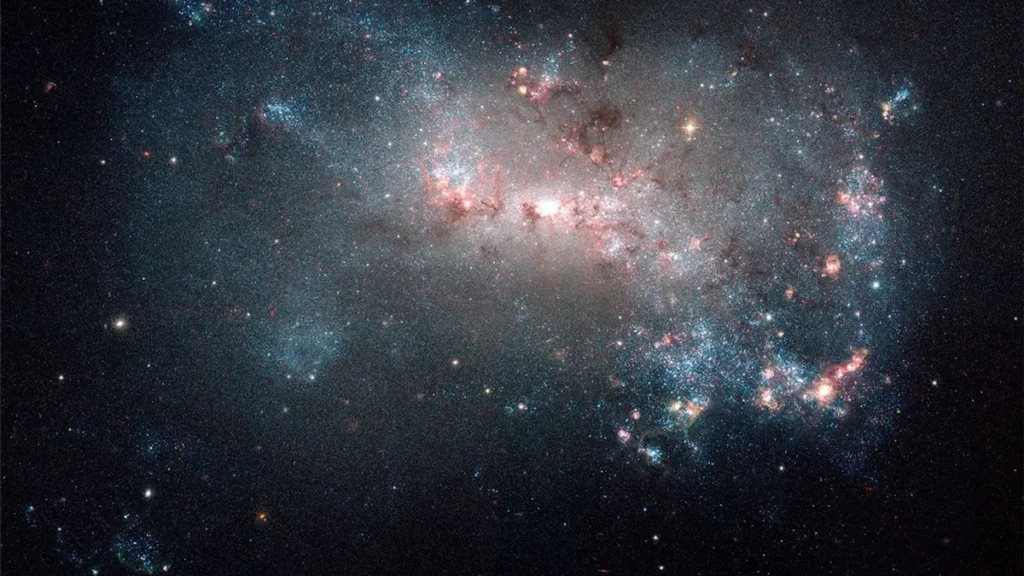
NASA announced Monday that the Hubble Space Telescope found less oxygen than simulations predicted in 37 nearby dwarf galaxies, according to a study published that day in The Astrophysical Journal. NASA released the results on the same day the paper appeared, presenting the missing-oxygen mystery as a new challenge for galaxy-evolution models. The work used archival Hubble observations of galaxies whose masses fall in a range where theory predicts oxygen expulsion via supernovae.
The Galaxies Losing Oxygen via Winds project traced oxygen distribution in stars, gas, dust and intergalactic space to understand how dwarf galaxies lose heavy elements. Funded by NASA and the National Science Foundation, GLOW used Hubble’s archival optical imaging data to resolve stellar populations and determine star-formation histories and compositions. Researchers combined those observations with data from NASA’s retired Spitzer Space Telescope and the ground-based Very Large Array and Australian Telescope Compact Array to analyze all 37 galaxies.
The team selected the galaxies because their masses fall within the range where simulations predict oxygen expulsion through supernovae, and because they are close enough for Hubble to resolve individual stars. Dwarf galaxies are small systems containing a few thousand to hundreds of millions of stars. This size range describes the galaxies observed by Hubble and distinguishes them from more distant dwarfs that cannot be studied in the same way.
Most known dwarf galaxies are too distant for such detailed study, which limited research to larger, star-forming systems like the Milky Way. Oxygen is the most abundant element after hydrogen and helium, and its production is well understood, so it serves as a reliable indicator of chemical element distribution in galaxies. These traits make oxygen simple to detect and measure.
Simulations show dwarf galaxies should retain far more oxygen than Hubble observed, because oxygen tracks the heavy elements produced by stars and distributed within galaxies. The findings challenge chemical-evolution models by showing these small systems retain far less oxygen than predicted, implying revised theories for heavy-element distribution in the early universe. The discrepancy suggests galactic winds are more effective at expelling oxygen from low-mass galaxies than modeled, with implications for understanding galaxy formation and intergalactic enrichment.
Co-investigator Grace Telford, an assistant professor in the Department of Physics and Astronomy at the University of Utah, said oxygen made by stars inside these galaxies must have been ejected because it existed in the past. She said energy from massive stars and supernova explosions needs to drive material out of host galaxies and into intergalactic space. Telford will use Hubble to study individual massive stars in nearby GLOW targets to characterize how they differ in small galaxies and contribute to oxygen ejection through supernovae.
Kristen Wingfield McQuinn, GLOW’s principal investigator, said tracing oxygen helps explain galaxy evolution and how galaxies enrich the intergalactic medium. McQuinn, an associate professor at Rutgers University in New Brunswick, New Jersey, who heads the Science Operations Center for NASA’s Nancy Grace Roman Space Telescope at the Space Telescope Science Institute in Baltimore, Maryland, said the team chose oxygen for practical reasons. She described oxygen as one of the primary elements formed by stars and a key to understanding chemical enrichment processes.
Astronomers have long suspected that galaxies expel a large fraction of oxygen and other heavy elements, but an open question remains about where these metals end up. A 2014 study found that Milky Way-like galaxies lose oxygen to their circumgalactic medium, while previous teams have measured oxygen in the circumgalactic medium of dwarf galaxies. It remains unclear whether most missing oxygen lies there or has been ejected from the galaxies’ surroundings. GLOW expands that earlier research on Milky Way-like galaxies to low-mass galaxies across many masses and environments.
McQuinn hopes to study even lower-mass galaxies in the nearby universe through an approved Roman Space Telescope program designed to find faint and small systems across a wide swath of sky. After identifying those galaxies, she plans to observe them more deeply with Hubble and NASA’s James Webb Space Telescope to reconstruct their star-formation histories across cosmic time. The work would build on the Roman survey of low-mass systems in the nearby universe.
The Hubble Space Telescope has operated for more than three decades. NASA’s Goddard Space Flight Center in Greenbelt, Maryland, manages the telescope and mission operations, Lockheed Martin Space in Denver supports mission operations at Goddard, and the Space Telescope Science Institute in Baltimore conducts Hubble science operations for NASA. The Association of Universities for Research in Astronomy operates the institute.


Join the discussion