Key facts
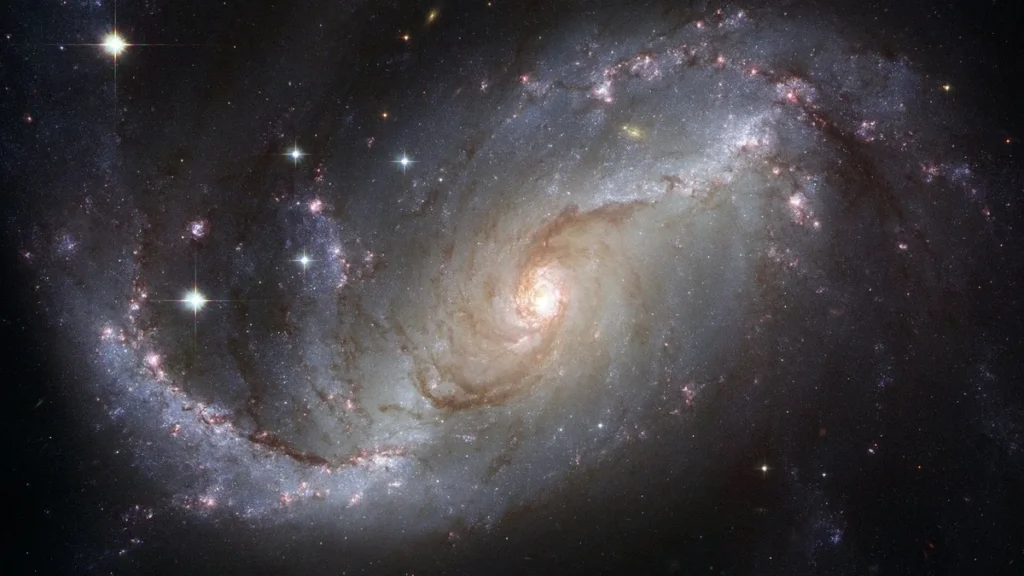
- NASA's Hubble Space Telescope captured an Oct. 22, 2026 image showing a sweeping barred galaxy with gravitational lensing at bottom right.
- The images will also lay groundwork for future Roman observations.
- Phys.org explains that gravitational lensing occurs when a foreground galaxy's mass warps spacetime, bending light and distorting and magnifying images as light passes around the object.
- Phys.org says the light now seen from that galaxy began traveling toward Earth when the solar system was still in formation.
NASA’s Hubble Space Telescope captured an image on Oct. 22, 2026, showing a barred spiral galaxy with gravitational lensing at bottom right.
The observation is one of many gravitational lensing images Hubble took in preparation for science with the Nancy Grace Roman Space Telescope. Astronomers will use these images to analyze gravitational distortions to learn about dark matter in foreground galaxies. The images will also lay groundwork for future Roman observations. NASA and Phys.org present the paired telescopes as complementary, and NASA says images like this offer a glimpse of how Hubble and Roman will work together to build a more comprehensive picture of the cosmos.
Phys.org explains that gravitational lensing occurs when a foreground galaxy’s mass warps spacetime, the fabric of space and time, bending light and distorting and magnifying images as light passes around the object. Lensing results from a precise alignment between the galaxies, which makes background light curve around the foreground galaxy like a giant lens.
The gravitational lens in the image shows a foreground elliptical galaxy roughly 4.5 billion light-years away. Phys.org says the light now seen from that galaxy began traveling toward Earth when the solar system was still in formation. The background galaxy lies about 8 billion light-years away, almost twice as far as the foreground galaxy. It appears as two arcs produced by the lensing alignment: one large arc noticeable upper left of the foreground galaxy and a smaller flipped image lower right.
Phys.org states that a more massive foreground galaxy produces a stronger lens and bends light more. Researchers can determine the foreground galaxy’s mass by studying the background galaxy’s distortion. Because visible matter cannot explain the distortion, they can calculate both the galaxy’s total mass and its dark matter content. Dark matter is the invisible substance making up most cosmic mass.
Nearly every object in the image is a galaxy, apart from a few scattered foreground stars. The barred spiral galaxy shown is about as large as the Milky Way, which astronomers think is also barred. Phys.org says a spiral near the large spiral may be a satellite galaxy resembling the Large and Small Magellanic Clouds that orbit the Milky Way.
Hubble observes mainly in visible and ultraviolet light with some infrared coverage, while Roman sees infrared wavelengths and some visible light. It delivers high-resolution views of individual objects, while Roman’s much larger field of view suits panoramas. It can view these gravitational lenses only one at a time, but Roman’s wide sky view will provide a larger sample for statistical analysis.
Using Hubble’s sharp images, astronomers are building a computer model to better analyze dark matter-induced distortions to aid analysis of Roman’s large images. Roman-detected lenses that look interesting will receive follow-up observations from Hubble.
PBS describes Roman as an observatory that could help scientists investigate dark matter and dark energy and search for exoplanets, and it could potentially reveal thousands of new worlds. The image credit goes to NASA, ESA, and X. Huang of the University of San Francisco, with processing by Gladys Kober of NASA/Catholic University of America.

Join the discussion