Key facts
- Researchers at Chalmers University in Sweden conclude that magnetic fields, not stellar winds alone, drive mass loss from the AGB star Mira.
- The research paper "A giant magnetic eruption from the asymptotic-giant-branch star Mira A" was published in Astronomy and Astrophysics in 2026.
- Lead author Wouter Vlemmings is Professor in the Department of Physics and Astronomy at Chalmers University of Technology in Gothenburg, Sweden.
- Cool, luminous stars known as AGB stars are running out of hydrogen and have left the main sequence.
A Chalmers University team in Sweden reported in 2026 that magnetic fields drive mass loss from the aging star Mira, not stellar winds by themselves. The finding appeared in the paper A giant magnetic eruption from the asymptotic-giant-branch star Mira A, published in Astronomy and Astrophysics in 2026. Chalmers scientists argue magnetic effects belong beside radiation-driven winds when explaining how older stars feed the galaxy.
Wouter Vlemmings, a professor in Chalmers University of Technology’s physics and astronomy department in Gothenburg, Sweden, led the research. Vlemmings is identified as the lead author of the Mira magnetic-eruption study and as the speaker in a Chalmers press release about the result. The Chalmers group says magnetic effects should be treated as central to mass loss from aging stars rather than as a secondary factor.
AGB stars are cool, luminous objects that have left the main sequence and are running out of hydrogen. These aging stars shed gas and dust into space, providing raw material for future stars and planets. Aging AGB stars can release up to 30 Earth masses of matter each year into the interstellar medium.
Chalmers researchers keep watch on Mira, an AGB star about 300 light years away. Mira is the prototype and namesake of oxygen-rich Mira variables. Mira variables are pulsating AGB stars, and Mira is the nearest dusty, pulsation-driven oxygen-rich AGB star of its type, making it a natural target for study. Its proximity and dusty nature make it ideal for detailed observation.
Under the older view, aging AGB stars send out gas in pulses that cool into dust, and radiation pressure pushes that dust outward with the stellar wind. The key emitted materials are carbon and silica, with silica mainly building rocky planets and carbon contributing to organic particles. This output means stellar winds from AGB stars matter greatly for the formation of planets, other stars, and potential life.
Certain oxygen-rich AGB stars like Mira shed mass even though they have too little dust to explain it. Mira stands as the closest dusty, pulsation-driven O-rich AGB star of its type. The lack of dust challenges explanations based solely on dust-driven winds and motivated detailed study of Mira.
The new findings argue against the older view that starlight and radiation pressure drive winds carrying heavy elements into the interstellar medium. Chemical enrichment of the Universe depends on this mass-loss process, which has received enormous research attention for decades. This process shapes how heavy elements spread through space and become available for new generations of stars.
Previous studies detected strong magnetic fields around AGB stars like Mira, but evidence of their role in mass loss was absent. Wind-loss models left out magnetic effects, even though researchers had suggested the fields might drive mass loss. The missing proof had been a gap in understanding how these aging stars lose mass.
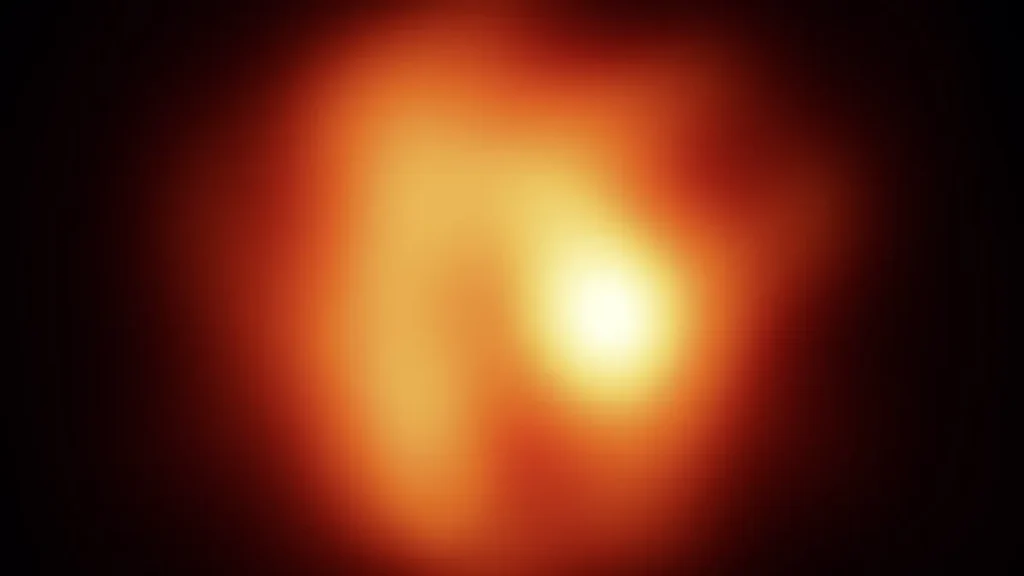
In August 2025, ALMA and the Very Large Array observed Mira A along with its white-dwarf companion Mira B. This work added to a ten-year record showing dramatic surface changes on the star. The combined data set spans visible, millimetre, and submillimetre wavelengths and covers a decade of high-angular-resolution monitoring.
Mira’s ten-year monitoring is the longest surface study ever made of any star except the Sun. The long timeline let researchers track unexpected phenomena in the stellar atmosphere and mass-loss process. This extended record made it possible to catch changes that shorter observations would have missed.
The team used ALMA observations to study how Mira’s magnetic fields shape mass loss. ALMA cannot see magnetic fields directly, so it deduces them from how they polarize radio emissions. This indirect method relies on the polarizing effect of magnetic fields on radio emissions to reveal field geometry around the star.
A flare from 2023 on Mira expanded over two years into a huge gas loop that researchers imaged in 2025. The loop reaches out to Saturn’s distance from the Sun. The loop dwarfed the star and was unlike anything researchers had observed before.
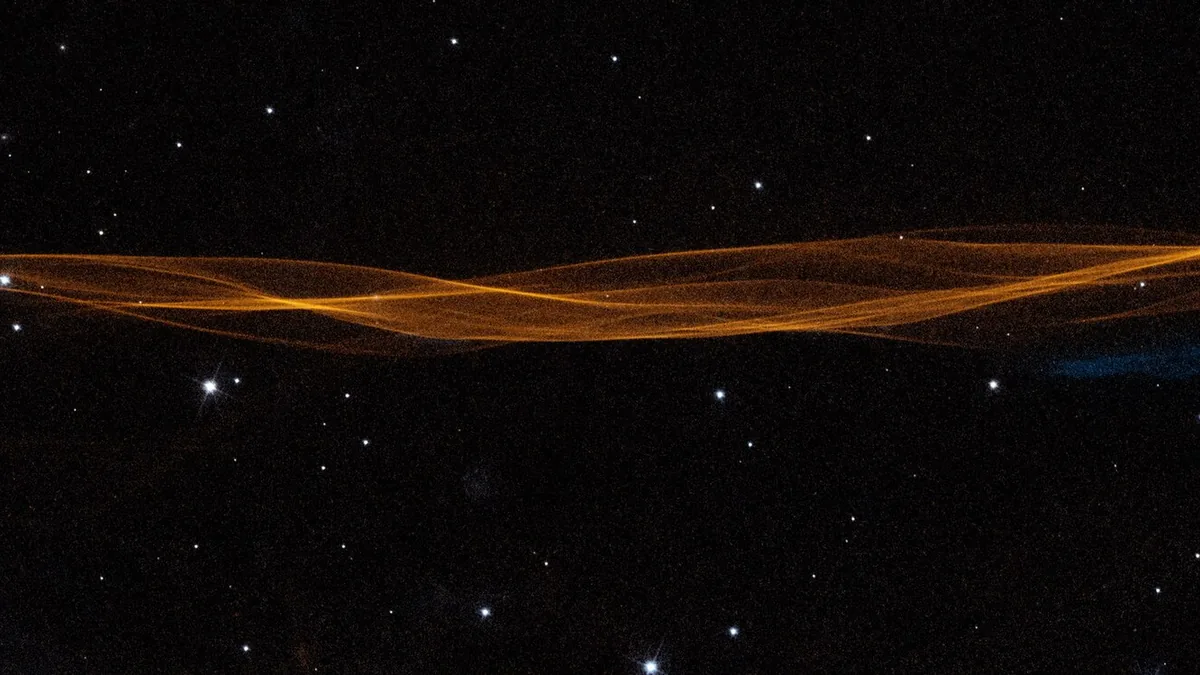
SiO masers are silicon monoxide masers found in the gas shells around aging stars. They usually appear near the inside edge of the dust-formation zone around AGB stars, but Mira A’s masers sit far beyond that zone in gas too thin for a strong maser. According to researchers, the masers follow an outward-moving shock that is much denser than expected. The odd position and polarization of the masers showed both shock activity and a magnetic loop near Mira A.
Mira A’s masers display linear and circular polarization, which researchers used to map the star’s magnetic-field geometry and how it affects the wind. Linear polarization means organized polarization, while circular polarization rotates in a corkscrew pattern; together they reveal field structure. A strong magnetic field inside the loop affects the star’s wind. Vlemmings said the link brought to mind phenomena observed on the Sun.
Miora Andriantsaralaza, a postdoctoral researcher at Chalmers and co-author of the study, said the surface of the star changes all the time. The brightest spots are different each time, and flares release huge amounts of energy. She called the brightest patches amazingly bright and said the team realized the star keeps flaring.
Some hotspots show brightness temperatures of 8,000 Kelvin, far higher than the typical 2,000 K level. The hotspots belong to the continually changing surface shown by the decade-long observations. These temperature spikes are part of the ongoing surface changes that researchers have tracked over ten years of monitoring, with the brightest areas differing each time the star is observed.
Miora Andriantsaralaza said magnetic storms on Mira’s surface keep creating bright flares strong enough to blast outer layers into interstellar space. She said the flares keep happening again and again on the evolved star. These recurring flares release vast amounts of energy from the star’s surface.
Researchers remain uncertain about the origin of Mira’s magnetic fields. The authors note that several mechanisms have been proposed, though the responsible source remains unclear. One idea involves a turbulent dynamo in the convective envelope; the other involves differential rotation between core and envelope. Understanding how the fields are generated is needed to advance modeling of magnetic mass loss.
The findings resemble the Sun, where magnetic fields create flares and coronal mass ejections, although the Sun is young and not an old AGB star losing mass in the same way. The comparison draws a link between solar magnetic storms and the eruptions observed on Mira. This parallel helps explain how magnetic activity can drive mass loss even on evolved stars.
Understanding AGB mass loss requires including magnetic fields, not only radiation-driven winds. Coronal-mass-ejection-style eruptions can account for clumpiness and asymmetry, along with time variability and planetary nebula morphologies. The authors say these eruptions redefine late-stage stellar evolution and help explain AGB mass-loss features and planetary nebulae. Such eruptions can explain features that steady wind models cannot.
The paper concludes that models should treat magnetic activity as a primary force behind mass loss and circumstellar environment shaping. This conclusion comes from seeing magnetic fields as central instead of peripheral to AGB mass loss. Magnetic activity should be built into models as a dominant force that starts mass loss and shapes the environment around the star.
Vlemmings said the research matters for the galaxy’s ecosystem. Before the Sun was born, storms on a red giant star may have been necessary for Earth to exist, he suggested. He said the result matters for the whole galaxy and for where atoms in our bodies come from. “But this star is showing us something different: that strong magnetic fields can also shape and power stellar winds.”

Join the discussion