Key facts
- Centaurus A is located around 12 million light-years away from Earth, and its central supermassive black hole is approximately 60 million times as massive as the sun.
- The research team performed a magnetohydrodynamic simulation incorporating general relativistic effects to model an accreting supermassive black hole and its launched plasma jets.
- Researchers expected the center of black hole jets to be brightest because energy is most concentrated there, but observations of Centaurus A show the edges are brighter than the center.
- Brighter jet limbs have been observed not only in Centaurus A but also in M 87 and 3C 84.
Researchers at the University of Würzburg published a study in Astronomy & Astrophysics on Oct. 12, 2026, explaining why plasma jets launched by the supermassive black hole in Centaurus A glow brighter at their edges than in their centers.
The Event Horizon Telescope’s decade-long observations of bright edges in Centaurus A’s jet motivated the new research. The University of Würzburg team published the study in Astronomy & Astrophysics with DOI 10.1051/0004-6361/202660093. Felix Glaser, a Master’s student at the university’s Chair of Astronomy, served as lead author on the paper titled Probing anisotropic particle acceleration and limb brightening in Centaurus A’s jet.
Centaurus A lies around 12 million light-years from Earth, and its central supermassive black hole is approximately 60 million times as massive as the sun. It is the closest active galaxy to Earth and the closest radio galaxy, so its jets serve as a unique laboratory for observing extreme physical conditions in exceptional detail. Astronomers have observed the jets in detail for many years.
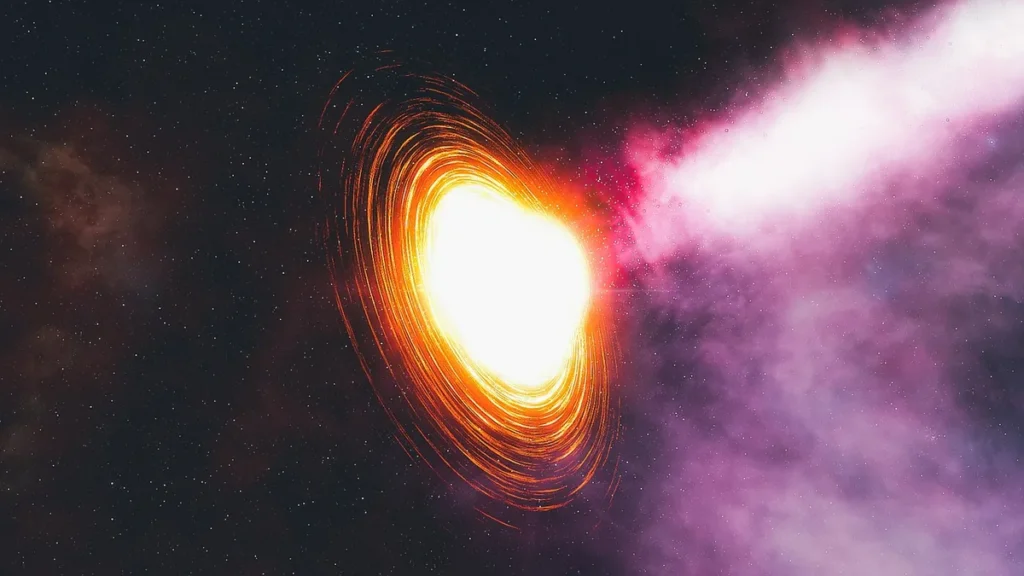
The black hole hurls two enormous plasma jets into space at nearly the speed of light. Event Horizon Telescope observations spanning a decade revealed that the jets are brighter at their edges than in their centers. This limb brightening puzzled researchers for decades because standard expectations suggested the center, where energy is most concentrated, should be brightest.
The researchers constructed a magnetohydrodynamic simulation that included general relativistic effects to represent an accreting supermassive black hole and its launched plasma jets. This approach treats plasma as an electrically conducting fluid. Because the jets move at relativistic speeds, the simulation included those effects.
Researchers adjusted free parameters, including black hole mass and viewing angle, to match the simulation to Event Horizon Telescope observations of Centaurus A. The simulation successfully mimicked the recent observations, allowing the researchers to connect their plasma-informed model to the actual observed edge brightening.
Edge brightening emerged naturally in the results from an anisotropic particle distribution, where electrons in the jets are spread unevenly across pitch angles. A particle’s pitch angle is the gap between its velocity and the magnetic field. When particles are forced to follow the curve of a magnetic field, they produce synchrotron radiation, whose intensity depends strongly on pitch angle.
Because observed brightness changes depending on the viewing angle of the magnetic field that particles are forced to follow, the uneven electron distribution produces the bright edges and comparatively dark core seen in the model. Universe Today says this relationship between pitch angle and viewing angle determines how the anisotropic particle distribution produces edge brightening in the model.
In the jet of Centaurus A, fast electrons travel along extremely strong magnetic field lines, and their brightness depends on how the magnetic field is oriented. The complex structure of the magnetic field creates bright rims and a darker core across regions spanning several light-days, observed at 1.3 millimetres. The Würzburg team traced the answer to the behavior of plasma — the ionized gas that forms the jets — and confirmed that the bright rims agree with what the Event Horizon Telescope saw.
The work should open the door to a new generation of models that improve understanding of the most powerful particle accelerators in the Universe. idw-online.de calls that the broader significance of the research.

Brighter jet limbs have also been observed in M 87 and 3C 84, and the phenomenon has occupied researchers for decades. Because those galaxies differ from one another, the authors used Centaurus A as a pilot study to model Event Horizon Telescope observations, choosing it because it is the closest. idw-online.de explains that while a jet should be brightest at its center, Event Horizon Telescope observations show mainly the edges glowing in Centaurus A.
Professor Karl Mannheim of the University of Würzburg noted that insights gained from studying plasma under extreme conditions in Centaurus A may contribute to the development of future fusion energy. Both black hole jets and fusion reactors are governed by the physics of plasma, providing a conceptual link between astrophysical environments and artificial magnetic plasma confinement. Universe Today says the research may matter beyond black hole jets because fusion reactors rely on magnetic plasma confinement. “Cen A is our closest window into the physics of relativistic jets” — Felix Glaser.
Any working fusion reactor needs extremely powerful artificial magnets that create fields to confine plasma within a vacuum vessel. The ITER international nuclear fusion research project uses D-shaped toroidal field magnets, each weighing 330 tons, to confine plasma in its vacuum vessel. Fusion reactors can draw on plasma physics lessons learned from black hole jets.
Dr. Christian Fromm, who leads the Computational Astrophysics Group, said effects at the plasma’s smallest scale can shape structures across vastly larger scales. He said combining high-resolution observations with numerical simulations and plasma physics is helping researchers grasp how black holes launch powerful jets and produce radiation. Future observations should reveal more plasma signatures, he added, so realistic plasma physics belongs in current models.
Professor Matthias Kadler, spokesperson for the DFG Research Unit Relativistic Jets in Active Galaxies (FOR 5195), said the paper shows the unit aims to combine observations with numerical simulations and plasma physics. That unit brings different disciplines together to work out how black holes launch powerful jets and create the radiation we observe. The research also sheds light on how black holes drive particles to enormous energies and what radiation comes out of the process. idw-online.de ties this point to the DFG Research Unit ‘Relativistic Jets in Active Galaxies’ (FOR 5195).
Astrophysical jets from supermassive black holes are powered by rotational energy and powerful magnetic fields, travel at relativistic speeds, and inject energy into the intergalactic medium, heating gas and creating turbulence that acts against star formation. These jets originate from active galactic nuclei where material in an accretion disk rotates and heats up before some of it is ejected. Exactly how the jets are created remains unclear.
Combined very long baseline interferometric observations, including the Global mm-VLBI Array and the Event Horizon Telescope, can resolve jet structure close to its launching site. The study authors wrote that these high-resolution observations make it possible to investigate jet structure near where it originates.
Future facilities are expected to take the work even further. The Square Kilometre Array is slated to open in 2027 as the largest and highest-resolution radio telescope worldwide, while Very Large Array upgrades finish in 2031. The Wetterstein Millimeter Telescope planned for the Zugspitze is intended to sharpen observations considerably, and the next-generation Very Large Array together with the Square Kilometre Array will deliver more detailed findings in the future. idw-online.de calls these projects sources of sharper insight ahead.



Join the discussion