Key facts
- An international team led by Wouter Vlemmings and Miora Andriantsaralaza, both from Chalmers University of Technology, imaged the nearby red giant star Mira using the ALMA telescope in Chile.
- Mira is a red giant star located 330 light years from Earth in the constellation Cetus the Whale, and it is cooler, older, bigger and brighter than the sun.
- Behzad Bojnordi Arbab, a doctoral student at Chalmers and a member of the research team, said a flare appeared on Mira's surface in 2023 and did not stop there.
- The gas loop around Mira is far larger than the star and spans a distance equal to that between the sun and Saturn.
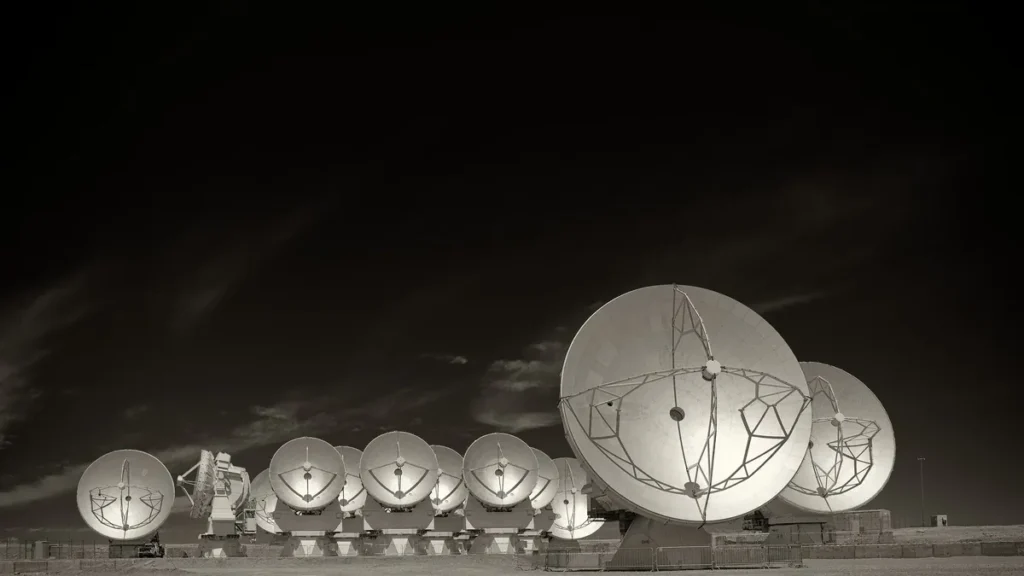
An international team led by Chalmers University researchers Wouter Vlemmings and Miora Andriantsaralaza used the ALMA telescope in Chile to capture sharp new images of Mira, a red giant star 330 light years from Earth in the constellation Cetus the Whale, and ESO featured the image as Picture of the Week on 23 November 2026.
Mira is cooler, older, bigger and brighter than the sun, and it has long been a favorite target for astronomers because its age offers a preview of the sun’s future state billions of years from now. In a few billion years, the sun will become a cool, windy star like Mira. The new observations are the sharpest surface images ever taken by ALMA, revealing a dramatic change in the star in less than ten years. A decade of detailed Mira images reveals recurring magnetic storms and a gigantic gas loop.
A flare appeared on Mira’s surface in 2023 and did not stop there, said doctoral student Behzad Bojnordi Arbab of Chalmers. Over the next two years the surface eruption created a large growing gas ring around the star, recorded in an image from 2025. The image shows Mira and its surroundings as seen by ALMA, revealing a huge gas ring produced by a record-bright stellar eruption in 2023.
The gas loop is far larger than the star and spans a distance equal to that between the sun and Saturn. Arbab said the researchers had not seen anything like that loop before, and it became central to identifying magnetism as the driver of Mira’s wind. The loop holds a powerful magnetic field that must affect the star’s outflow, revealing a link between the flare and the loop that brought to mind events observed on the sun, according to Professor Wouter Vlemmings.
Vlemmings said astronomers long believed starlight shining on dust grains in a star’s outer atmosphere pushes stellar winds, but Mira shows powerful magnetic fields can also mold and drive those winds. He added that this alters a basic element of how the atoms forming people came to exist. “For decades, astronomers have believed that the winds from stars like this must be powered by starlight,” Vlemmings said.
The findings mean scientists must take magnetic fields into account when seeking to understand stellar winds, which disperse atoms such as carbon, oxygen and nitrogen so those atoms can build future stars and planets. Miora Andriantsaralaza, a postdoctoral researcher at Chalmers, said magnetic storms on Mira’s surface continually create bright flares, and every flare is powerful enough to raise sections of the star’s outer layers and send them into interstellar space.
“We were astonished to see how the star’s surface is constantly changing,” Andriantsaralaza said. She said the team was astonished by how constantly the surface changes, with different bright areas appearing each time they looked, and realized the brightest patches are amazingly bright, showing the star is flaring and sending out enormous amounts of energy every time.
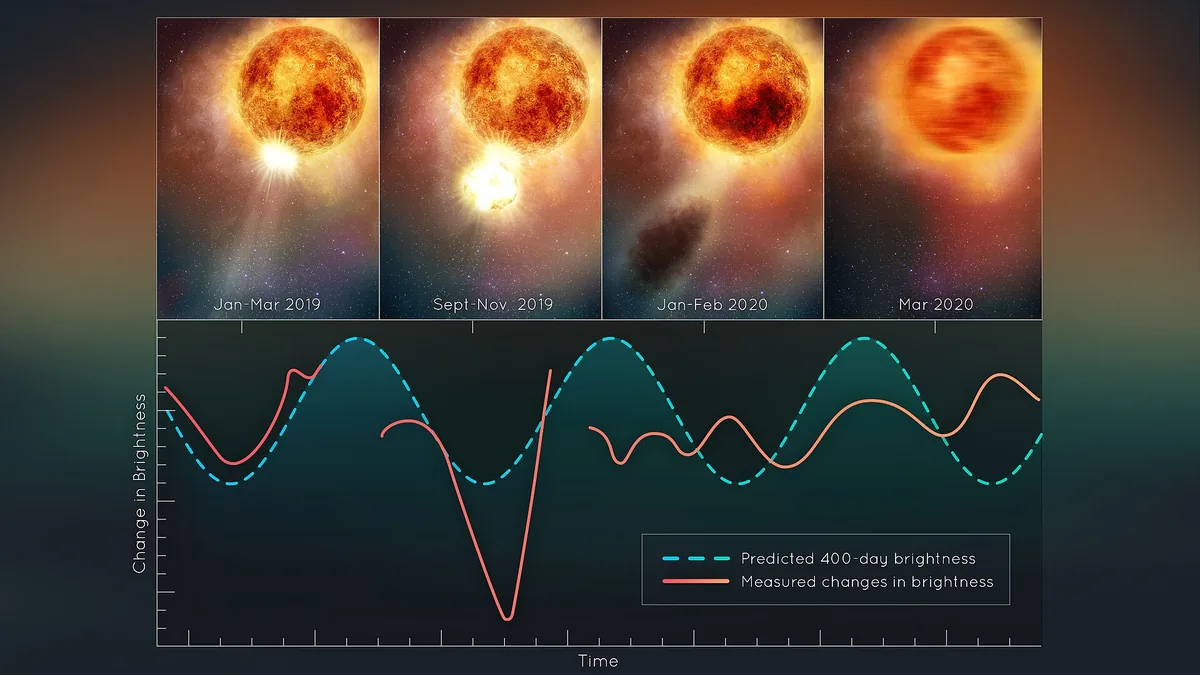
The team estimates Mira’s brightest flares exceed all flares previously seen from similar stars, an estimate that follows the team’s creation of extremely detailed surface images of Mira. On the sun, bright flares and magnetic storms cause coronal mass ejections, bursts of solar material that send particle streams toward Earth and can create auroral displays, but scientists had not previously expected such phenomena on a red giant star.
Stellar winds disperse atoms such as carbon, oxygen and nitrogen so those atoms can build future stars and planets, and magnetic activity on a red giant can directly distribute material into interstellar space. The results challenge the assumption that winds from stars like Mira are powered by starlight acting on dust grains in the star’s outer atmosphere, and they mean magnetic storms on stars like Mira can lift outer layers into the space between stars, spreading key elements through the Milky Way.
The results appear in two papers in Astronomy & Astrophysics in 2026. W. Vlemmings et al. published A giant magnetic eruption from the asymptotic-giant-branch star Mira A, a late-life phase in which a star swells into a red giant and sheds material. M. Andriantsaralaza et al. published Periodic activity on the (sub)millimetre surface of the asymptotic giant branch star Mira A, focusing on periodic activity on the submillimetre surface of the star.
Authors of the first paper are affiliated with Chalmers University of Technology in Sweden, University of Oslo in Norway, ESO in Germany, and Masaryk University in Czechia. Authors of the second paper are affiliated with Chalmers, Observatorio Astronomico Nacional (OAN-IGN) in Spain, ESO, and Uppsala University in Sweden. ESO credited the Mira image to ALMA(ESO/NAOJ/NRAO)/W. Vlemmings et al., and the two new studies show how red giant stars seed the galaxy with carbon, oxygen and nitrogen.

Join the discussion