Key facts
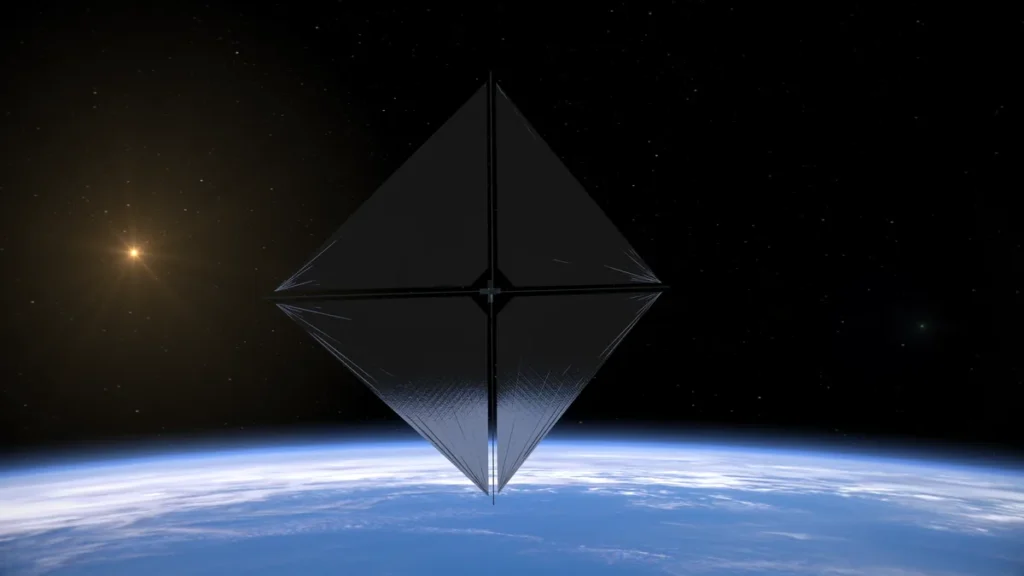
- A team from the Rochester Institute of Technology has proposed an ultrathin solar sail made with liquid crystals that can push a spacecraft sideways without turning the sail away from the Sun.
- The design appears as a preprint on arXiv and has not been peer-reviewed, so it currently exists only as computer simulations.
- Ordinary solar sails act like giant mirrors and must tilt toward or away from the Sun to create sideways thrust, which cuts the light hitting the sail and makes steering harder.
- The new sail redirects incoming photons at steep angles, so the sail gets pushed the other way, and the craft steers by rolling around its Sun-facing axis.
A team from the Rochester Institute of Technology has proposed an ultrathin solar sail made with liquid crystals that can push a spacecraft sideways without turning the sail away from the Sun, according to research reported on Nov. 24, 2026.
Conventional solar sails act like giant mirrors. To create sideways thrust, operators must tilt the sail toward or away from the Sun. That tilting cuts the sunlight hitting the sail and makes steering harder, much like angling an umbrella in a strong wind, as Around Prague describes it. The new approach avoids tilting by redirecting light instead.
The new sail redirects incoming photons at steep angles, so the sail gets pushed the other way. A spacecraft steers by rolling around its Sun-facing axis while the sail stays pointed head-on at the Sun. Photons carry momentum despite having no mass, and they exert a small pressure when they bounce off a surface. The rolling motion lets the craft change direction without sacrificing the amount of sunlight captured.
A large, lightweight sail can harness this photon pressure to gradually accelerate a spacecraft without carrying propellant. With no friction in space, the craft can keep accelerating over time as long as sunlight reaches the sail. ZME Science contrasts this with conventional rockets, which require propellant.
Liquid crystal molecules form microscopic spiral patterns that act as diffraction gratings, bending light by twisting its polarization through the Pancharatnam phase, a polarization-based light-bending effect. The microscopic spirals are the key to bending light without moving the sail. One liquid crystal layer by itself redirects only a narrow band of wavelengths. Most sunlight would pass through such a single layer without providing thrust.
Using simulations and an optimization algorithm, the team formed a three-layer liquid crystal stack. The stack measures 5.5 micrometers thick, roughly one-tenth of a human hair. It captures visible light and two infrared bands. The thin profile suits a flexible, lightweight plastic that can be packed into a small spacecraft, and the layers work together to broaden the range of sunlight the sail can use.
Because the material works with just one polarization state of sunlight, the researchers propose two complementary three-layer films. They predict the paired films could turn 51.2 percent of incoming sunlight momentum into sideways thrust. ZME Science gives the 51.2 percent figure as a prediction for the combined complementary films. The two films are meant to work together because each responds to only one polarization state.
The design exists only as a theoretical concept. The team has not built a prototype or tested whether the material could survive launch and the space particle environment. The work appears as a preprint on arXiv and has not been peer-reviewed, so it currently exists only as computer simulations. No flight or prototype test of the idea has been announced.
The new concept builds on NASA Innovative Advanced Concepts research into diffractive sails for reaching orbits over the Sun’s poles. Grover Swartzlander Jr., an RIT professor and paper author, came up with the idea roughly ten years ago with program backing. He expanded on work started in 2017 to 2018 by Swartzlander with Amber Dubill at Johns Hopkins Applied Physics Laboratory. NextBigFuture reports that the foundational project ran Phase I in 2018, Phase II from 2019 to 2021, and Phase III from 2022 with $2M.
Earlier diffractive sail models used patterns etched into metal-coated films. Those designs proved difficult to scale and package inside a rocket fairing. Lab tests have checked prototype gratings, but no space demonstration has flown yet. NASA is funding progress toward one, and key hurdles include grating durability, broadband efficiency and attitude control.
The work remains at the laboratory stage.

A separate 2025 NIAC Phase I study led by Marco Caporicci, formerly of the European Space Agency, won $175,000 to study a ribbon solar sail. The ribbon design cancels normal light pressure forces so thrust runs along the ribbon when tilted toward sunlight. It removes the need for support structures and allows roll-up or zigzag stowage, and the design scales by extending ribbon length. The concept is useful for solar polar observatories, debris tugs, planetary defense and interplanetary transport.
Solar sailing has a flight record. Japan’s IKAROS spacecraft became the first successful interplanetary solar sailing demonstration in 2010. LightSail 2, run by the Planetary Society, altered its Earth orbit using only sunlight in 2019. NASA opened an 80-square-meter solar sail in 2024 using a new lightweight deployment system, making the sail about half a tennis court in size.
NASA’s Advanced Composite Solar Sail System launched in April 2024 and deployed its sail in August 2024. The mission showed boom technology that might work with diffractive sails. Universe Today says multiple proof-of-concept flights in the last ten years have demonstrated that solar sailing works. A 2025 study described a precursor mission using a small satellite carrying a 400-square-meter solar sail.
Scientists have long suggested placing a giant sheet at the Sun-Earth L1 Lagrange point to block sunlight and cool the planet. The L1 point sits about 1.5 million kilometers, or 930,000 miles, from Earth. At L1, a spacecraft can orbit the Sun at Earth’s pace and remain stationary from the ground. The James Webb Space Telescope is at L2 on the opposite side.
Sunshades would have to adjust their paths regularly, and tilting a conventional sail would cut its shading area. A conventional shade would shrink its shadow when tilting to hold position. A diffractive shade could stay Sun-facing without losing size while holding position. The new sail could therefore simplify navigation for solar-powered spacecraft and might help build giant sunshades to fight global warming.
Changing or removing individual liquid crystal layers could let wavelengths useful for photosynthesis or solar electricity reach Earth while sending other wavelengths away. Removing the middle layer would let near-infrared light for solar panels pass through. Layers could be tuned to pass red light for plants while the rest still pushes the sail.
A planetary sunshade would bring enormous manufacturing, logistical, environmental and money problems and would not remove carbon dioxide from the air. The broader solar sail work remains an emerging concept rather than an operational mission.
The team received technical advice from BEAM Engineering and from diffractive sail experts at Johns Hopkins Applied Physics Laboratory. Around Prague, reporting Universe Today, describes the concept as very early-stage and expects a space test will happen eventually. ZME Science says the sail remains a theoretical design for now.


Join the discussion