Key facts
- Astronomers using the NSF’s Karl G. Jansky Very Large Array (VLA) and ALMA detected atmospheric disturbances in Betelgeuse linked to its companion star, Siwarha, between 2021 and 2026.
- Siwarha’s gravitational influence creates an egg-shaped distortion in Betelgeuse’s atmosphere, detectable through radio observations at multiple frequencies.
- Siwarha’s orbit may eventually lead to its engulfment by Betelgeuse, altering the supernova’s expected type from a hydrogen-rich Type II to a hydrogen-depleted Type Ib or Ic.
- Betelgeuse’s atmosphere, previously disturbed by a 2019 shock wave and dust ejection, has largely recovered, with temperatures near its surface now stabilizing at around 3,500 Kelvin.
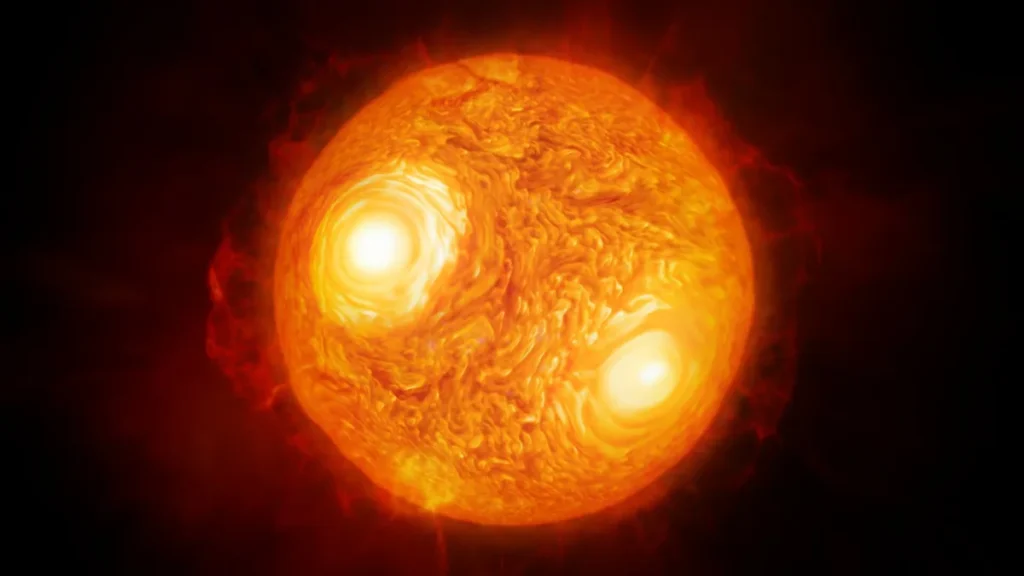
Astronomers using the NSF’s Karl G. Jansky Very Large Array together with ALMA detected atmospheric disturbances around Betelgeuse linked to its companion star Siwarha from 2021 through 2026.
Dr. Lynn D. Matthews of MIT Haystack Observatory led the research. The study combined observations at seven radio frequencies from 22 GHz to 485 GHz. Colleagues from the Center for Astrophysics | Harvard & Smithsonian, the University of Manchester, and the European Southern Observatory completed the four-author team. Their paper, “New Spatially Resolved Observations of Betelgeuse from the VLA and ALMA: Evidence for Atmospheric Perturbations from a Close Companion,” appeared in The Astronomical Journal under DOI 10.3847/1538-3881/ae953d.
Siwarha orbits at only 2.3 stellar radii from Betelgeuse’s center, deep inside the chromosphere, the star’s outer atmospheric layer, rather than at an external distance. Its gravitational influence creates an egg-shaped distortion in Betelgeuse’s atmosphere, detectable through radio observations at several frequencies. The star’s radio-emitting layers become more elongated when Siwarha is at maximum separation and rounder when the companion passes in front of or behind the star. “This companion is orbiting so close to the star that it actually passes through its extended atmosphere,” Matthews said.
Betelgeuse lies roughly 550 light-years from Earth in Orion and is about 16.5 to 19 times as massive as the Sun. The star is about 100,000 times as bright and ten million years old. It pulses on a roughly 400-day cycle, while a second, poorly understood cycle repeats about every 2,100 days. Its atmosphere, previously disturbed by a 2019 shock wave and dust ejection, has largely recovered, with temperatures near its surface stabilizing around 3,500 kelvin.
A cooler temperature minimum layer drops to roughly 2,200 kelvin, more than 1,000 degrees cooler than Betelgeuse’s photosphere, coinciding with the MOLsphere of molecular gas. ALMA’s highest-frequency observations revealed this cool layer between the visible surface and chromosphere. The 2019 disturbance was linked to the Great Dimming in late 2019 and early 2020, when Betelgeuse became the faintest in more than a century of record-keeping and ejected about a billion tons of solar material.
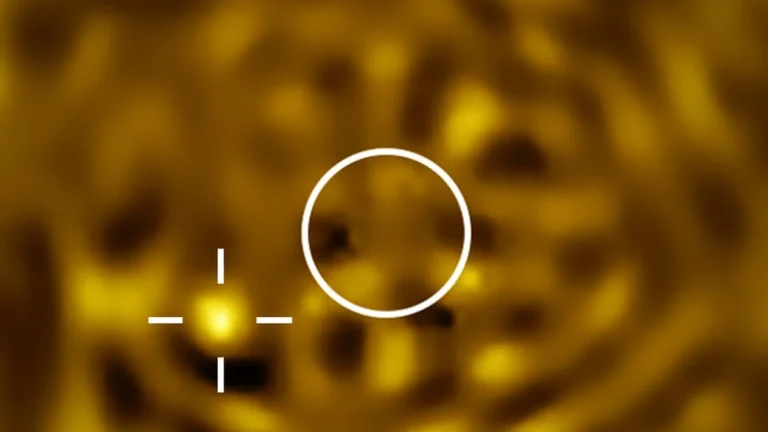
Radio interferometry probes stellar atmospheres layer by layer, unlike optical telescopes that integrate line-of-sight emission. Siwarha is likely tens to hundreds of times too faint to detect directly at radio wavelengths, so astronomers inferred the companion from subtle changes in Betelgeuse’s radio-emitting shape. Siwarha currently sits on the far side of Betelgeuse from Earth, and even the Very Large Telescope cannot detect it. If Siwarha appears on the opposite side of the star from its December 2024 detection, displaced as its orbital period predicts, astronomers will consider its existence definitively established.
The next observable window is expected in late 2027.
Astronomers first suspected Betelgeuse had a companion as early as 1908 based on irregular changes in velocity and brightness. The longer brightness cycle lasts around 2,110 days and matches a long secondary period. Siwarha was first proposed in 2024 to explain Betelgeuse’s 2,100-day brightness cycle. In December 2024, Montargès’s team at the Observatoire de Paris confirmed the companion’s orbital position and mass using ESO’s Very Large Telescope SPHERE instrument, estimating 2.6 to 3.1 solar masses and an orbital period of roughly 2,100 days.
A July 2026 optical detection by Montargès used the same VLT SPHERE instrument and achieved a detection significance of 6.1 sigma, placing Siwarha roughly 52 milliarcseconds from Betelgeuse’s center. The findings describing the companion were published in Astronomy and Astrophysics on July 28. Montargès describes himself as very conservative about the results and keeps calling Siwarha a candidate, while Andrea Dupree says the companion is really there.
Siwarha means “her bracelet” in Arabic, a name that complements Betelgeuse’s translation as “the hand of al-Jawza” and reflects the stars’ close orbital relationship. Researchers proposed the name in 2025, and informally the companion is also called Betelbuddy or Betelgeuse B. A different research team reported a faint image of a possible Betelgeuse companion in 2025, but the data were inconclusive.
Andrea K. Dupree of the Center for Astrophysics | Harvard & Smithsonian leads the Months of Betelgeuse program, a multi-year, multiwavelength monitoring effort involving more than 20 researchers worldwide. The program tracks Betelgeuse’s atmosphere and binary interactions across radio, ultraviolet, and X-ray wavelengths. In January 2026, Dupree and colleagues published a spectroscopic study in The Astrophysical Journal tying Siwarha’s transits to added manganese absorption in optical wavelengths and to stronger mass outflow seen in ultraviolet light from iron, silicon, and magnesium.
Dupree described the companion’s effect as a ripple effect in Betelgeuse’s atmosphere visible in the data, like a boat moving through water and creating a wake. Dent et al. published a 2026 ALMA study in Astronomy & Astrophysics using the longest baseline configuration to image Betelgeuse’s submillimeter photosphere at wavelengths between 0.6 and 1.4 millimeters with resolutions as fine as seven milliarcseconds. Dent’s team found two hot patches northeast and southwest of the photosphere persisting since 2015, with the brightest showing a temperature enhancement of roughly 800 kelvin above surrounding emission.
Hubble and Chandra failed to detect Siwarha because their observations could not overcome Betelgeuse’s glare. Steve Howell, a senior scientist at NASA’s Ames Research Center, directly observed Siwarha for the first time using the ‘Alopeke speckle imaging system on the Gemini North telescope in Hawai’i. “This detection was at the very extremes of what can be accomplished,” Howell explained.
Siwarha’s orbit is aligned with Betelgeuse’s spin axis, suggesting strong tidal interactions that may accelerate the red supergiant’s rotation. Theory of binary stellar evolution predicts that tidal forces progressively extract angular momentum from the orbit, which causes the separation between the two stars to shrink over time. Siwarha may eventually spiral inward and be engulfed by Betelgeuse, altering the supernova’s expected type from a hydrogen-rich Type II to a hydrogen-depleted Type Ib or Ic.
Future observatories like the Next Generation Very Large Array will enable routine studies of red supergiant companions, refining models of their evolution and material shedding. The ngVLA’s development will enhance radio interferometry’s ability to resolve stellar companions embedded in supergiant atmospheres.

Join the discussion