Key facts
- A study using the NSF VLA and ALMA found that Betelgeuse's extended atmosphere is being actively perturbed by its close-in companion star, Siwarha.
- Siwarha orbits at about 2.3 stellar radii from Betelgeuse's center, embedded in the chromosphere throughout its roughly 2,000-day circuit rather than circling from outside.
- Brightness temperature near a radius of about 2.7 times the star's size has returned to roughly 3,500 kelvin, comparable to the photosphere, after radio measurements were unusually cool before the Great Dimming.
- The team inferred the companion from Betelgeuse's radio atmospheric ellipticity: the disk is more elongated near the companion's greatest apparent separation and rounder during front or back passage.
A team led by Dr. Lynn D. Matthews of MIT Haystack Observatory used the NSF VLA and ALMA from 2021 to 2026 to find that Betelgeuse’s close companion, Siwarha, is actively perturbing the red supergiant’s extended atmosphere.
The study came out in The Astronomical Journal in 2026 with DOI 10.3847/1538-3881/ae953d. The authors include Matthews from MIT Haystack Observatory. Dupree works at the Center for Astrophysics, which is part of Harvard and Smithsonian. Richards is with the Jodrell Bank Centre for Astrophysics at Manchester, and Dent is from ESO/ALMA.
The team observed at seven radio frequencies spanning 22 GHz to 485 GHz. At 22 GHz, corresponding to 1.36 centimeters, the emission comes from ionized gas in the outermost chromosphere, where it is optically thick roughly four to six stellar radii from Betelgeuse’s center. Higher frequencies reach deeper, hotter gas closer to the star. Together they build a vertical profile starting just above the visible surface and extending out several stellar radii.
Standard optical pictures lack that depth resolution because visible light combines emission from the entire gas column along the viewing path instead of isolating a single atmospheric layer. Radio wavelengths therefore caught disturbances that optical surveys missed.
The companion sits roughly 2.3 stellar radii from the star’s center. It moves through the chromosphere throughout its roughly 2,000-day circuit rather than circling from outside. Being at that depth means the companion travels through stellar plasma directly, rather than disturbing the atmosphere from a distance.
Researchers proposed the companion in 2024 to account for Betelgeuse’s 2,100-day brightness cycle. Its name means “her bracelet.” Researchers estimate the companion is tens to hundreds of times fainter than radio instruments can detect directly. Researchers inferred it from Betelgeuse’s radio atmospheric ellipticity: the disk looks more elongated when the companion is at its greatest apparent separation and rounder during front or back passage.
“This companion is orbiting so close to the star that it actually passes through its extended atmosphere.” Matthews said.
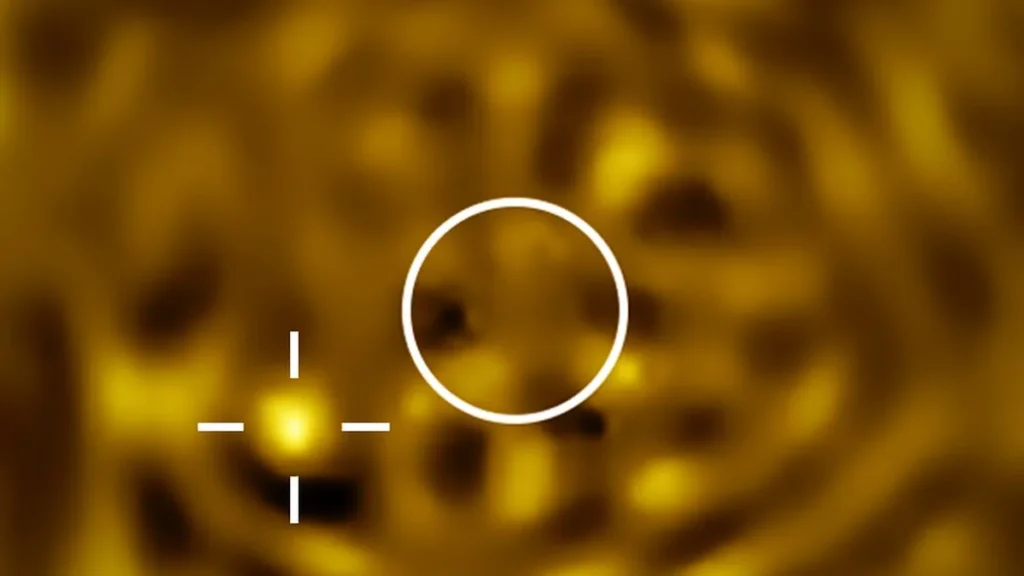
ESO’s VLT/SPHERE captured a direct image of Betelgeuse B in December 2024. The companion lay roughly 52 milliarcseconds from the center at 6.1-sigma significance. The Observatoire de Paris – PSL researcher Montargès led the team, which estimated the companion’s mass between 2.6 and 3.1 solar masses. The work came out on July 28, 2026 in Astronomy & Astrophysics.
“I jumped from my chair when I saw the processed images.” Montargès said.
Older estimates placed the companion near the Sun’s mass. The new VLT data indicate Betelgeuse B is roughly two to three times the Sun’s mass. This qualifies as direct imaging because SPHERE on ESO’s VLT detected the companion’s own light. Earlier clues, including a possible Gemini North sighting in Hawaii, were weaker.
Today the companion lies behind Betelgeuse from Earth’s viewpoint and cannot be separated even using the VLT. A viewing opportunity at maximum separation should arrive in late 2027, when Montargès’s group plans another VLT look.
The seven-frequency portrait came from the “Months of Betelgeuse” program.
The 2026 Dent et al. study used ALMA’s most extended baseline. That setup resolved details down to about 7 milliarcseconds. It also captured Betelgeuse’s submillimeter photosphere (the layer visible at submillimeter wavelengths, between radio and infrared). The wavelengths ran from 0.6 to 1.4 millimeters.
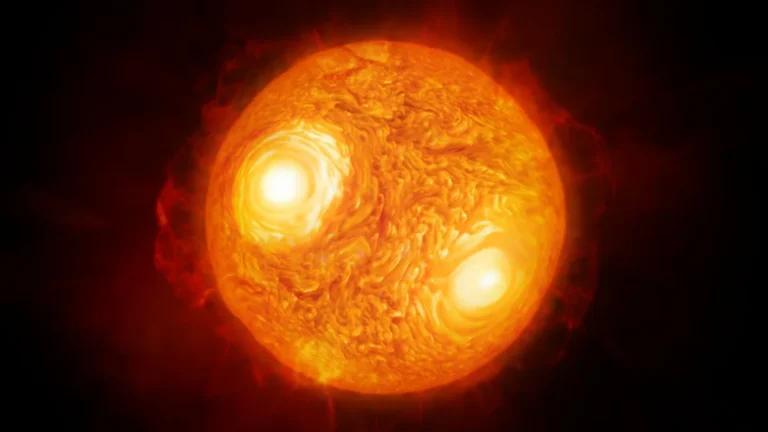
Those maps showed Betelgeuse’s submillimeter photosphere is optically thick. The thick region spans 1.1 to 1.3 stellar radii. The temperature runs about 2,300 kelvin, and two brighter patches appear toward the northeast and southwest.
The brightest hot region sat 800 kelvin above its surroundings. It stayed in roughly the same spot since a 2015 ALMA observation, a persistence of more than 10 years that current convection models struggle to explain. Dent et al. found radius changes reaching 6 percent in the submillimeter photosphere. The team also detected fainter emission at roughly 2.5 stellar radii, close to the companion’s orbital distance.
The Matthews et al. results indicate departures from that structure tied to Siwarha. Meanwhile, the Dent et al. work lays out the basic atmospheric baseline. The Matthews et al. radio maps uncovered asymmetries and structural deviations. Those features do not fit convection or pulsation by themselves, and they line up with the companion’s predicted orbital phase.
The seven-frequency set produces a depth-resolved, three-dimensional view of Betelgeuse’s atmosphere. That view has no match before for red supergiants.
Betelgeuse’s atmosphere has largely recovered from the Great Dimming. The star reached its faintest point during late 2019 and early 2020, after more than a century of record-keeping. Brightness temperature at about 2.7 times the star’s radius is back to roughly 3,500 kelvin, matching the photosphere. Radio measurements had been unusually cool before the Great Dimming.
The team confirmed a temperature minimum from the visible surface to the chromosphere. Gas there fell to roughly 2,200 kelvin. That is more than 1,000 degrees below the photosphere, coinciding with the molecular-gas MOLsphere above the photosphere. ALMA’s highest frequencies reached closer to the star’s surface than ever before.
Matthews’s team proposed the idea before the Great Dimming in 2019. The group said a convection-triggered shock wave disturbed Betelgeuse’s outer gas. That set the stage for a dust-forming outburst ejecting about a billion tons of material from the star. That ejection partly blocked the star’s view and came before the dramatic fading in late 2019 and early 2020.
A January 2026 spectroscopy paper by Dupree and coauthors in The Astrophysical Journal reported that manganese absorption in optical light rises after Siwarha passes in front of Betelgeuse. Iron, silicon, and magnesium outflow in ultraviolet light rises and falls with the crossings, fitting an expanding gas wake left behind the companion.
Theory says tidal forces in a close binary steadily pull angular momentum from the orbit. That makes the separation shrink over time. It is unclear whether the star’s core will swallow the companion before the supernova or the companion will escape as a runaway star after the blast. The relevant timescales are not well known.
Models say that if the companion falls into the star before core collapse, it could remove the hydrogen-rich outer layers. The blast could shift from the usual Type II supernova to a hydrogen-poor Type Ib or Ic explosion, changing the spectrum, light curve, energy output, and leftover remnant. Models based on a single star governed death predictions over a century. Those models are now inadequate because they assumed isolation.
EarthSky says astronomers should study how the companion may affect the star’s expected supernova. This follows the detection of Betelgeuse B.
The star sits in Orion’s shoulder at roughly 500 to 700 light-years, or about 1,600 to 2,300 trillion miles. To the unaided eye it appears as a steady orange-red point, hiding the activity inside.
Astronomers have suspected a companion for Betelgeuse for more than a century. Two 2024 studies predicted it would be farthest from Betelgeuse and easiest to see in December 2024. Montargès and his team used ESO’s VLT to observe Betelgeuse in December 2024 after those predictions. They then spent several months processing the data.
Montargès led researchers who used ESO’s VLT to study the dimming. They determined that a dust cloud, not an impending blast, blocked the star’s light.
Join the discussion