Key facts
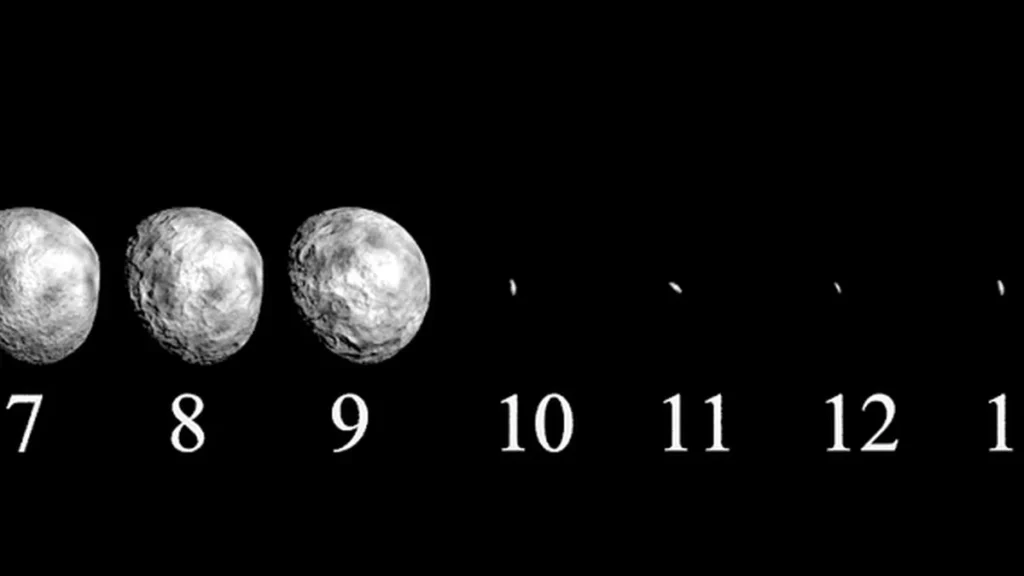
- PSI’s model shows that most asteroid debris mass remains in fragments approximately 0.1 to 1 kilometer in size after tidal disruption near white dwarfs.
- Previous models of asteroid disruption near white dwarfs assumed objects behaved like loosely bound rubble with no internal strength, allowing them to break into progressively smaller pieces.
- Similar tidal fragmentation processes have been observed in our solar system, such as the breakup of Comet Shoemaker-Levy 9 near Jupiter in 1992, producing fragments of ~100–1,000 meters.
- The study was published in The Astrophysical Journal Letters under the title 'Size Limits on Tidal Debris around White Dwarfs: The Kilometer-size Barrier.'.
Planetary Science Institute researchers found that asteroids passing close to white dwarfs break into larger fragments instead of crumbling directly into dust, according to research presented Oct. 29, 2026, at the American Astronomical Society’s Division for Planetary Sciences annual meeting and published in 2026 in The Astrophysical Journal Letters.
The research identifies an overlooked stage in debris formation around dead stars. Rather than crumbling into dust immediately, an asteroid undergoing tidal disruption near a white dwarf leaves most of its mass in pieces roughly 0.1 to 1 kilometer across, or 0.06 to 0.6 miles. The scientists call this limit the kilometer-size barrier, and it explains why so much debris remains in larger fragments instead of turning into dust right away.
Earlier models assumed asteroids were loosely bound rubble with no internal strength, so tidal forces were expected to crush them into progressively smaller fragments until they became dust. Those older calculations ignored the way rubble-pile asteroids stay bound through van der Waals forces between grains. The Planetary Science Institute’s model instead includes that minimum strength, giving the asteroid enough integrity to resist complete pulverization.
Steckloff said these internal forces stop asteroids from shattering into fragments right away, underscoring a role for structural strength that earlier tidal disruption models missed.
The resulting fragments are too large to be moved by Poynting-Robertson drag, the process in which radiation from a star causes particles to spiral inward. Because radiation does not efficiently nudge objects of this size, the pieces persist in orbit longer than dust would. Turning them into fine dust would require other processes, such as collisions or rotational breakup, rather than radiation alone.
The fragments also keep nearly identical orbits after breaking apart, so debris around white dwarfs may stay more concentrated than earlier calculations assumed. It also means observers may need to revise expectations for how debris spreads around these systems.
A comparable event occurred in our own solar system when Comet Shoemaker-Levy 9 broke apart near Jupiter in 1992. The tidal fragmentation produced pieces roughly 100 to 1,000 meters across, or 330 to 3,300 feet, and those large fragments later collided with the planet. The episode offers a solar-system comparison for how asteroids break apart near white dwarfs, demonstrating that tidal forces can leave sizable chunks behind instead of creating dust immediately.
The study appeared under the title “Size Limits on Tidal Debris around White Dwarfs: The Kilometer-size Barrier” in The Astrophysical Journal Letters. Its authors are Jordan Steckloff and Kat Volk, senior scientists at the Planetary Science Institute, and Dimitri Veras of the University of Warwick. NASA funded the work through grant 80NSSC20K0267, supporting the research conducted by the institute’s scientists.
Kat Volk said knowing how debris forms and changes around white dwarfs is essential for reading observations and studying what happens to small bodies around stars in their final phases. She emphasized that the research connects observational data with theoretical models to better understand planetary systems as stars die.
White dwarfs are the dense leftover cores of stars that have run out of nuclear fuel, and they are frequently surrounded by disks of planetary debris, including dust from asteroids pulled apart by the star’s gravity. Previous models assumed these objects behaved like loose rubble with no internal strength, leading to predictions that tidal forces would turn them into dust right away. The new work replaces that assumption with a model that recognizes the structural integrity of rubble-pile asteroids.
By identifying an overlooked stage in asteroid disruption, the findings could reshape how astronomers read observations of dead stars and what those observations say about the ultimate fate of planetary systems like our own. The results also suggest that debris around these stars may remain more localized than earlier models predicted.
Jordan Steckloff presented the research at a press conference on Oct. 29, 2026, at 11:45 a.m. PDT as part of the Division for Planetary Sciences annual meeting. The session was available through livestream or in-person registration, allowing a broad audience to hear the details directly from the research team.

Join the discussion