Key facts
- Engineers completed Voyager 1's "Big Bang" power-saving effort in early September by turning off three devices and substituting them with three lower-power alternatives simultaneously.
- The Big Bang was unique because all three swaps had to happen at once; the six devices help keep the spacecraft warm, so changing all three reduced power use while keeping heat properly distributed.
- NASA reports that shrinking power has made the Voyager team switch off two science instruments over recent years.
- Voyager 1's signal reappeared on Oct. 20 after the 48-hour communication loss, and controllers have maintained contact with the spacecraft since then.
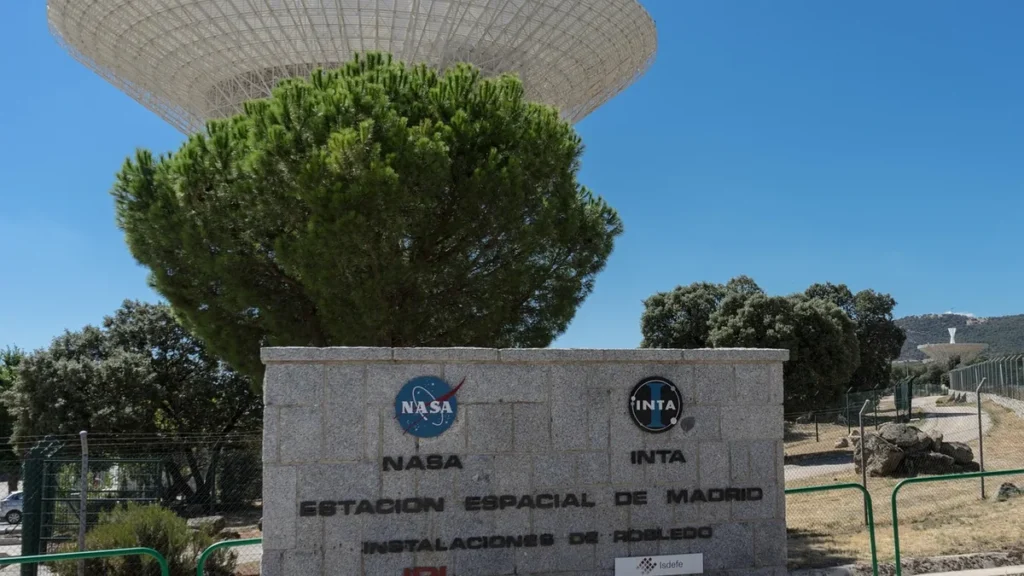
NASA’s Deep Space Network, the agency’s array of antennas for communicating with distant spacecraft, could not detect a radio signal from Voyager 1 during two scheduled communications attempts 24 hours apart on Oct. 18 and Oct. 19, when the spacecraft was 16 billion miles (24 billion kilometers) from Earth. Voyager 1’s signal reappeared on Oct. 20 after the 48-hour communication loss, and controllers have maintained contact with the spacecraft since then.
Engineers found that one set of Voyager 1’s thrusters—small rockets used to adjust a spacecraft’s orientation or trajectory—went offline while backup thrusters turned on automatically when spacecraft computers detected a problem with the active thrusters. The anomaly took place as Voyager 1 traveled through interstellar space more than 24 billion kilometers from Earth, beyond the edge of the Sun’s influence. Kareem Badaruddin, Voyager mission manager at NASA’s Jet Propulsion Laboratory, said this is the first time the team has seen the spacecraft do something like this, but they must expect the unexpected at this point in the mission, and he added that the team feels relieved to be back in contact with Voyager 1 and eager to understand what happened. “This is the first time we’ve seen the spacecraft do something like this,” Badaruddin said.
In early September, engineers completed Voyager 1’s “Big Bang” power-saving effort by turning off three devices and substituting them with three lower-power alternatives simultaneously. The swap was unique because all three changes had to happen at once. The six devices help keep the spacecraft warm, so changing all three reduced power use while keeping heat properly distributed. NASA described the effort as a months-long campaign to stretch the spacecraft’s diminishing power supply so remaining science instruments can operate longer; engineers finished the swap about six weeks after engineers did the same work on Voyager 2, and NASA says it will let Voyager 1’s remaining science instruments work longer than anticipated.
Both Voyager probes lose about 4 watts of power every year as their radioisotope thermoelectric generators convert heat from decaying plutonium into electricity and the plutonium supply continually depletes. A radioisotope thermoelectric generator is a power source that turns heat from radioactive decay into electricity, using plutonium, a radioactive element whose supply is continually depleted. The Voyager mission launched in 1977 with 10 dedicated science instruments, and some were turned off after the spacecraft’s planetary encounters. NASA reports that shrinking power has made the Voyager team switch off two science instruments over recent years.
Without the Big Bang power-saving swap, Voyager 1 would have needed to turn off another science instrument as early as summer 2027. Specialists at the Jet Propulsion Laboratory transmitted a command on April 17 directing Voyager 1 to shut down its Low-Energy Charged Particles instrument to conserve dwindling electrical power. Engineers designed the Low-Energy Charged Particles instrument to measure low-energy charged particles such as ions, electrons and cosmic rays, helping scientists map the boundary between the solar system and the wider galaxy. With the LECP shutdown, seven instruments on Voyager 1 are now retired.

Each Voyager probe originally carried 10 instruments, though not all were identical. Engineers powered down Voyager 2’s Low-Energy Charged Particles instrument in March 2025 as part of the same power conservation strategy. Engineers took a similar step with Voyager 2 as part of the long-term power-down strategy engineers and scientists mapped out years ago.
According to NASA engineers, careful power management could let the Voyagers keep operating into the early 2030s before the spacecraft likely fall silent. Voyager 1 is traveling at 38,000 mph (61,155 kph) toward a milestone on Nov. 18, when it will be 16.09 billion miles (25.89 billion kilometers) from Earth, equal to one light-day, the distance light travels in a day. The spacecraft will not detect any change in its environment when it passes one light-day, and nothing will change aboard the spacecraft. Both Voyager spacecraft continue to send valuable data back to Earth, though signals require more than 22 hours to travel each direction because of the immense distance.

Join the discussion