Key facts
- Tests showed the prototype could capture and direct rocket exhaust through vents built into the pad, the research team reported.
- Dr. Judy Schneider said Earth's water-cooled flame buckets will not work on the Moon because water is in limited supply, so the team aims to redirect the rocket plume away from landing vehicles and nearby structures.
- The tested prototype measured 12 feet (3.7 meters) across, assembled from individual concrete components, with sensors built in to record flow through the vent system during the three rocket-motor firings.
- NASA says crewed lunar landings will begin in 2028, with Artemis III in 2027 and future uncrewed demonstrations near the Moon helping improve astronaut safety and reduce risk.
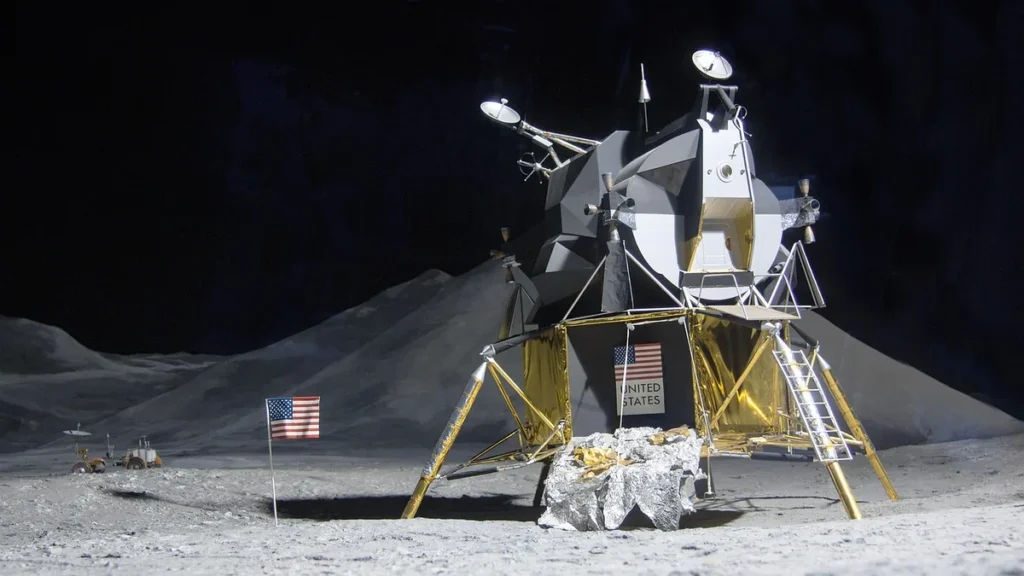
University of Alabama in Huntsville students and researchers ran three rocket-motor tests this summer on a prototype lunar landing pad at the campus propulsion center, seeking safe landings that do not damage vehicles or nearby infrastructure.
The Moon has no readily available atmosphere, so exhaust plumes expand freely and strike the surface directly, while landing blasts can hurl dust and debris at speed, potentially harming spacecraft, equipment and nearby habitats. Controlling plume and blast hazards will become more important as lunar missions grow longer and infrastructure becomes permanent. The report notes that the hazard grows as lunar missions move toward longer stays and permanent infrastructure, making blast protection increasingly important.
Dr. Judy Schneider, a professor in the University of Alabama in Huntsville’s engineering department, leads the student team in a multiyear partnership with Linc Research Inc., which the report describes as a certified HUBZone company (a federal program for small businesses in historically underutilized business zones). Earth launch infrastructure uses water-cooled flame buckets to redirect rocket exhaust, but water is in limited supply on the Moon. Schneider said the team aims to redirect the rocket plume away from landing vehicles and nearby structures instead. “On Earth, we use water-cooled flame buckets to redirect rocket exhaust,” Schneider explains.
The team’s design is an interlocking landing pad with integrated vents that guide rocket exhaust away from the landing pad, channeling exhaust through the pad to limit thermal damage instead of relying on a solid structure. The tested prototype measured 12 feet (3.7 meters) across, assembled from individual concrete components, with sensors built in to record flow through the vent system during the three rocket-motor firings. Schneider said the hot-fire tests showed the internally vented structure prevented the heat damage that could occur in a solid structure.
Tests showed the prototype could capture and direct rocket exhaust through vents built into the pad, the research team reported. The same report describes the result as a step forward for landing infrastructure meant to support future moon bases. The report says the research focuses on a modular, vented landing pad meant to shield spacecraft and nearby structures from landing heat and force.
Researchers are studying how to convert lunar regolith (moon soil) into durable construction materials using melting and sintering, so a modular pad built from local materials could simplify assembly, expansion, maintenance and repair. Transporting construction materials from Earth to the moon is costly and logistically challenging. The report calls the cost and difficulty of hauling Earth-built materials to the Moon the reason a modular pad built from lunar regolith is central to the project’s long-term vision. The concrete tested in the prototype serves as an Earth-based stand-in for future lunar-produced materials.
The team’s next major milestone is to build a landing pad 20 feet (6.1 meters) across for delivery to the NASA Marshall center in Huntsville for testing and evaluation. The larger prototype will help assess performance and advance the technology toward future lunar missions, with continued testing to determine how the vented modular approach scales for repeated landings. Huntsville is also home to NASA’s Marshall Space Flight Center, which manages the Human Landing System Program.
NASA says crewed lunar landings will begin in 2028, with Artemis III in 2027 and future uncrewed demonstrations near the Moon. In a July 23, 2026 NASA release, the agency describes Artemis III as an orbital rehearsal in which Orion astronauts will dock separately with prototype lunar landers from Blue Origin and SpaceX, letting crews and ground teams practice complex maneuvers before crewed landings begin in 2028. Before Artemis III, NASA will verify that both lander test articles are ready and safe to approach with a crewed Orion spacecraft.
Steve Creech, who manages the Human Landing System Program at NASA’s Marshall center in Huntsville, Alabama, said the companies offered aggressive objectives to complement uncrewed lunar demonstrations and build confidence before crewed landings. “Each human landing system provider has taken a different approach to the Artemis III mission,” Creech said. Both companies will fly test articles of their human landing systems on Artemis III to build understanding and confidence before crewed landings.
NASA says SpaceX plans to fly Starship Version 3 as the basis for its future Starship human landing system, while Blue Origin intends to test its crew cabin. Blue Origin’s Blue Moon test lander will be based on its Mark 2 crew lander architecture for the Artemis III demonstration, and its test lander is expected to launch first and remain in orbit for as long as 30 days.
The student team includes Cadis Ammons, completing a master of science in mechanical engineering, and undergraduates Isaac Menzel and Matthew Allmon in mechanical engineering and Andrew Angelucci in civil engineering. Dr. Judy Schneider said the team gives student researchers valuable hands-on experience with aerospace engineering challenges. The report describes hands-on student work as crucial. Team members learn how to run experimental tests, manage engineering design tasks, and solve the hands-on problems of building hardware for tough space settings.
The University of Alabama in Huntsville is part of The University of Alabama System. NASA’s Marshall Space Flight Center is in Huntsville, Alabama, the same city as the university, and the UAH team plans to deliver its larger 20-foot pad there for testing; NASA’s Human Landing System Program manager Steve Creech works at that same center. The planned 20-foot prototype will go to NASA’s Marshall center for testing and to assess how the vented modular design scales for pads supporting repeated landings over time.



Join the discussion