Key facts
- NASA researchers uncovered compelling evidence of an ancient ice reservoir in the Kuiper Belt beyond Neptune by studying microscopic space dust collected from Earth's upper atmosphere.
- Scientists used abundant solar energetic particle tracks in the dust to connect the grains to the Kuiper Belt.
- Researchers found minerals formed through water-dust interactions long ago in the solar system.
- Chemical signatures in the minerals show the ancient water contained elevated levels of heavier oxygen isotopes.
NASA researchers based at the Johnson Space Center in Houston found compelling evidence of an ancient ice reservoir in the Kuiper Belt, the region beyond Neptune, by examining microscopic space dust from Earth’s upper atmosphere.
The discovery adds insight into how material was distributed in the early solar system and how planets formed. Researchers have long suspected that the outer solar system holds ice with high concentrations of heavier oxygen isotopes, a suspicion dating back decades.
Previous studies of meteorites and carbon-rich asteroid samples yielded hints about outer-solar-system ice without supplying definitive proof, but the evidence stayed limited.
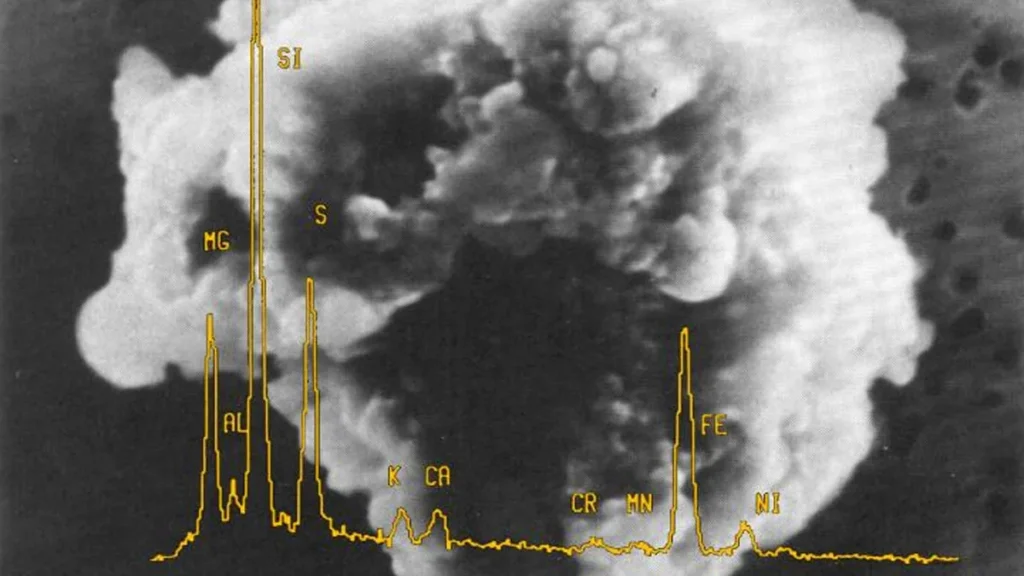
A research team at the Johnson Space Center in Houston studied 12 dust particles from Earth’s stratosphere with the ER-2 high-altitude research plane. The ER-2 aircraft collected the microscopic dust particles from Earth’s stratosphere, part of the planet’s upper atmosphere.
Researchers studied the particles’ minerals and oxygen isotopic compositions alongside University of California, Los Angeles colleagues. Isotopic composition refers to the relative amounts of different isotope forms in a sample.
Researchers used the plentiful solar energetic particle tracks in the dust to link the grains to the Kuiper Belt. The tracks are trails left by high-energy particles from the Sun. A high concentration of the tracks acted as a signpost to the distant region beyond Neptune. This work builds on that long-standing hypothesis.
University of California, Los Angeles colleagues joined the team, which used advanced electron microscopy at NASA and an ion microprobe at UCLA to study the particles’ minerals and oxygen isotopes. NASA’s facilities provided the electron microscopy, while UCLA supplied the ion microprobe for isotopic analysis.
Electron microscopy images tiny structures using beams of electrons. Using both methods, researchers could study the mineral structures and oxygen signatures within each particle.
The team found minerals that formed through interactions between water and dust long ago in the solar system. These minerals supply chemical evidence of ancient water activity tied to the icy reservoir in the outer solar system.
Signatures in the minerals’ chemistry show that the ancient water held elevated levels of heavier oxygen isotopes. Heavier isotopes are forms of oxygen atoms with greater mass. That enrichment supports the view that outer solar system ice was rich in heavier oxygen.
The Genesis mission from NASA supplied measurements that serve as a reference point for comparing oxygen isotopes. Researchers compared the mineral signatures to that Genesis reference data, using it as a benchmark for the stratospheric dust analysis. The reference helps put the Kuiper Belt findings into a wider solar-system context.
Comparable signatures are rare in meteorites, a fact that points to giant planets likely having limited mixing between the outer and inner solar system. These isotope patterns rarely appear in meteorites. Researchers infer that giant planets restricted exchange between the inner solar system and the distant Kuiper Belt.


Join the discussion