Key facts
- The grains show solar energetic particle track densities roughly 100 times the level expected for asteroid belt or Jupiter-family comet dust, which the team links to a long drift from the Kuiper Belt beyond Neptune.
- The researchers propose that Saturn, and possibly Uranus and Neptune, isolated the heavy water reservoir by creating a pressure bump in the protoplanetary disk that blocked inward drift of outer particles.
- Chemical modeling indicated the water that altered the grains had an oxygen-18-to-oxygen-16 ratio roughly 15 percent higher than Earth's ocean-water standard, which the team calls a model-based upper-limit estimate.
- In this research "heavy water" refers to water made with heavier oxygen isotopes, oxygen-17 and oxygen-18, not deuterium-based heavy water used in nuclear reactors.
Researchers from NASA’s Johnson Space Center and UCLA published a paper in Science Advances in 2026 saying that twelve interplanetary dust grains point to a long-cut-off reservoir of water rich in oxygen-17 and oxygen-18 beyond Neptune, dating back to the Solar System’s formation.
Lindsay P. Keller of NASA’s Johnson Space Center, the lead author, and colleagues measured oxygen isotope ratios in the hydrated clays of the grains and rebuilt the original water chemistry of the parent Kuiper Belt objects. They measure 10 to 30 micrometers across, and high-altitude NASA aircraft gathered them from the stratosphere under the Cosmic Dust program, an airborne sampling effort based at Johnson Space Center since 1981.
The grains hold hydrated clays such as saponite and serpentine, minerals created when liquid water reacted with rock inside parent bodies that once contained liquid water warmed by radioactive decay or impacts. They also hold iron-nickel sulfides and roughly four times as much carbon as certain carbonaceous meteorites contain. Phys.org reports that the team studied the particles with electron microscopy and chemical analysis, concluding that the clays formed through low-temperature reactions between water and rock inside the parent bodies—work the authors describe as “showing that the amorphous silicates are highly reactive and readily hydrated at low temperatures.”
The team says “heavy water” here means water built from heavier oxygen isotopes—oxygen-17 and oxygen-18—not the deuterium-based heavy water of nuclear reactors. Phys.org reports that most oxygen is oxygen-16, with eight protons and eight neutrons, while the heavier forms carry eight protons and nine or 10 neutrons. Chemical modeling indicated that the water that altered the grains showed an oxygen-18-to-oxygen-16 ratio roughly 15 percent above Earth’s ocean-water standard, an estimate the team calls model-based and treats as an upper limit. Since the ancient water is gone, the hydrated clays preserved its oxygen isotope fingerprint.
Around 4.5 billion years ago, the researchers say, carbon monoxide self-shielding formed the heavy-water reservoir when ultraviolet sunlight split carbon monoxide near the Sun. Oxygen-16 was the most common isotope in the protoplanetary disk, so carbon monoxide built from it soaked up much of the ultraviolet light nearest the Sun, while wavelengths reaching the outer disk freed oxygen-17 and oxygen-18, which bonded with hydrogen. Then other ultraviolet wavelengths split heavier-isotope carbon monoxide in the outer disk, and the freed oxygen joined with hydrogen to form heavy water.
The researchers propose that Saturn—and possibly Uranus and Neptune—cut off the heavy water reservoir in the solar system’s first few million years, creating a pressure bump in the protoplanetary disk that stopped outer particles from drifting inward. Titled A primordial heavy water reservoir in the outer solar system, the paper draws on isotope measurements in the grains’ clays to argue that the reservoir stayed apart from inner planet material.
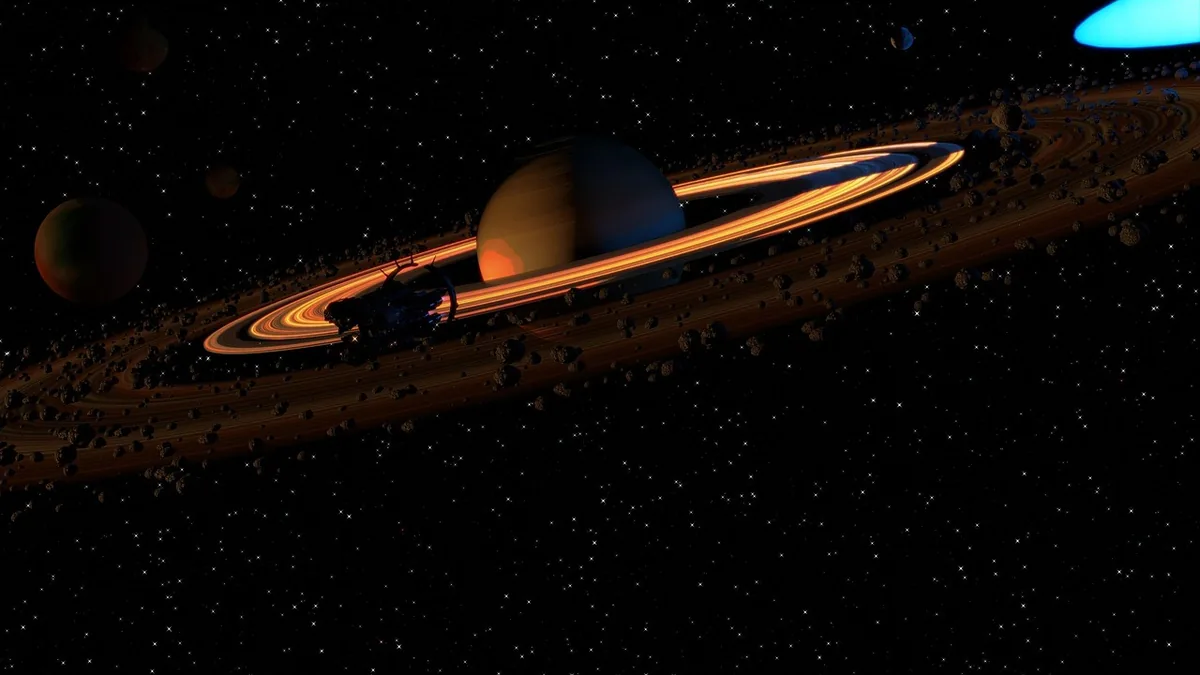
Around Prague describes the Kuiper Belt as icy objects beyond Neptune, located roughly 30 astronomical units from the Sun, about 30 times the Earth-Sun distance, and says its bodies count among the least altered remnants left from the Solar System’s formation 4.5 billion years ago. Phys.org says the objects are mostly ice—frozen water, methane and ammonia—mixed with rock and dust, unlike the asteroid belt’s rock and metal. The research team says the grains carry solar energetic particle track densities roughly 100 times the level expected for asteroid belt or Jupiter-family comet dust, which the team ties to a long journey from the Kuiper Belt past Neptune because grains from that region spend more time in interplanetary space, exposed to particles from solar flares.
NASA’s Cosmic Dust program has flown high-altitude aircraft out of Johnson Space Center since 1981, and Around Prague puts yearly cosmic dustfall on Earth at 5,200 metric tons, citing ScienceAlert. With few spacecraft having reached the Kuiper Belt and landing a probe or bringing back samples out of reach, stratospheric dust is one of the few direct ways to study these distant icy bodies. The team says the Rosetta and Stardust missions lost outer Solar System water isotopes when the heat of capture melted the water-bearing materials.
According to the 2011 Genesis mission findings, solar material holds more light oxygen in proportion than Earth and most meteorites, showing a gap between the makeup of the Sun and the planets. Scientists proposed carbon monoxide self-shielding to explain why inner Solar System material carries more heavy oxygen than the Sun, and Universe Today reports that the results give that theory a significant boost. Phys.org reports that researchers had seen this heavy water type before, in minerals from one primitive meteorite and in comet 67P, but could not say whether such water existed generally across the outer Solar System, and that testable material from the Kuiper Belt region is rare.
Phys.org reports that the grain isotope patterns did not match those of familiar water-altered meteorites, suggesting a distinct water source and backing the idea that the Kuiper Belt held its own reservoir of heavy oxygen water, apart from material shared with the inner Solar System. The Science Advances paper notes grain similarities with the Acfer 094 meteorite, opening the possibility that Acfer 094 came from the Kuiper Belt, though the authors call that a hint, not a confirmed identification. Around Prague reports the team calls the finding evidence of a large store of water made with heavy oxygen beyond the giant planets, sealed off from inner Solar System material.
The paper appeared as Lindsay P. Keller et al., A primordial heavy water reservoir in the outer solar system, in Science Advances in 2026, with DOI 10.1126/sciadv.aeg1602. Around Prague says the finding rests on only twelve grains, with wider application still to be tested through further analysis.
Join the discussion