Key facts
- Keller and colleagues found 12 dust grains, each measuring 10 to 30 micrometers across, in stratospheric material collected by high-altitude NASA aircraft.
- The research was published in Science Advances.
- Jupiter's rapid growth carved a gap in the protoplanetary disc around the young Sun, acting as a barrier that limited movement of outer Solar System material into the inner region.
- A Fresnel reflection near 3.1 microns observed after perihelion indicated crystalline water ice in 3I/ATLAS, with molecules arranged in neat crystalline lattices.
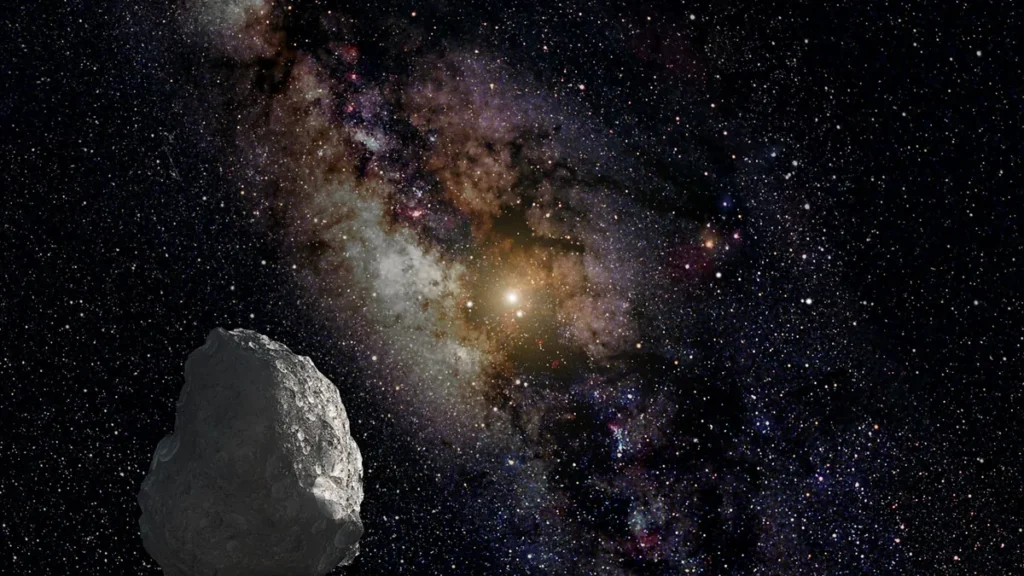
Scientists led by Lindsay Keller of NASA’s Johnson Space Center reported Nov. 11, 2026, that dust grains carried from beyond Neptune to Earth contain traces of water unlike Earth’s, providing evidence from the distant Kuiper Belt.
The Kuiper Belt lies beyond Neptune’s orbit at roughly 30 astronomical units from the Sun. Few human-made craft have ventured there, and scientists consider returning samples too difficult and expensive. An estimated 5,200 metric tons of cosmic dust rains on Earth every year, and some has traveled from the outer Solar System. Kuiper Belt objects represent some of the most unchanged remnants of the early Solar System, which coalesced about 4.5 billion years ago.
The team identified 12 dust grains, each spanning 10 to 30 micrometers, inside stratospheric material gathered by high-altitude NASA aircraft. Their track densities were about 100 times higher than scientists expect for dust from the asteroid belt or Jupiter-family comets. Solar energetic particles leave radiation trails in mineral lattices, and researchers use those tracks as a cosmic odometer to gauge how long a grain drifted in interplanetary space.
Dust orbiting the Sun also feels the Poynting-Robertson effect, a slight drag from sunlight that makes grains spiral inward. Carbon content was extraordinarily high, at roughly four times the level found in certain carbonaceous meteorites. Clays such as saponite and serpentine appeared in many of the grains, along with hydrated minerals that form when water reacts with rock. Radioactive decay or collision heat could once have warmed icy Kuiper Belt interiors enough to melt water.
The minerals retained some of the oxygen from the ancient water molecules, letting the team reconstruct the water’s isotopic composition. Oxygen isotopes include oxygen-16, oxygen-17, and oxygen-18, which differ by neutron count. Keller and colleagues found an unusual enrichment in heavier oxygen isotopes, and the resulting signature differed from water inferred from carbonaceous meteorites formed elsewhere in the early Solar System.
Models suggest Saturn created a pressure bump in the disk around the young Sun, slowing or stopping inward drift. Most meteorites come from regions where mixing obscured original signatures. In a 2022 paper, Keller and George Flynn of the State University of New York estimated that as much as a quarter of interplanetary dust entering the inner Solar System may have traveled from the Kuiper Belt.
Keller called the findings “compelling evidence for the presence of a major heavy water reservoir beyond the orbits of the gas giant planets.” The research appeared in Science Advances.
The detection lands in a debate over Earth‘s water origins. Research led by Paolo Sossi and Dan Bower at ETH Zurich, published Sept. 16, 2026, indicates Earth assembled nearly entirely from inner Solar System material, with outer Solar System material making up less than two percent of Earth’s mass, possibly none. They compared isotope ratios across 10 different isotope systems in meteorites linked to Mars and Vesta, measuring them against Earth’s own composition.
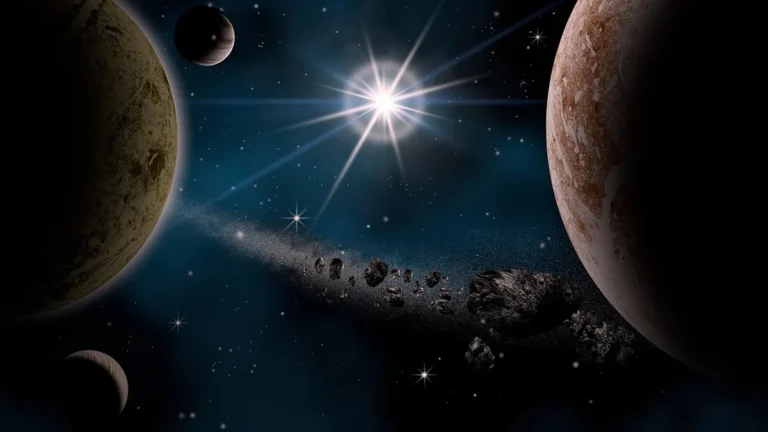
Earlier proposals held that 6 to 40 percent of Earth’s building material came from beyond Jupiter. Past work generally looked at two isotope systems, while the ETH team drew on 10. Jupiter’s rapid growth carved a gap in the protoplanetary disk, limiting outer material’s inward movement. Earth’s composition resembles that of Mars and Vesta.
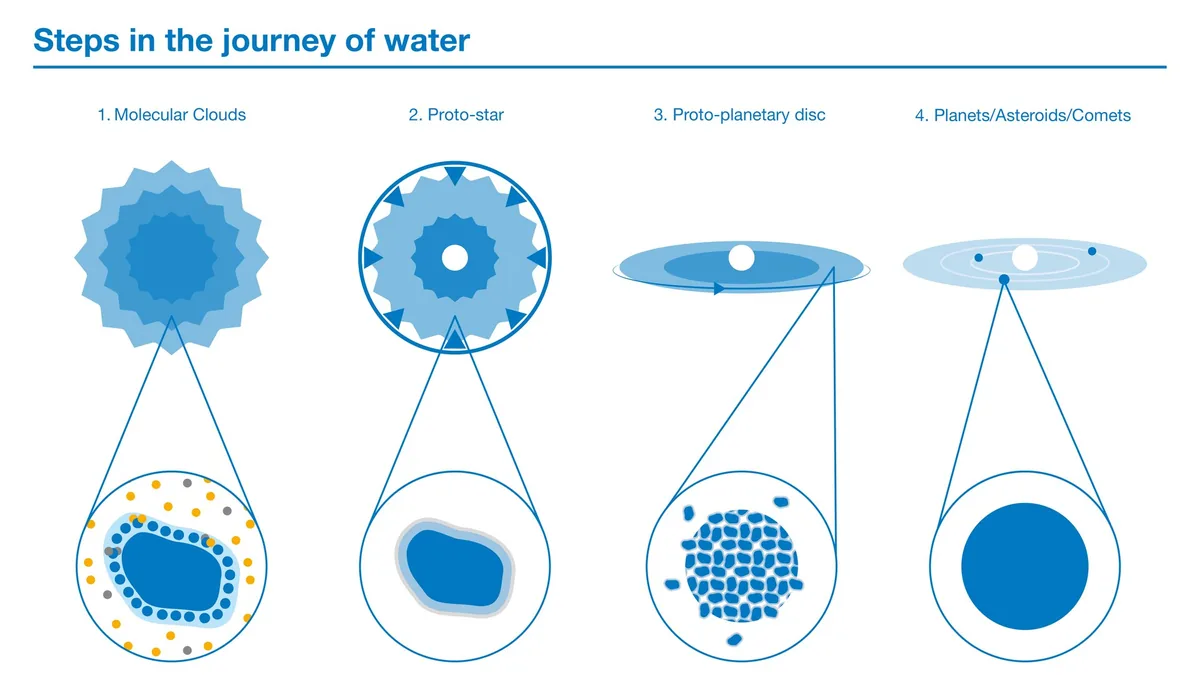
The findings suggest most volatiles, including water, already existed in the inner Solar System. Sossi’s team plans to investigate how enough water could exist in the hot inner Solar System for Earth’s oceans, and whether similar processes occur around other stars. Bower said, “We were truly astonished to find that the Earth is composed entirely of material from the inner Solar System.”
The Kuiper Belt link also appears in interstellar visitor research. 3I/ATLAS, the third known interstellar object, was discovered in July 2025. The James Webb Space Telescope observed it three times as it moved from roughly 3.31 astronomical units out from perihelion to about 5.65 astronomical units past that point. A team led by Dr. Silvia Protopapa of NASA’s Goddard Space Flight Center and the Southwest Research Institute published the work in The Astrophysical Journal Letters.
JWST found water ice in 3I/ATLAS trapped in microscopic grains that mix water with dark rocky minerals such as pyroxene and carbon, instead of existing as pure water ice. Infrared patterns match certain Trans-Neptunian Objects in the Kuiper Belt, suggesting the 3.0 micron pattern seen in TNOs may be dusty ice rather than organics. A Fresnel reflection near 3.1 microns after perihelion indicated crystalline water ice with molecules in neat lattices.
Water ice absorbs infrared at 1.5, 2.0, and 3.0 microns, a pattern seen in comets such as Hartley 2. JWST saw a clear 3.0 micron line in 3I/ATLAS but weak or absent 1.5 and 2.0 micron lines. Light travels only a short distance through mixed ice-and-dust before hitting dust, muting 1.5 and 2.0 micron absorption while 3.0 microns pass through.
Japan’s Hayabusa2 mission returned about 5.4 grams of material from asteroid Ryugu. Researchers identified all five DNA and RNA bases—adenine, guanine, cytosine, thymine and uracil—in two samples from Ryugu. The molecules did not need to originate in a living cell, but finding the ingredients does not mean DNA, RNA, or organisms were found, nor can it establish how much material reached young Earth.
Material from Bennu, brought to Earth in 2023 by NASA’s OSIRIS-REx mission, and the Murchison meteorite, which landed in 1969, both hold amino acids used to build proteins. A Penn State-led team used pico-CSIA and a modified GC-Orbitrap to read carbon isotopes at distinct positions inside molecules. For beta-alanine, the carbon isotope average matches between samples from Bennu and Murchison within margin of error, while position-by-position readings differ completely.
The enriched carbon in Bennu’s beta-alanine marked the highest isotope anomaly ever recorded in an organic molecule from space. Of the three carbons in beta-alanine, one measured much higher in neutrons while the other two were depleted. McIntosh said, “I was genuinely astonished by the enormous isotope difference between two neighboring atom positions within the same molecule.” The team plans to study how exposure to water and other space processes might affect isotope order within molecules.


Join the discussion