
Key facts
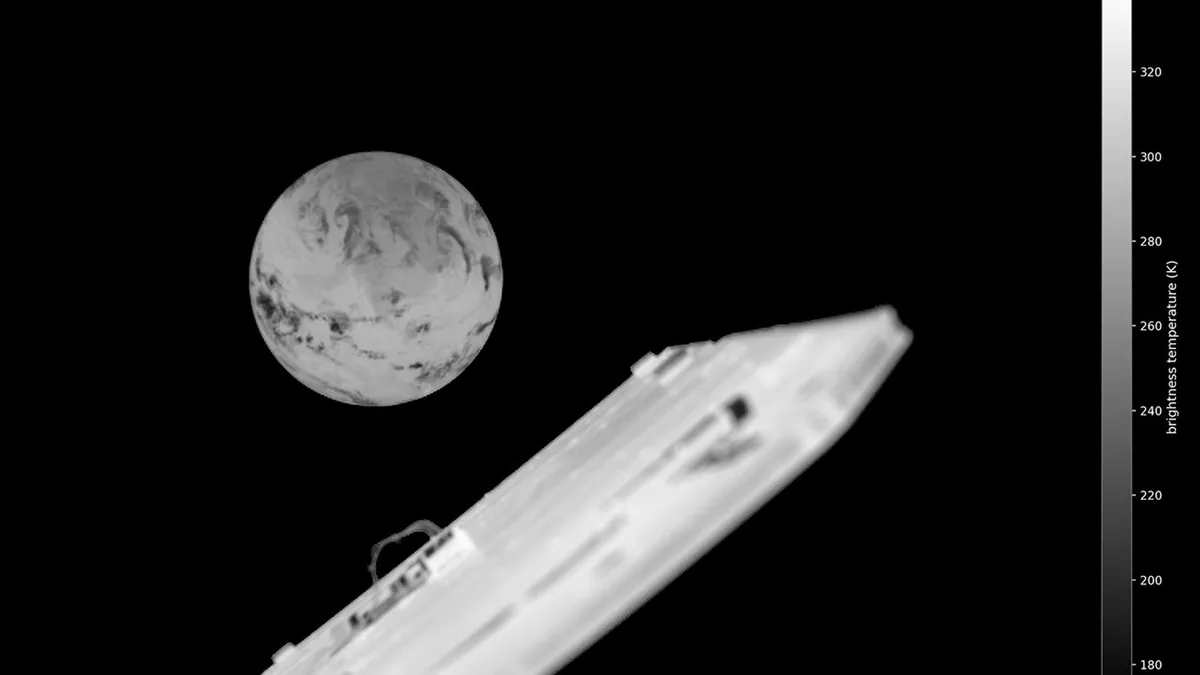
- NASA's twin ESCAPADE spacecraft completed a powered flyby of Earth, and one probe downlinked farewell images of the planet before continuing toward Mars.
- The images were captured using the Visible and Infrared Observation System camera, which was provided by Northern Arizona University, in visible and infrared light.
- NASA reports the photos were acquired around 9 a.m. Eastern on Nov. 9, 2026, about three hours after closest approach, when the craft sat roughly 38,500 miles from Earth with the Western Hemisphere in view.
- The pair of ESCAPADE probes conducted close Earth approaches this month, pairing engine burns with planetary gravity to send themselves toward Mars over a 10-month trip.
NASA’s twin ESCAPADE spacecraft completed powered flybys of Earth on Nov. 7 and Nov. 9, 2026, and one probe downlinked images of the planet as it continued toward Mars.
Blue passed Earth on Nov. 7, beginning its engine burn at about 5 a.m. EST, while Gold flew by on Nov. 9 at about 6 a.m. EST. SpaceNews reported that NASA completed the maneuver successfully twice within two days, marking the agency’s inaugural powered Earth flyby to send a spacecraft toward Mars. Acting heliophysics flight director Asal Naseri called the execution flawless. Principal investigator Rob Lillis said the burns were as critical as a Mars orbit insertion burn and were executed perfectly.
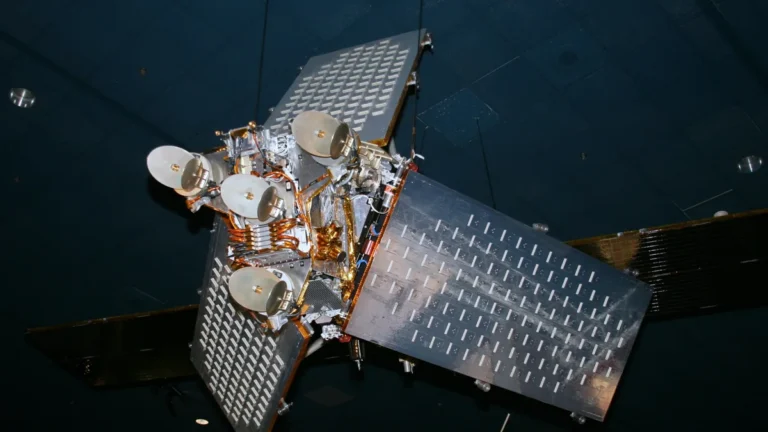
The departing spacecraft photographed Earth using the Visible and Infrared Observation System camera, supplied by Northern Arizona University, capturing the planet in visible and infrared light. NASA acquired the images around 9 a.m. Eastern on Nov. 9, roughly three hours after closest approach, when the craft sat about 38,500 miles away with the Western Hemisphere in view. A commercial satellite also imaged the pair from roughly 3,000 miles away, and a mission team member photographed the spacecraft overhead from a residence near Los Angeles.
The exact burn length and closest approach distances vary by outlet. Tech Times said the engines ran approximately 9.5 minutes, Berkeley News reported more than 9 minutes, and Rocket Lab’s announcement said approximately 10 minutes. Berkeley News placed Blue about 1,000 miles (1,700 kilometers) above Earth, while SpaceNews said roughly 1,600 kilometers. For Gold, Berkeley News cited about 650 miles (1,000 kilometers), compared with SpaceNews’s figure of about 1,050 kilometers; Rocket Lab reported better than 99 percent accuracy overall and final attitude error below one degree.
ESCAPADE, which stands for Escape and Plasma Acceleration and Dynamics Explorers, began its journey on Nov. 13, 2025, riding Blue Origin’s New Glenn rocket during the vehicle’s second flight from Cape Canaveral Space Force Station. Because Earth and Mars occupied opposite sides of the sun at launch, the craft entered a kidney bean-shaped loiter orbit around the Earth-Sun Lagrange Point 2, roughly 930,000 miles from Earth near the James Webb Space Telescope, and waited nearly a year for favorable geometry. The departure used a powered flyby, or Oberth maneuver, in which a spacecraft fires its engine at maximum speed, so kinetic energy produces far more energy than elsewhere in orbit.
During their loiter orbit, the spacecraft crossed Earth’s distant magnetotail multiple times and collected science observations there, using the region to calibrate instruments before the Mars cruise. On the 10-month voyage, the probes will examine how the solar wind behaves between Earth and Mars. NASA’s MAVEN has measured atmospheric loss since 2014 from a single location, a limitation ESCAPADE is built to overcome with simultaneous two-point readings of Mars’ hybrid magnetosphere.
Mars lost its internal dynamo billions of years ago, leaving magnetized crust patches surrounded by a hybrid magnetosphere shaped by the solar wind and ionosphere. Atmospheric sputtering occurs when solar wind ions are energized and ejected from Mars’ ionosphere into space, and the planet’s pressure stands at 0.6% of Earth’s sea level. Nicky Fox, associate administrator of NASA’s Science Mission Directorate, said the mission supports planning for astronauts on Mars, where surface radiation averages about 0.64 millisieverts per day. Michele Cash, an ESCAPADE program scientist at NASA headquarters, said solar wind research could aid planning for future human exploration.
After arrival in September 2027, Gold will fire its engine on Sept. 7 and Blue on Sept. 9, each conducting an approximately 11-minute burn to enter Mars orbit. The craft will spend several months reaching their initial science formation, flying one behind the other in elliptical orbits spanning 100 miles to 6,200 miles above Mars. Six months later, they will separate into different orbits for a five-month campaign, with one craft watching the incoming solar wind and the other tracking the planet’s real-time response. Science operations are set to begin in June 2028.
The probes will operate in a string of pearls formation, spaced two to 30 minutes of arc apart, allowing scientists to distinguish real spatial variations from changes over time at one location. NASA’s Deep Space Network will use Multiple Spacecraft per Aperture to contact both probes through one antenna dish, part of the mission’s cost-saving design. Rocket Lab constructed both spacecraft under NASA’s SIMPLEx program and finished them in approximately 3.5 years, about half the schedule of a standard planetary mission.
ESCAPADE is the last surviving SIMPLEx mission. NASA selected it in 2019 alongside Janus and Lunar Trailblazer; Janus was canceled in 2023 after Psyche launch delays, and Lunar Trailblazer malfunctioned after its February 2025 launch and was terminated five months later. Two earlier cubesat-class SIMPLEx missions, LunaH-Map and Q-PACE, also failed after launch, and NASA has not solicited new proposals because of budget pressures.
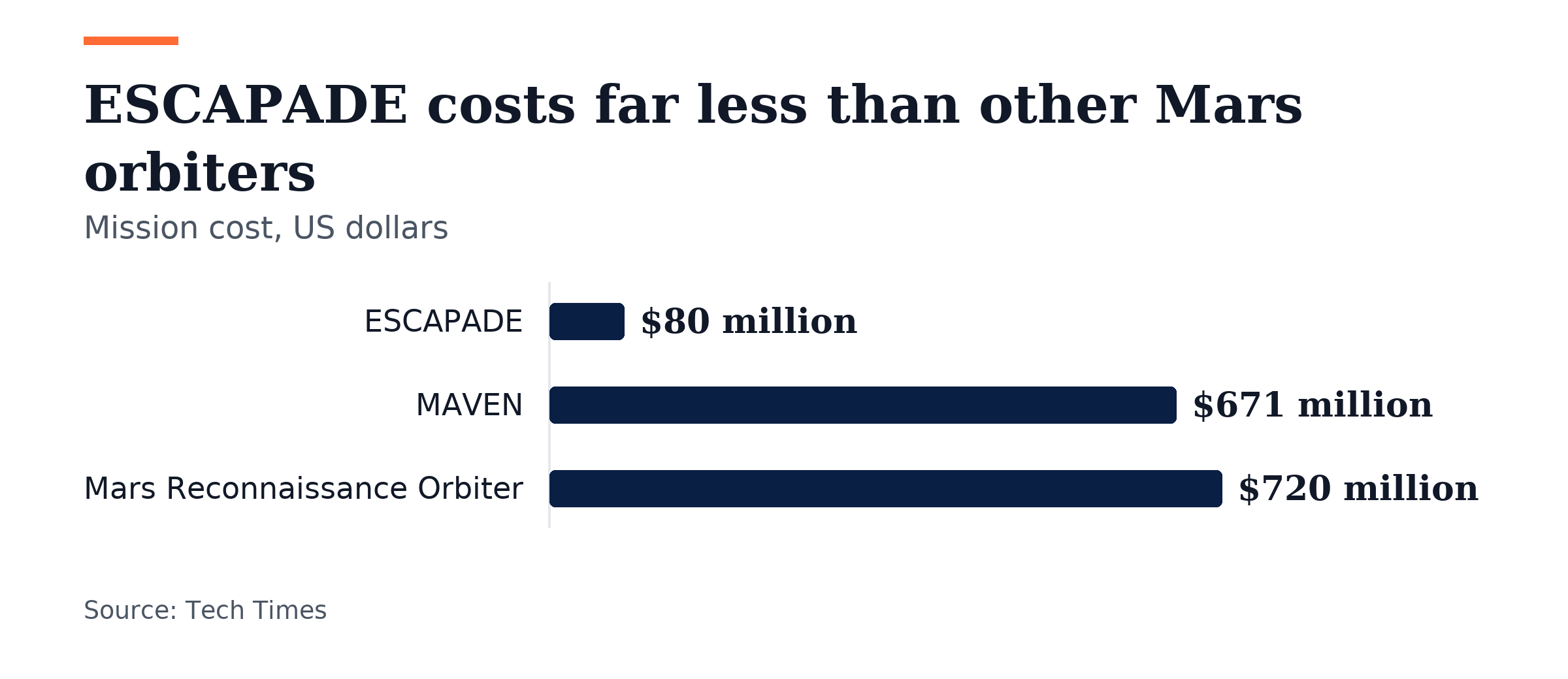
The mission runs on a budget under $80 million, roughly 10% of a typical Mars orbiter. MAVEN cost about $671 million and the Mars Reconnaissance Orbiter roughly $720 million. Principal investigator Robert Lillis framed the SIMPLEx tradeoff by asking, “Instead of spending $800 million for a 95% chance of success, can we spend $80 million for an 80% chance?”
Rocket Lab’s Nov. 10 statement said it designed and built both spacecraft for NASA and UC Berkeley’s Space Sciences Laboratory, completing the trans-Mars injection burns autonomously while operators oversaw them. The company called the maneuvers one of its two biggest propulsive moves, alongside Mars orbit insertion, and said each craft had to hold a controlled engine firing because the burn could not be divided into segments. Founder and CEO Sir Peter Beck said the flawless execution reflected close collaboration with UC Berkeley and NASA.
Gold experienced lower-than-expected thrust during late 2025 trajectory corrections, delaying a critical maneuver that was replaced on Jan. 6, 2026. An engine failure during the November flyby window would cause a spacecraft to miss its trans-Mars injection opportunity, with the next viable window opening roughly two years later. Tech Times says the mission could potentially proceed with one spacecraft, but the core science advantage of simultaneous dual-point measurements would be compromised.
The L2 loiter strategy lets a spacecraft launch almost anytime, wait for Mars to come around, and then use a powered Earth flyby to depart, making the traditional 26-month Mars alignment window optional in principle. Every prior Mars mission was constrained by optimal alignments roughly every 26 months lasting only a few weeks, and ESCAPADE was designed to break that constraint.
JAXA launched its MMX spacecraft on Oct. 20, 2026, toward the Martian moons Phobos and Deimos using the same Hohmann Transfer method, with arrival expected in August 2027, roughly two weeks ahead of ESCAPADE. CNET reports the twin probes carry the nicknames Blue and Gold, taken from UC Berkeley’s school colors, and will have spent 22 months in space by the time they reach Mars.
Advanced Space CTO and lead mission designer Jeff Parker said the loiter orbit and Earth flyby pioneer a new Mars strategy, offering flexibility to launch almost anytime and use Earth’s gravity for a boost instead of waiting for alignment every two years. “With this loiter orbit and Earth flyby, Escapade is pioneering a new strategy for getting to Mars,” Parker said.

Join the discussion