Key facts
- The research used Chang'e-6 lunar samples allocated to HKU DEPS for study, along with Chang'e-4 data and satellite observations.
- The investigators identified two varieties of magnesium-rich rocks with separate geological origins.
- The team determined when major impacts occurred that shaped the South Pole–Aitken basin.
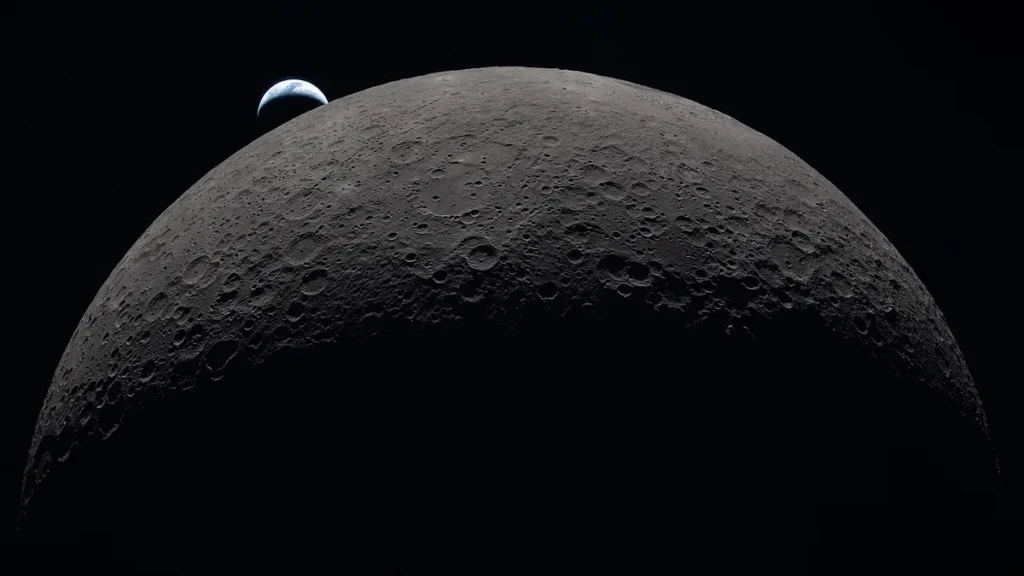
- The South Pole–Aitken basin lies on the Moon's far side and ranks among the oldest and largest impact structures of the solar system, thought to have come from a huge collision billions of years ago.
Geologists from the University of Hong Kong’s Department of Earth and Planetary Sciences released findings Nov. 19, 2026, explaining how the South Pole–Aitken basin on the Moon’s far side formed and changed over billions of years.
The results appear in Science Advances in a paper titled ‘Postimpact evolution of the South Pole–Aitken basin revealed by Chang’e-4 and Chang’e-6,’ published in 2026 under DOI 10.1126/sciadv.aeh9798. Professor Guochun Zhao, the Mok Sau-King Professor in the department, led the investigation. Dr. Yuqi Qian served as first author on the study.
Researchers from Northwest University, Brown University, the University of Münster, Peking University, the University of Hawaiʻi, the European Space Agency and the Chinese Academy of Sciences joined the Hong Kong team for the basin study. Their participation spans institutions in Asia, Europe and North America. The group represents the international network supporting Hong Kong’s planetary research. International partners contributed to the research reported in Science Advances.
Since 2025, HKU and the Institute of Geology and Geophysics, Chinese Academy of Sciences have jointly organized the International Lunar Sample Research Symposium annually. The event brings together over 200 researchers worldwide each year. The symposium shares findings and fosters collaboration in lunar science. It forms part of HKU’s broader planetary research program.
Investigators relied on Chang’e-6 lunar samples allocated to the department for study. They also used Chang’e-4 data and satellite observations. The samples came from the Chang’e-6 mission. Satellite observations gave a broader view of the lunar surface.
Chang’e-4 touched down on the Moon‘s far side in 2019. Chang’e-6 returned the first far-side samples in 2024. The far side is the lunar hemisphere that faces away from Earth. These two missions provided the surface context and returned material for the basin study.
The investigation yielded direct surface evidence from both landing sites through combined Chang’e-6 sample analysis and surface readings from both missions. They brought together Chang’e-6 sample results and surface measurements from both missions. This direct evidence covered the Chang’e-4 and Chang’e-6 locations. The approach gave investigators information from the surface and from returned material.
The South Pole–Aitken basin lies on the Moon’s far side and ranks among the oldest and largest impact structures in the solar system. Scientists think it originated from a huge collision billions of years ago. Its scale and antiquity position it as a major planetary impact structure. The basin’s age places it among the earliest large features on the Moon.
Studying the basin could help answer questions about the Moon’s early history. Those questions include why the near and far sides differ, what lies beneath the surface and when major impacts occurred. Investigators pursue these questions through the basin’s geological record. The research addresses fundamental uncertainties about lunar development.
Researchers found two kinds of magnesium-rich rocks that formed in different ways. The first consists of moderately magnesium-rich norites formed from the original impact melt sheet. The second consists of highly magnesium-rich rocks likely produced by magnesium-suite magmatism associated with the impact. Magnesium-suite magmatism is a different process from the original impact melt sheet.
Moderately magnesium-rich norites came from the original South Pole–Aitken impact. Norites are igneous rocks that crystallize from magma. The impact melted enormous quantities of rock into a thick molten sheet. The material cooled and separated over time.
The Finsen impact dug up some norites and carried them to the Chang’e-4 landing site in Von Kármán crater. These norites appeared at central peaks of large impact craters. The Chang’e-4 landing site is in Von Kármán crater on the far side. An impact crater’s central peak is a mountain in the middle of the crater floor.
The second rock type likely came from magnesium-suite magmatism associated with the South Pole–Aitken impact. These materials appeared along the Apollo basin’s western peak ring before transport. The Chaffee S impact carried them to the Chang’e-6 landing site. The Apollo basin’s western peak ring held these materials before an impact moved them.
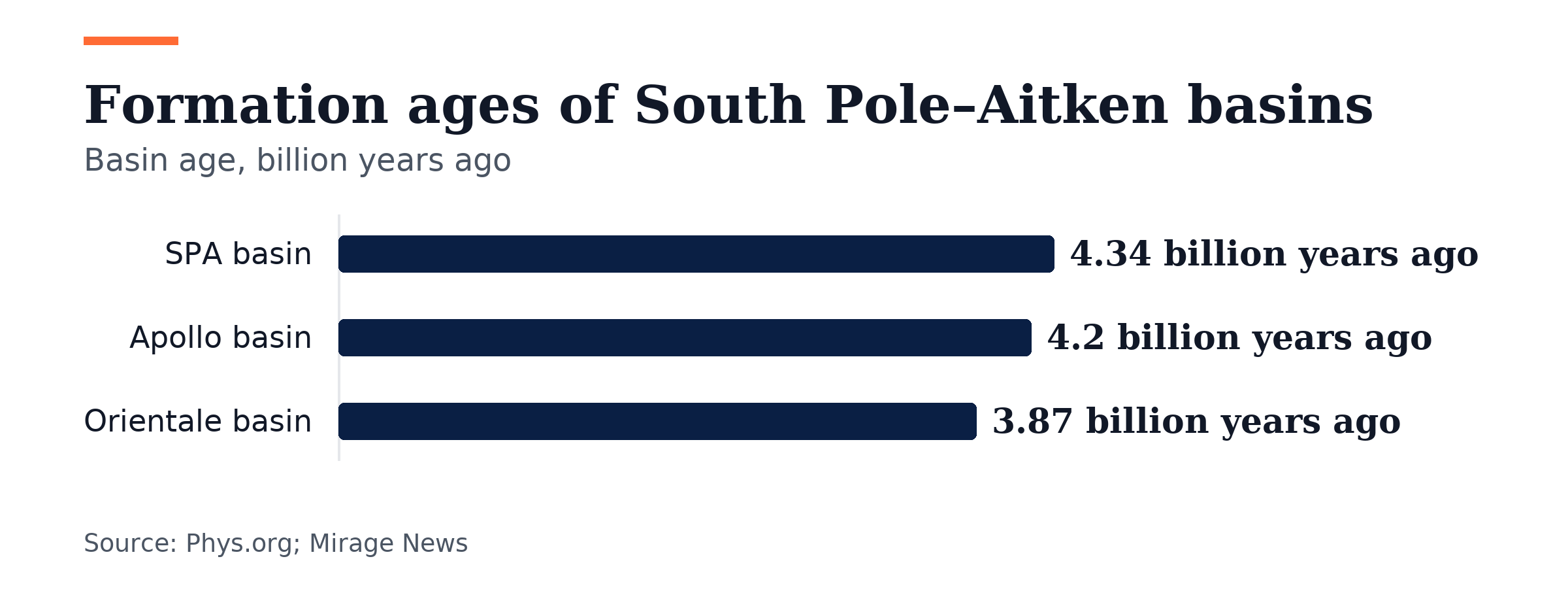
The team determined when major impacts occurred that shaped the South Pole–Aitken basin. SPA basin formation happened around 4.34 billion years ago. The Apollo basin formed around 4.2 billion years ago, and the Orientale basin formed approximately 3.87 billion years ago. These figures establish a sequence of large lunar impacts.
The latest study investigated how successive collisions shaped the basin’s geological evolution. Collisions dug up and spread large amounts of rock fragments across the region. They merged sample data from Chang’e-6 with surface readings from both missions. Then they applied remote sensing and numerical simulations to extend the results across the wider basin.
The study extended the results from both landing sites across the whole basin. Numerical simulations helped model the basin’s evolution across its full area. Remote sensing supported the broader mapping effort. The expansion connected sample sites to the wider region.
Previous HKU-led work detected signs of prolonged volcanic activity in the South Pole–Aitken region. It also identified unrecognized magma activity there. That work proposed that ilmenite-bearing cumulates played a role in different volcanic histories on the Moon’s near and far sides. Ilmenite-bearing cumulates are accumulations of titanium-rich minerals, and the earlier research built the background for the latest focus on impact history.
The University of Hong Kong obtained Chang’e-5 lunar samples for scientific research in 2023 and became Hong Kong’s first university to do so. This allocation gave HKU access to material from China’s lunar exploration programme. The samples support scientific research at the department.
Dr. Yuqi Qian leads HKU’s Chang’e-5 and Chang’e-6 sample studies. The Chang’e-5 portion is 822.6 milligrams. The Chang’e-6 portion is 1,000 milligrams. Qian is a Research Assistant Professor in the Department of Earth and Planetary Sciences.
He also supports other robotic and human lunar exploration missions of China.
Beyond the sample studies, Qian works on other robotic and human lunar exploration missions of China. He supports their implementation. His work spans both robotic and human mission categories. Qian contributes to China’s national lunar exploration effort through these roles.
Professor Guochun Zhao leads the NWU-HKU Joint Center of Earth and Planetary Sciences and the GIG-CAS & HKU Joint Laboratory of Chemical Geodynamics. These positions support HKU’s participation in the national space program. Hong Kong builds its planetary research through international collaborations and participation in China’s national lunar exploration program. Zhao’s leadership spans several joint research structures.
The new ORIGINS COLLECTIVE at HKU, led by Professor Nicolas Dauphas, will develop advanced facilities for research on planetary materials from the Moon, Mars and beyond. The collective is part of HKU’s effort to strengthen planetary research through international partnerships. It expands the university’s capacity to examine extraterrestrial samples. The initiative adds another research structure to HKU’s lunar science portfolio.


Join the discussion