Key facts
- The MeerKLASS Collaboration reported the first direct measurement of how neutral hydrogen clusters across the largest cosmic scales in a Monthly Notices of the Royal Astronomical Society paper.
- The MeerKLASS team studied MeerKAT observations covering about 250 square degrees of sky, an area Mirage News and Newswise liken to roughly 1,250 full moons.
- The neutral hydrogen signal measured by MeerKLASS came from about 4.5 billion years ago, at a time when the Universe was just over 9 billion years old.
- MeerKLASS results indicate that the distribution of neutral hydrogen tracks the largest structures in the cosmic web.
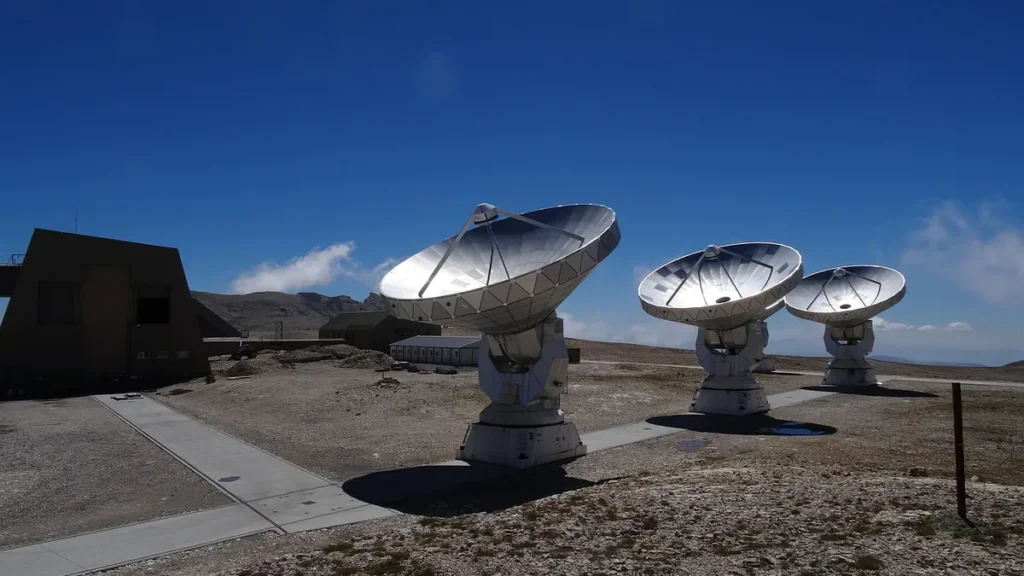
A MeerKLASS Collaboration paper in Monthly Notices of the Royal Astronomical Society reports the first direct measurement of neutral-hydrogen clustering across the largest cosmic scales from MeerKAT observations. The international team studied about 250 square degrees of sky, an area equal to roughly 1,250 full moons, with each dish operating independently instead of combining the dishes into a single interferometer.
MeerKLASS measured the signal from about 4.5 billion years ago, when the cosmos was just over 9 billion years old. The team built separate maps using different dishes and observing times, compared them against each other to limit instrument effects, and verified that the detection exceeded the statistical noise by more than six times.
Astronomers can study hydrogen from different eras because neutral hydrogen emits a faint 21-centimeter radio line that cosmic expansion stretches to longer wavelengths. The 21-centimeter signal is roughly 10,000 times fainter than foreground emission from other sources across the Universe, so extracting it required new observing and analysis methods, including independent dish operation and map cross-comparison. Instead of identifying galaxies one by one, intensity mapping detects the combined glow of many unresolved galaxies, which enables large three-dimensional maps showing the distribution of gas, dust, stars, galaxies and clusters across the cosmic web.
The MeerKLASS results indicate that neutral hydrogen’s distribution tracks the largest structures in the cosmic web, advancing 21-cm intensity mapping as a probe relevant to cosmic expansion, Dark Energy and Dark Matter. Its measurements can constrain the Hubble-Lemaître Constant, the influence of Dark Energy and the distribution of Dark Matter.
Universe Today describes Dr Steven Cunnington as a senior research fellow at Purdue University’s Institute of Cosmology and Gravitation, while Mirage News and Newswise say he works at the University of Portsmouth’s Institute of Cosmology and Gravitation, noting that he rejoined in April 2025 as a Stephen Hawking Fellow. Cunnington led development of the analysis pipeline behind the MeerKLASS detection and mapping, and he has co-led one of the collaboration’s working groups since 2015. He started his PhD at Portsmouth more than 10 years ago, called the result the culmination of that journey, and said witnessing the team’s achievement was a remarkable milestone.
Professor Mário Santos of the University of the Western Cape, the MeerKLASS survey’s Principal Investigator, called the measurement a milestone and said, “This is a milestone in establishing 21-cm intensity mapping as a novel tool for cosmology.” He said the result came from patient teamwork and credited the South African Radio Astronomy Observatory for building and operating MeerKAT, adding that none of the work would exist without the observatory. Team members work in seven countries on three continents, many of them early-career scientists who have spent their whole careers on the project.
In separate work, scientists from the University of Manchester, working with the University of the Western Cape, detected neutral-hydrogen intensity mapping on megaparsec scales at redshifts near 0.32 and 0.44, publishing the results in The Astrophysical Journal Letters. Dr Sourabh Paul is the lead author, with Zhaoting Chen, Mario G. Santos and Laura Wolz as co-authors. Researchers studied about 96 hours of MeerKAT observations; the data were gathered in 2018, not long after MeerKAT started science operations. They found hydrogen signals from two eras, with light traveling roughly four to five billion years to reach Earth.

Paul said the detection marks an exciting milestone, evidence that intensity mapping of hydrogen is becoming practical for cosmology. According to Chen, neutral hydrogen ranks among the key ingredients for understanding galaxy formation and evolution.
Wolz noted that the signal came from MeerKAT observations not designed for hydrogen intensity mapping, calling the result encouraging and pointing toward future Square Kilometre Array Observatory observations. The researchers say foreground emission, radio-frequency interference and instrumental effects challenge the technique, although it is becoming practical for cosmology; previously such measurements combined radio data with optical galaxy surveys, while this study identified the signal using MeerKAT observations alone.
Bigger, longer sky surveys should allow more precise neutral-hydrogen mapping and should help show how dark matter shapes the cosmic web, which the researchers say could clarify galaxy formation and evolution across billions of years. Santos said researchers still have a rich trove of MeerKAT data to explore with this method. The Square Kilometre Array Observatory is expected to make hydrogen intensity mapping a major science driver, and MeerKAT serves as its precursor telescope.
That study traced hydrogen across several million light-years, roughly the distance from the Milky Way to the Andromeda galaxy. During the Cosmic Dark Ages — the Universe’s first few hundred million years — neutral hydrogen was the only element around, feeding stars, galaxies and the cosmic web; today it remains the most abundant element, present throughout the interstellar and intergalactic media. Cosmologists have worked to chart the Universe’s large-scale structure for decades. In September 2025, the MeerKLASS collaboration held a biannual Busy Week meeting at the University of Torino.
Join the discussion