Key facts
- Uranus reaches opposition on November 25th, U.S. Thanksgiving eve, putting the planet in good position for Thanksgiving-evening viewing.
- Saturn passed opposition on October 4th and Neptune did the same on September 26th earlier in the autumn.
- Through a telescope eyepiece around opposition Uranus shows only a 4-arcsecond disk, barely resolvable and difficult to tease out detail.
- The planet looks like a blue-green star that stubbornly refuses to snap into focus when observers sweep the field at low power.
Universe Today says Uranus reaches opposition on November 25, Thanksgiving eve, putting the planet in good position for Thanksgiving-evening viewing across the United States.
Universe Today defines opposition for an outer planet as the moment it rises opposite the setting Sun as seen from Earth. Around that moment the planet is above the horizon through much of the night. Late November 2026 is prime Uranus observing season because the outer planets are moving back into the evening sky. The weeks around Thanksgiving are the time to look for Uranus, with opposition falling on Thanksgiving eve.
Universe Today notes that Saturn passed opposition on October 4 and that Neptune reached opposition on September 26, earlier in the autumn. Uranus follows on November 25, Thanksgiving eve. The three dates mark a run of outer planets moving back into the evening sky across the fall, with Saturn and Neptune already there as Uranus joins them.
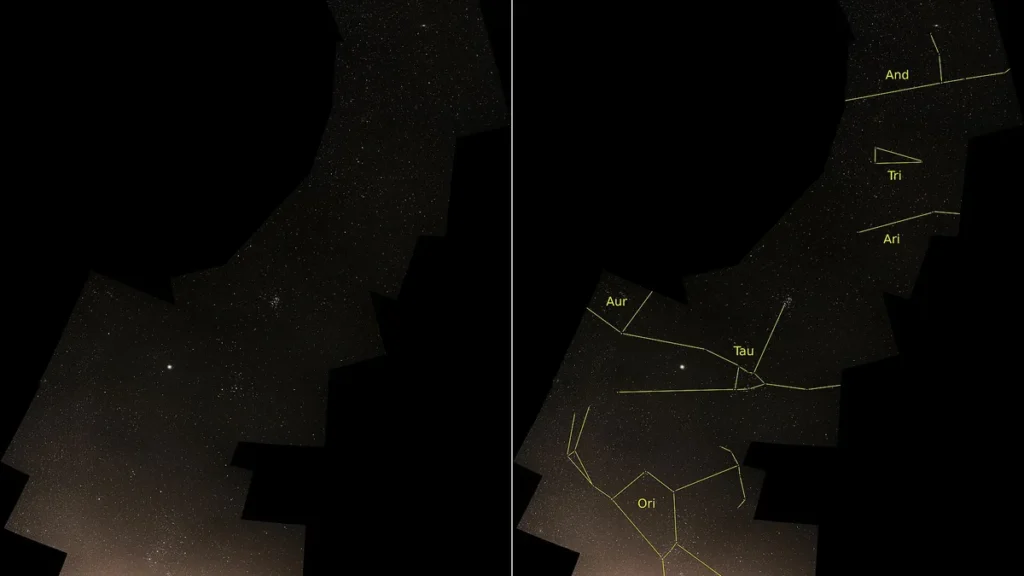
At opposition Uranus sits in the constellation Taurus, between the Hyades and the Pleiades open star clusters. An observer who can locate the Hyades and the Pleiades has a reference point for finding Uranus nearby in Taurus.
Universe Today puts Uranus at about magnitude +5.5 near opposition, topping +6th magnitude. Magnitude is the brightness scale astronomers use, in which smaller numbers denote brighter objects. At that brightness Uranus sits close to the naked-eye threshold under dark-sky conditions. From a good dark sky site it is near the limit of visibility without optical aid.
Through a telescope eyepiece around opposition Uranus shows only a 4-arcsecond disk, Universe Today reports. An arcsecond is a tiny angular measure of sky. A disk that small is barely resolvable at the eyepiece around opposition, and fine detail is difficult to tease out or extract. The 4-arcsecond disk leaves the planet as a small target rather than a resolved world.
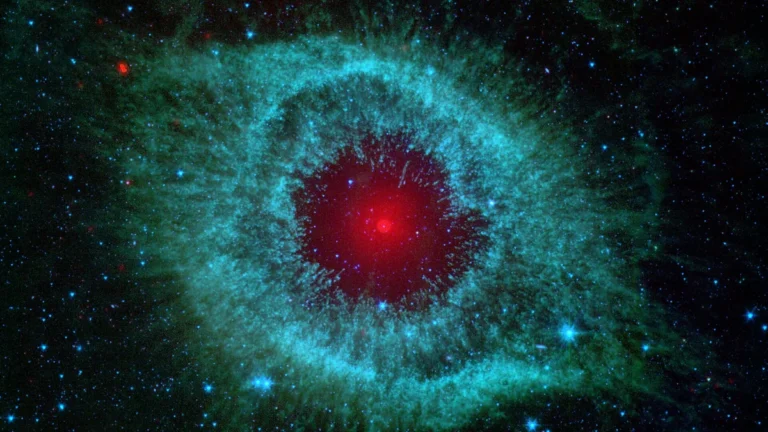
At the eyepiece the planet looks like a blue-green star that refuses to snap into focus when observers sweep the field at low power. Universe Today compares the view to a tiny planetary nebula or a fuzzy comet. A planetary nebula is a glowing shell of gas, but the comparison here is only visual: the blue-green object will not sharpen into a detailed disk.
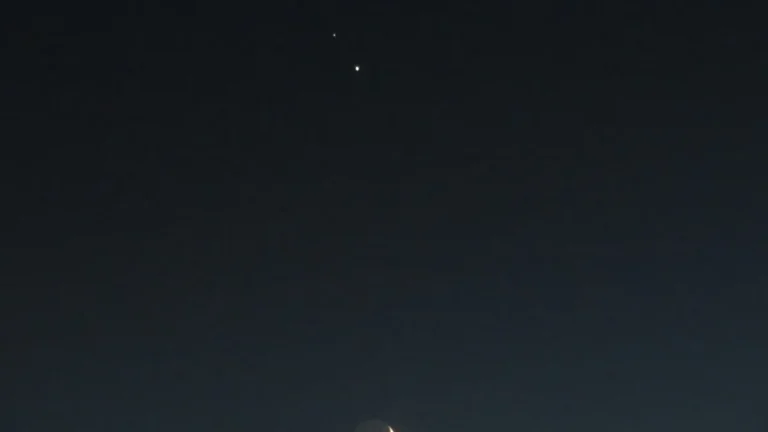
The Full November Beaver Moon falls on November 25, the same date as opposition, Universe Today says. On November 24 the Moon occulted the Pleiades for the Arctic. An occultation occurs when one celestial body passes in front of another, blocking it from view. The bright full Moon shares the sky with Uranus on opposition night.
Uranus has 29 known moons, but only five are within potential reach of amateur telescopes, according to Universe Today. Titania is the brightest of that reachable group at magnitude +13.9. The source describes Titania as leading the small set of Uranian moons that amateurs might attempt to sight. The other reachable moons are fainter than Titania.
Titania orbits Uranus once every 8.7 days and reaches the greatest elongation of 28 arcseconds from the planet, Universe Today says. Greatest elongation is the moon’s farthest apparent separation from Uranus as seen from Earth. The 8.7-day orbit and 28-arcsecond greatest elongation help observers separate Titania from background stars near the planet.
The Uranian moons’ orbits are nearly perpendicular to our view in 2026, Universe Today says, meaning they are nearly edge-on from Earth. Because the orbits reach that edge-on alignment only once every 42 years, the moons can transit Uranus, crossing in front of the planet’s disk. The last run of transits ran from 2006 to 2009, and the next begins around 2048. Transits are rare.
Universe Today says only one spacecraft has seen Uranus close up: NASA’s Voyager 2 flew past the planet and its moons in 1986. Voyager 2 remains the sole spacecraft to have flown past Uranus and its moons, returning the only close-up views of the Uranian system. No other mission has matched that 1986 flyby.
A Cassini-style Uranus orbiter has been proposed and would be feasible for around the 2040s time frame, Universe Today says. Such a mission would need a long journey and orbit insertion before reaching the planet.
Every 84 years, Uranus orbits the Sun once and has a 370-day synodic period, Universe Today says. A synodic period is the time between repeat alignments of the planet, Earth and the Sun. The 84-year orbit and 370-day synodic period push each opposition later by roughly five days each year, so oppositions slide forward about five days annually.
In 2009, Uranus reached aphelion of 20 astronomical units from the Sun and is inbound toward perihelion of 18.3 astronomical units expected in 2050, Universe Today says. An astronomical unit is the Earth-Sun distance. The planet is moving closer to the Sun on its long orbit from that distant point.
Sir William Herschel discovered Uranus on March 13, 1781, in Bath, England, from his garden. Universe Today notes that in 2033 the planet will pass near that Taurus discovery point, close to the border with Gemini. The return brings Uranus back to the part of Taurus where Herschel first sighted it in 1781.
Before anyone recognized it as a planet, Uranus appeared on star charts of the era at least 20 times, Universe Today says. The object turned up on those charts repeatedly without being identified as a new world. Herschel’s sighting in 1781 was the moment the object was finally recognized as a planet rather than a charted star.
Herschel originally mistook the discovery for a comet or nebula, Universe Today says. He then recognized the object as a distant world beyond Saturn and proposed naming it George for King George III.
An ancient encounter with another large body tipped Uranus over 98 degrees on its side, Universe Today says. That axial tilt, blamed on an ancient collision, means observers are now looking nearly at the planet’s north pole. The north pole will aim toward Earth in late 2029. An axial tilt of 98 degrees leaves the planet essentially rolling on its side as it orbits the Sun.
In 2007, Uranus reached its southernmost sky point and crossed the celestial equator several times from 2011 to 2012, Universe Today says. It crosses the ecliptic northward in 2029 and reaches its northernmost point in 2032. The celestial equator is Earth’s equator projected onto the sky, while the ecliptic is the Sun’s apparent yearly path. The source traces this slow northward drift.
The Moon will not resume occulting Uranus until a cycle beginning on September 29, 2029, Universe Today says. An occultation happens when the Moon passes in front of the planet from Earth’s viewpoint. After 2026’s events, the next Moon-Uranus occultation cycle starts in 2029.


Join the discussion