
Key facts
- Université de Montréal Professor Patrick Dufour said the system has no clean explanation for how it formed and called that question the driver of the team's next observations.
- SPIRou at the Canada-France-Hawai'i telescope detected a velocity shift of about 16 km per second in the red dwarf TYC 3980-1081-1 over 4.8 years, a change far too large to come from any planet.
- The two white dwarfs point to a system age of 9 to 11 billion years, yet the red dwarf is metal-rich, unusual for such an old star.
- The name Welopōʻai comes from the A Hua He Inoa program of the ʻImiloa Astronomy Center of Hawaiʻi and combines 'welo,' an inherited family trait, with 'pō'ai,' an orbit.
The Université de Montréal’s Dr. Étienne Artigau led astronomers in identifying a faint white dwarf in orbit around the red dwarf in Welopōʻai, a triple system 27.6 light-years away, the team reported the finding Nov. 19, 2026.
The research appeared in Astronomy & Astrophysics in 2026 under the identifier A&A 715, A321, with DOI 10.1051/0004-6361/202661214. The work labeled Welopōʻai a peculiar triple system lying 8 pc from the Sun. The Montreal-based Trottier Institute for Research on Exoplanets led the international team, working from the Université de Montréal. Artigau, an IREx researcher, served as the paper’s lead author.
The triple holds two white dwarfs and one red dwarf. The team said nothing else in the Sun’s neighborhood matches the system. Astronomers already knew of a second white dwarf, previously identified, that circles the pair from 124 AU away. The new companion travels close to the red dwarf, and the ʻAlopeke instrument on Gemini North at Maunakea placed it roughly 0.6 arcseconds away, with brightness roughly six magnitudes below the red dwarf’s, which kept the faint object out of earlier views.
Observers first aimed SPIRou at TYC 3980-1081-1 hoping to find planets. SPIRou operates at the Canada-France-Hawai‘i Telescope atop Maunakea and identifies exoplanets through minute stellar velocity shifts caused by orbiting bodies. Dr. Artigau said, “We were actually looking for planets. Instead, we found something much more surprising,” The instrument detected a velocity shift of about 16 kilometers per second in the star over 4.8 years, equal to 10 miles per second, a shift no planet could generate, and years of follow-up tracking led the team to conclude the hidden object’s mass was greater than half a solar mass.
The team could not initially exclude a neutron star or black hole as the unseen companion. Charles-Antoine Parent, an undergraduate student at Université Laval and co-author, said, “The most likely explanation was a white dwarf, although a neutron star or even a black hole couldn’t be ruled out.” He tied the object’s large mass and faintness to a dead stellar remnant, calling it the only plausible explanation. High-resolution images from Gemini North’s ʻAlopeke instrument then directly detected the faint white dwarf companion.
By combining velocities and positions, the team weighed the inner white dwarf at 0.618 solar masses, with 0.7% precision, a figure that ranks among the most precise white-dwarf mass measurements within 20 parsecs. TYC 3980-1081-1, the red dwarf, has a mass of 0.419 solar masses. The two stars orbit each other every 9.8 years, separated by roughly 4.6 astronomical units. Few white-dwarf mass measurements reach this level of precision, and the team’s sub-1% uncertainty offers a valuable test of stellar-evolution models and physics at extreme densities.
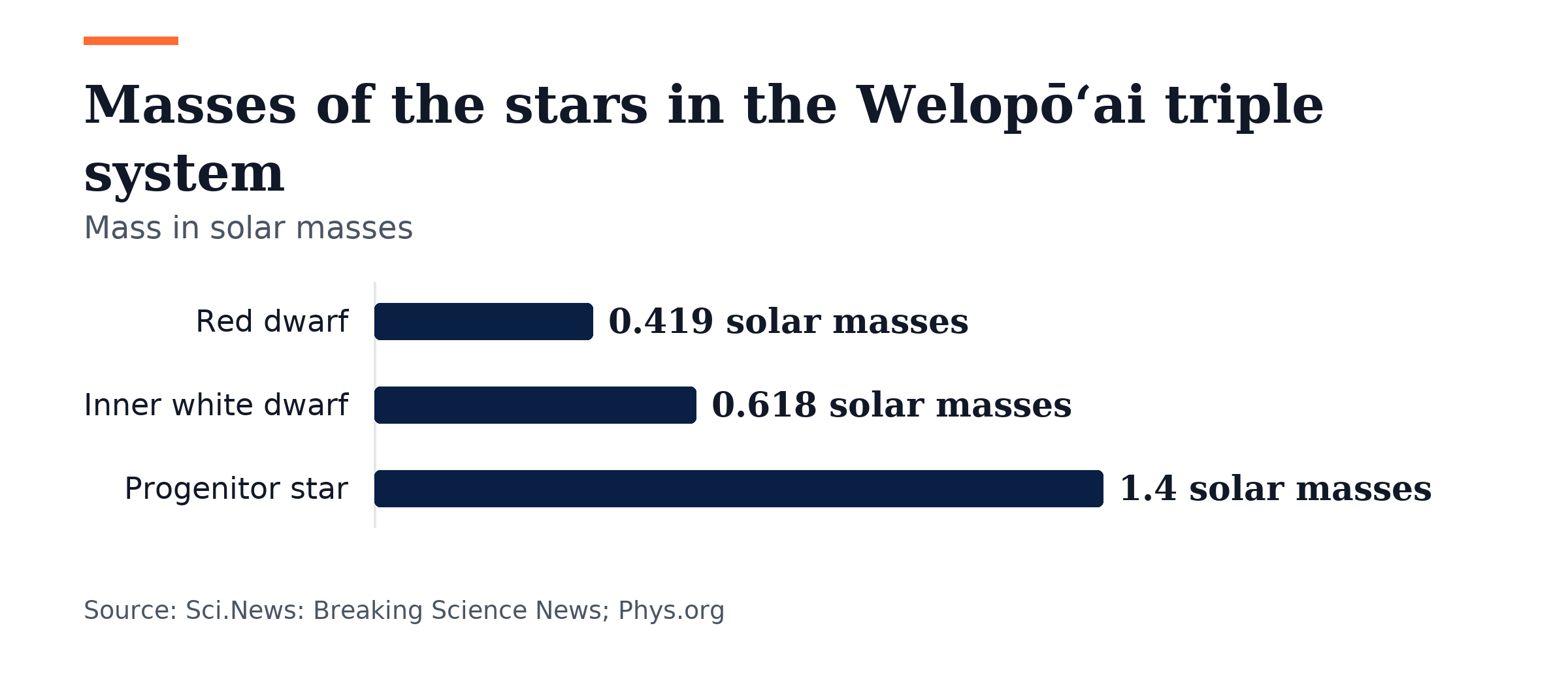
The progenitor probably had 1.4 solar masses, roughly 40% above the sun’s mass, and it swelled to several hundred times its original size. Such growth usually dooms a close companion to engulfment or merger, yet the red dwarf survived on a wide orbit and its survival mechanism is unclear. Ages of 9 to 11 billion years are indicated by the two white dwarfs, though the red dwarf’s metal-rich composition is unusual for a star that old. Université de Montréal Professor Patrick Dufour said the system lacks a clean explanation for its formation, calling that question the driver of the team’s next observations.
Welopōʻai’s name originates with the A Hua He Inoa program at the ʻImiloa Astronomy Center of Hawaiʻi. It combines ‘welo,’ an inherited family trait, with ‘pō’ai,’ an orbit, evoking a path of family traits.
A white dwarf is the extremely dense leftover of a sunlike star that burned through its fuel, and precise measurements of their masses remain rare. Red dwarfs shine far less brightly than the sun. The instrument tracks exoplanets through minute stellar velocity shifts. A reading of nearly 16 kilometers per second therefore far exceeded any planetary effect, and the companion’s brightness is roughly six magnitudes below the red dwarf’s, helping explain why it stayed hidden.
At 27.6 light-years away, the system stands out because nothing like it exists within 100 light-years, and the paper lists the distance as 8 pc from the Sun. A tentative infrared excess appeared around the inner white dwarf, possibly signaling a dusty debris disk, but the researchers say they need confirmation. Webb and Gaia observations could reveal the system’s three-dimensional structure and resolve the infrared question. Researchers also want to examine gravitational interactions among the three stars to test whether they account for the system’s unusual history.
Join the discussion