Key facts
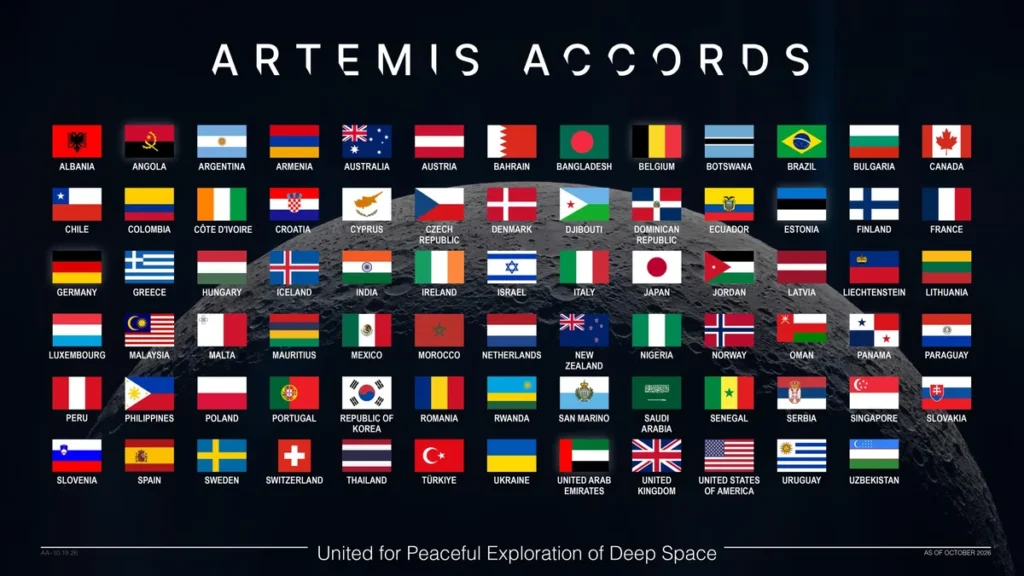
- The Artemis Accords now include 77 signatories, with nearly one-third joining since the start of President Trump’s second term, marking rapid international cooperation in civil space.
- The U.S. announced over $25 billion in commercial deals during the November 2025 White House summit with Central Asian leaders, including aviation orders, agricultural machinery, and advanced computing.
- The U.S. and Uzbekistan signed a memorandum on February 4, 2026, on supply chain security for critical minerals and rare earth elements, covering mining and processing.
- The five Central Asian countries (Kazakhstan, Kyrgyzstan, Tajikistan, Turkmenistan, and Uzbekistan) have developed a regional consultation process since 2018, expanding cooperation in transport, energy, and security.
During a ceremony in Samarkand on Oct. 19, 2026, the Republic of Uzbekistan formally entered the Artemis Accords as its 77th participant, pledging to uphold standards of safe, transparent, and responsible civil space exploration. Bakhtiyor Saidov, the nation’s top diplomat, put pen to paper on the agreement in Samarkand, noting that this step will deepen ties with NASA and open doors for training local experts and obtaining advanced space technologies. Uzbekistan achieved this milestone in parallel with the inaugural Enhanced Strategic Partnership Dialogue between the U.S. and Uzbekistan, which centered on economic cooperation, energy, advanced technologies, and security. On the sidelines of the C5+1 summit in Samarkand, U.S. Secretary of State Marco Rubio convened with the foreign ministers of all five Central Asian states to discuss commercial opportunities and regional security, pointing to the involvement of nearly 300 American businesses and potential agreements worth billions of dollars.
Established in 2020, the Artemis Accords set out principles for peaceful and transparent civil space exploration. Its core tenets include commitments to render aid, share scientific data, avoid interference, and preserve historic sites. NASA describes the accords as voluntary guidelines for civilian space exploration, rather than a binding treaty. This framework builds upon the 1967 Outer Space Treaty, modernizing its foundational principles for contemporary lunar and Martian exploration.
Of the nations that signed the 1967 Outer Space Treaty, nearly two-thirds have also joined the Artemis Accords, demonstrating broad global alignment with its core principles. These guidelines aim to enhance safety and coordination among nations exploring the Moon, Mars, and beyond, responding to growing global interest in lunar activities.
Uzbekistan is building a national space program to advance its space industry and participation in global space forums, with plans to launch its first CubeSat by 2028. This program includes collaboration with NASA and the broader international space community, with Uzbek students actively involved in the CubeSat development. In early October 2026, NASA officials met with representatives from Uzbekistan’s Ministry of Digital Technologies and Uzcosmos during the International Astronautical Congress in Antalya, Türkiye, to discuss civil space cooperation, focusing on increasing engagement and potential opportunities for collaboration. Additionally, Uzbekistan will host the annual International Astronautical Congress in 2028, highlighting its growing role in the global space community and its commitment to fostering international collaboration.
NASA Deputy Administrator Matt Anderson stated that Uzbekistan’s accession occurs at a pivotal moment, aligning with President Trump’s directive to build a Moon Base and establish an enduring lunar presence. NASA has invited all Artemis Accords signatories to join the Moon Base initiative through scientific payloads, technology demonstrations, CubeSats, and other capabilities, underscoring the collaborative nature of the framework. The milestone of 77 signatories reflects rapid international cooperation, with nearly one-third of the participants joining since the start of President Trump’s second term, meaning nearly 40% of the world’s nations are now part of the coalition. This growth reflects a shared commitment to peaceful, responsible exploration and a structured approach to lunar governance.
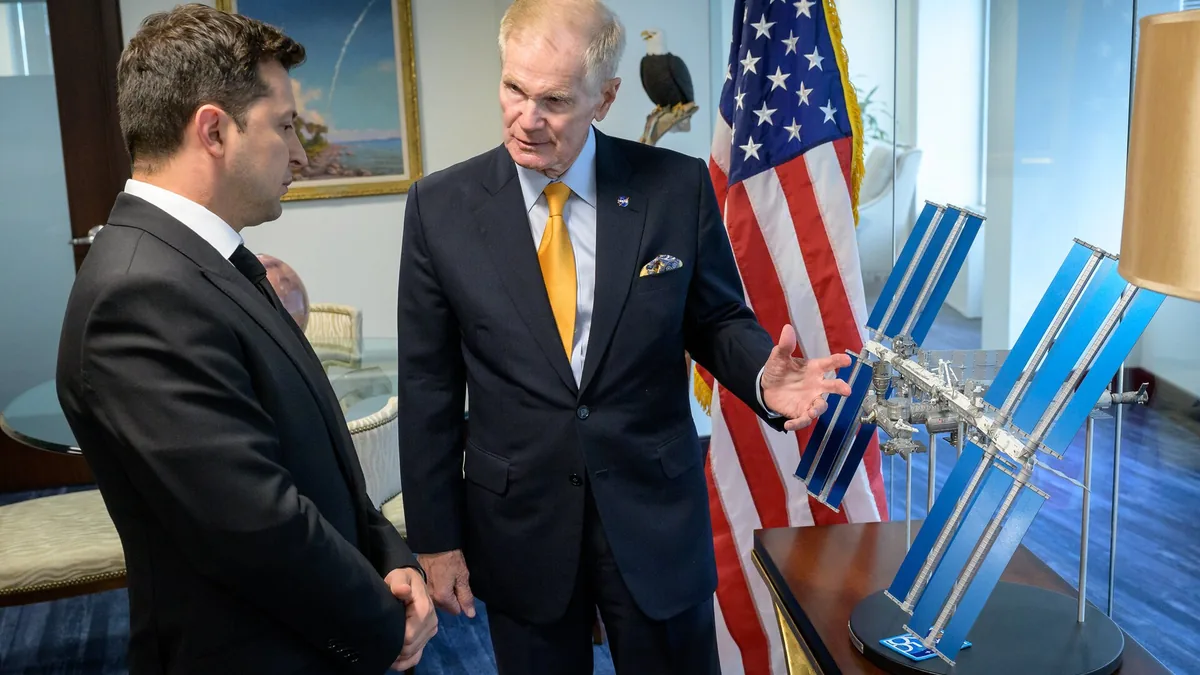
To support the implementation of the accords, the signatories adopted the Signatories Group Method of Operations in 2024, which includes twice-annual meetings, such as technical workshops and Principals’ Meetings, along with virtual sessions to support implementation. The 2026 Artemis Accords Principals’ Meeting, held on Oct. 5, 2026, at the International Astronautical Congress in Antalya, Türkiye, was co-chaired by NASA Deputy Administrator Matt Anderson and Major General Roberto Melgar Sheen of Peru’s space agency (CONIDA). The meeting focused on supporting emerging space nations and disseminating lunar debris-mitigation recommendations, reinforcing the structured approach to lunar governance.
Uzbekistan’s accession is situated within a broader geopolitical context of deepening U.S. economic and strategic ties in Central Asia. The five Central Asian countries – Kazakhstan, Kyrgyzstan, Tajikistan, Turkmenistan, and Uzbekistan – have developed a regional consultation process since 2018, expanding cooperation in transport, energy, and security. This regional framework complements broader international partnerships, including those with China and the European Union, reflecting Central Asia’s pursuit of diverse economic ties. In this environment, the U.S. and Uzbekistan signed a memorandum on Feb. 4, 2026, on supply chain security for critical minerals and rare earth elements, covering mining and processing, aligning with broader U.S. efforts to secure critical mineral supply chains.
Furthermore, the U.S. announced over $25 billion in commercial deals during the November 2025 White House summit with Central Asian leaders, including aviation orders, agricultural machinery, and advanced computing, reflecting a broad commercial interest in the region beyond mineral extraction.





Join the discussion