This is a new development in a story we reported earlier: NASA to provide instruments for JAXA's MMX Mars moon mission.
Key facts
- The primary scientific goal of the MMX mission is to determine whether Phobos and Deimos are captured asteroids or debris from a Martian impact by analyzing returned samples.
- After launch, the MMX spacecraft will take approximately one year to reach Mars, arriving in August 2027, and will then enter orbit around Phobos roughly one month later.
- After landing on Phobos, the MMX exploration module will conduct sampling activities for approximately 2.5 hours before departing, with the sample scheduled to arrive back on Earth in 2031.
- In early 2029, the MMX mission will deploy the Idefix rover, developed jointly by JAXA, CNES, and DLR, to operate on Phobos for about 100 days to assess surface conditions before the main landing.
JAXA’s Martian Moons Exploration (MMX) mission is set to launch on October 19, 2026, aboard an H3 rocket from Japan’s Tanegashima Space Center.
The mission’s primary scientific goal is to determine whether Phobos and Deimos are captured asteroids or debris from a Martian impact by analyzing returned samples. Scientists have long debated the moons’ origin, with the two leading hypotheses being that they are either captured asteroids or fragments from a Martian impact.
After launch, the MMX spacecraft will take approximately one year to reach Mars, arriving in August 2027, and will then enter orbit around Phobos roughly one month later. This timeline allows the spacecraft to survey Mars and its moons before selecting a landing site on Phobos.
Sources differ on the year of the MMX landing on Phobos, with some indicating 2030 and others stating no earlier than December 2028. The discrepancy affects the scheduling of surface operations and the rover’s preparatory work.
In early 2029, the mission will deploy the Idefix rover, developed jointly by JAXA, CNES, and DLR, to operate on Phobos for about 100 days to assess surface conditions before the main landing. The rover’s measurements will help scientists choose a safe and scientifically valuable landing site for the sampling module.
After landing on Phobos, the MMX exploration module will conduct sampling activities for approximately 2.5 hours before departing, with the sample scheduled to arrive back on Earth in 2031. The brief surface stay is sufficient for deploying a rover, collecting soil, and sealing the sample for Earth return.
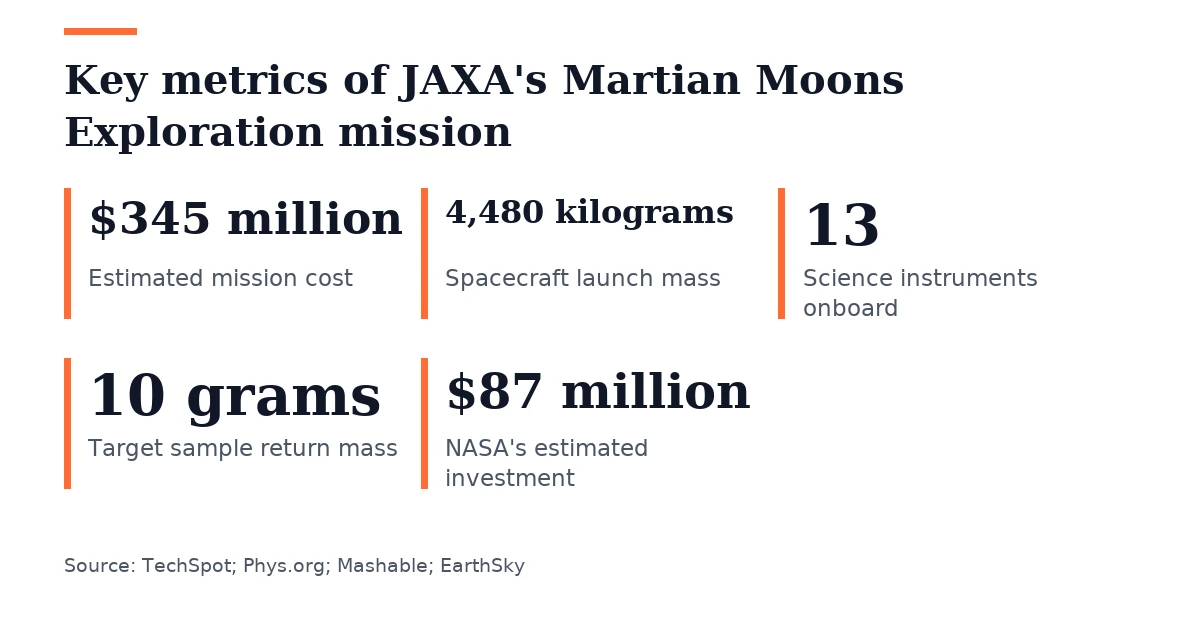
The mission aims to collect and return to Earth at least 10 grams of material from Phobos for detailed laboratory analysis. This quantity allows detailed laboratory studies and exceeds the samples returned from previous asteroid missions.
The exploration module will use a C‑sampler to drill a 2 cm core for an unaltered sample or, as a backup, a P‑sampler that releases nitrogen gas to lift soil into a chamber. This choice affects sample depth and protects the specimen from surface alteration caused by solar radiation. NASA-developed P‑sampler employs ultrapure nitrogen gas to lift loose soil into a chamber, working like a vacuum cleaner.
The spacecraft carries 13 science instruments, including the Tengoo and Orochi high‑resolution cameras, a laser altimeter (Lidar), an infrared spectrograph (MIRS), and a gamma‑ray and neutron detector (Megane) developed by NASA. These instruments will help select a landing site and interpret the returned samples’ mineralogy and elemental makeup.
The Tengoo and Orochi cameras will map Phobos’s surface, while the Lidar will measure distances to create a detailed topographic model. The MIRS will survey the moon’s mineral composition, complementing the elemental analysis provided by Megane.
Megane, meaning ‘eyeglasses’ in Japanese, will measure gamma rays and neutrons emitted from Phobos to determine its elemental composition. It will provide the first detailed measurements of Phobos’s chemical elements, helping scientists distinguish between the asteroid capture and impact-debris theories of its origin.
JAXA leads the MMX mission with U.S., French, German, and ESA partners, and NASA will supply the Megane instrument and one soil sampler while retaining at least 15 % of the returned samples. This partnership shares costs, expertise, and ensures broad scientific access to the Phobos material.

“MMX will be the first spacecraft ever to return to Earth from the Mars system,” said Tom Statler, NASA’s program scientist for the mission. He made the remark during pre‑launch briefings to highlight the mission’s historic nature and NASA’s role as a partner.
NASA estimates its investment in the MMX mission to be around $87 million over 14 years, covering contributions to the Megane instrument and one of the soil samplers. NASA’s involvement includes supplying critical instruments and technology, as well as retaining some of the returned samples for further study in the U.S.
Experts expect the mission to cost approximately $345 million. The spacecraft will launch with a mass of 4,480 kilograms, more than half of which is propellant for the outbound, operational, and return phases.
Researchers estimate that about 0.1% of the material collected by MMX from Phobos could have originated from Mars, as asteroid impacts eject Martian soil onto the moon’s surface. This would provide an indirect sample of the Martian surface, augmenting the scientific return of the mission.
MMX will test communication between the spacecraft and a newly developed ground station to ensure reliable contact during the mission. Reliable links are essential for sending commands and receiving science data over the interplanetary distance.
The spacecraft will use autonomous navigation to guide itself toward a safe landing site on Phobos, adjusting its position based on real‑time surface comparisons with pre‑loaded crater and terrain maps. The spacecraft will rely on autonomous decision‑making due to a potential 20‑minute communication delay between Earth and Phobos, which makes real‑time control impossible. Below 300 meters, MMX will actively scan for unexpected elevation changes that could pose a landing hazard, allowing it to shift to a safer location or abort the landing.
After reaching Mars and expending its outbound propellant, the spacecraft will discard its outbound propulsion module, then fly by the moon Deimos before jettisoning the exploration module and proceeding on the return trajectory to Earth. This modular design allows the spacecraft to optimize its mass and fuel usage for different phases of the mission, including the journey to Mars, operations around the planet, and the return to Earth.
The mission will test advanced autonomous navigation, landing, and sample‑return systems that could support future Mars missions, including robotic sample returns and potential human exploration. This mission serves as a critical step in developing technologies for future Mars exploration, including the ability to return samples from the Martian surface itself or support human exploration.
MMX could serve as a lighter alternative to the cancelled NASA‑ESA Mars Sample Return mission, which faced budgetary pressures leading to its effective cancellation by the U.S. Congress. Success would show critical technologies needed for future Mars sample‑return efforts.
The MMX mission’s sample return capsule will land in Australia, where teams will recover the sample and transport it to Japan for cataloging and distribution to mission partners. The capsule’s landing in Australia is part of the mission’s plan to ensure the safe retrieval and transport of the Phobos samples for international scientific collaboration.



Join the discussion