Key facts
- Re‑examining the 1999 Hubble data with an updated chemical database identified the element niobium as matching many of the previously unidentified features.
- Researchers interpret the niobium signature as evidence of material expelled during the white dwarf progenitor's death throes.
- The candidate planet is estimated to be a gas giant comparable in size to Jupiter.
- TESS monitored HS 0209+0832 for four months and detected periodic brightness variations consistent with a planet at that distance.
On 5 October 2026, researchers reported that Hubble archival data of the white dwarf HS 0209+0832 reveal a possible second‑generation planet formed from stellar debris.
The team found about 100 chemical features in the 1999 Hubble spectra that they could not identify at the time. Re‑examining those data with an updated chemical database matched many of the unidentified features to the element niobium. Niobium had never been detected in any white dwarf before, and its presence points to material forged in the star’s final stages. Elements heavier than iron, such as niobium, are not made by ordinary fusion in stellar cores; they are created in dying stars and expelled into space.
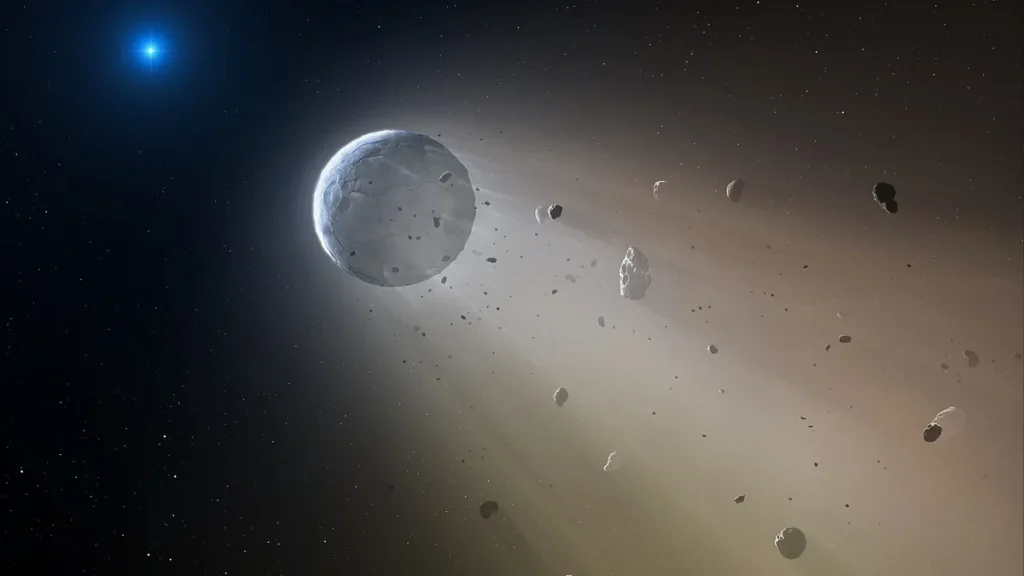
Researchers interpret the niobium signature as evidence of gas ejected during the white dwarf progenitor’s death throes. They propose that after ejection some of this chemically enriched material coalesced into a gas‑giant planet, while the rest dispersed into space. The candidate planet is estimated to be comparable in size to Jupiter. Its orbit lies about six million kilometers (3.7 million miles) from HS 0209+0832, far closer than Mercury’s distance from the Sun.
TESS monitored HS 0209+0832 for four months and detected periodic brightness variations consistent with a planet at that distance. Archival data from the retired FUSE mission also show strong niobium signatures in the HS 0209+0832 system, supporting the Hubble findings. The intense radiation from the hot white dwarf is likely stripping the planet’s atmosphere, possibly creating a comet‑like tail that falls back onto the star. Such a tail could explain the detectable niobium in the star’s light.
Lead author Jamie Williams of the University of Warwick said that if the planet exists, it likely survives and could live in a stable habitable zone for millions of years once the white dwarf cools. The research paper reporting these results appeared in Nature Astronomy on 5 October 2026. Researchers note that determining how common or rare such second‑generation planets are, and how they evolve around dead stars, remains an open question requiring further Hubble observations.
HS 0209+0832 is a relatively young white dwarf, about one percent of the Sun’s radius but roughly sixty percent as massive, and remains hot enough to bombard the nearby planet with intense radiation.
The international team includes scientists from the University of Warwick’s Centre for Exoplanets and Habitability, the Instituto de Astrofísica de Canarias, the Racah Institute of Physics, the Institut für Theoretische Physik und Astrophysik, the University of Wisconsin–Madison, MIT, the Laboratory for Atmospheric and Space Physics, the Harvard & Smithsonian Center for Astrophysics, and the Space Telescope Science Institute.
What Hubble is showing us in this white dwarf system is something we haven't seen before: a high abundance of the element niobium,
Jamie Williams, Universe Today

Join the discussion