Key facts
- Researchers selected 15 pristine, small, distant galaxies with minimal chemical evolution to serve as cosmic time capsules, preserving the chemical composition of the early universe.
- The team abandoned traditional extrapolation methods, which estimate primordial helium by observing many galaxies and projecting backward, because these methods introduced greater uncertainty.
- The researchers analyzed over 10 helium spectral lines and 15 hydrogen spectral lines simultaneously to correct for subtle systematic errors that had previously been overlooked.
- The study marks a significant advancement in precision cosmology, demonstrating that highly ambitious measurements can achieve their proposed goals and deliver transformative results.
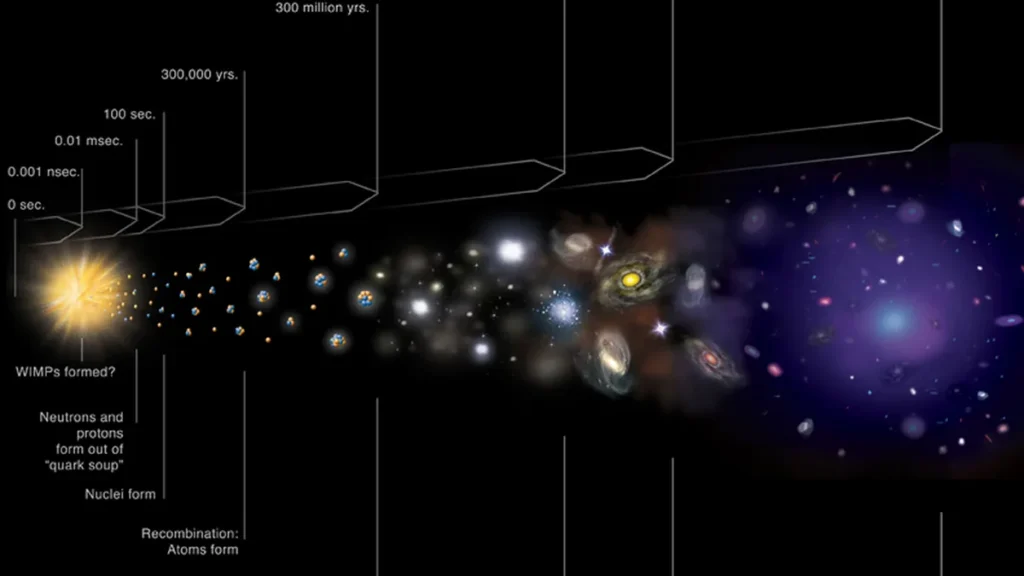
An international team of scientists measured the primordial helium produced during the first five minutes after the Big Bang, achieving an uncertainty of just 0.5%, which is three times more precise than previous estimates and marks a major leap in cosmological research. The team selected 15 pristine, small, distant galaxies that had undergone minimal chemical evolution, using them as cosmic time capsules to preserve the chemical composition of the early universe for detailed analysis. With 130 hours of observations using the Large Binocular Telescope and MODS spectrographs developed at Ohio State University, they analyzed helium and hydrogen spectral lines to reach this milestone and understand the early cosmos.
This precise measurement of primordial helium strengthens one of the three main pillars of the Big Bang theory, alongside the universe’s expansion and the cosmic microwave background. The analysis relied on spectral lines of helium and hydrogen from 15 pristine galaxies.
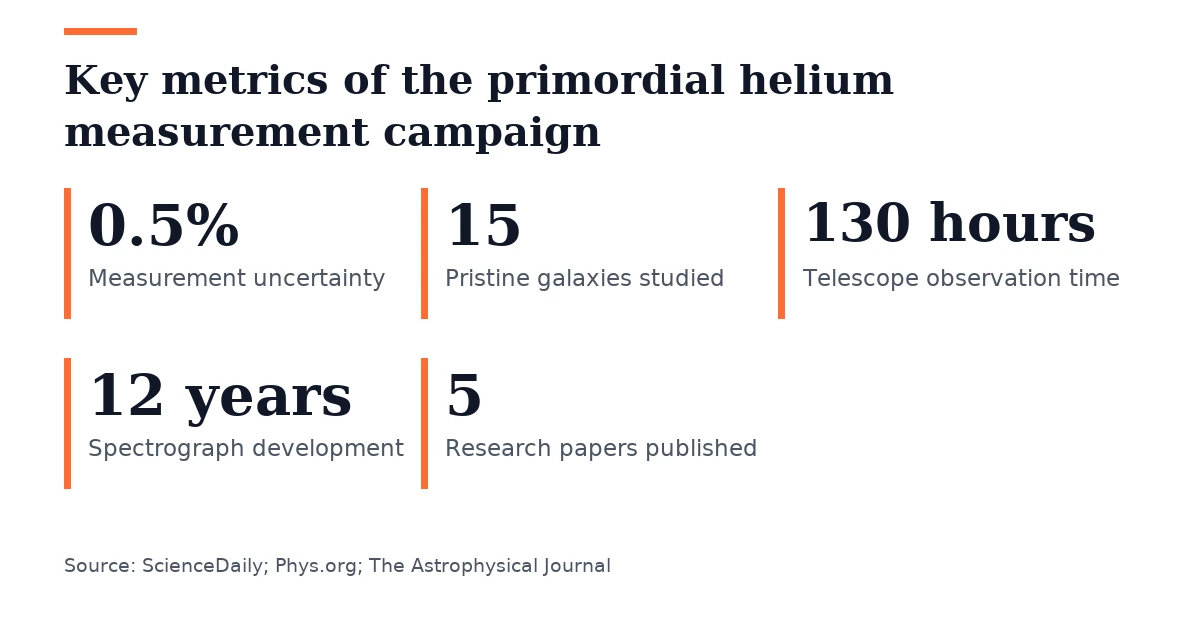
The researchers set aside traditional extrapolation methods, which estimate primordial helium by observing many galaxies and projecting backward, because these methods introduced greater uncertainty. Instead of relying on large samples, the researchers focused on 15 pristine galaxies that had undergone minimal chemical evolution, preserving the early universe’s composition more accurately. To achieve sub-percent accuracy, the team analyzed over 10 helium spectral lines and 15 hydrogen spectral lines simultaneously using the MODS spectrographs, correcting for subtle systematic errors that had eluded researchers.
Measuring primordial helium provides a direct test of the Standard Model of physics, as its amount depends on the physical conditions—such as the types of elementary particles—present during the universe’s first five minutes. Neutrinos, which are light subatomic particles, have behavior that plays a crucial role in understanding fundamental physics, and scientists can infer the number of neutrino families from precise measurements of primordial helium. The team used the helium measurement to calculate the number of neutrino families present in the early universe, offering a unique way to test or challenge the Standard Model’s predictions about the universe’s earliest moments and investigate the physical conditions of the early universe.
The study, published in five papers in The Astrophysical Journal in 2026, represents a significant step for precision cosmology, demonstrating that highly ambitious measurements can deliver results matching their original expectations. Evan Skillman, a Distinguished Professor at the University of Minnesota and a lead researcher, called the helium measurement one of the biggest findings in his 40-year career, emphasizing its diagnostic power for the Standard Model of Physics. He noted that achieving the proposed 0.5% uncertainty was highly unusual in science, where such precise results are rarely attained, underscoring the team’s meticulous planning and execution.
The research involved an extensive international collaboration of scientists from the University of Minnesota Twin Cities, Ohio State University, Gonzaga University, Northwestern University, The University of Texas at Austin, Indiana University, University of California Santa Cruz, University of Illinois, Universidad Nacional Autónoma de México, and TRIUMF. The five papers in The Astrophysical Journal provide a comprehensive description of the project, including sample selection, observations, and the methods used to achieve the precise measurement.



Join the discussion