
Key facts
- NASA accounted for only 55% of total civil space spending in FY2026, with $24.4 billion allocated, while the Department of Energy (DOE) ranked second at 18% with $7.5 billion.
- The Infrastructure, Energy, and Resiliency category saw a 29% reduction in FY2026 compared to FY2025, the largest cut among the seven national priorities.
- The White House and Congress are out of sync on civil space funding, with the FY2027 outcome uncertain due to a Continuing Resolution extending through December 11, 2026, and midterm elections approaching.
U.S. government spending on civil space activities totaled $42.6 billion in fiscal year 2026, representing a $1.6 billion decrease from the previous year, according to an analysis by The Aerospace Corporation. The report highlights a broader civil space budget encompassing 19 non-defense agencies, with NASA accounting for 55% of the total at $24.4 billion. The Department of Energy ranked second, contributing 18% or $7.5 billion to the civil space efforts. The Aerospace Corporation’s expansive definition of civil space moves beyond traditional NASA programs to include agencies like the Department of Agriculture, the Department of Energy, and the National Telecommunications and Information Administration, which leverage space for non-traditional purposes such as agricultural statistics, energy research, and telecommunications regulation.
The Aerospace Corporation categorizes civil space funding across 19 non-defense agencies into seven national priorities, reflecting how departments leverage space for non-traditional purposes. These priorities include American Leadership and Manufacturing, Fundamental Science, Infrastructure, Energy, and Resiliency, Remote Sensing Applications, Homeland Security, Streamlining and Expansion, and Workforce Development. Agencies such as the Department of Agriculture, the Department of Energy, and the National Telecommunications and Information Administration contribute to these categories, using space for agricultural statistics, energy research, and telecommunications regulation. DOE’s funding includes scientific research and energy programs indirectly supporting space activities, such as advanced computing and nuclear physics.
Despite the broad base of support, the FY2026 civil space budget experienced a $1.6 billion decrease from FY2025, with the Infrastructure, Energy, and Resiliency category suffering the largest reduction of 29%. The report attributes this reduction to congressional appropriations exceeding the President’s Budget Request but still falling short of FY2025 levels, with the Infrastructure category bearing the brunt of the cuts. This budgetary outcome occurred despite a historic government shutdown in FY2026, which lasted longer than any previous shutdown in history. During the shutdown, Congress ultimately appropriated more than the President’s Budget Request and added billions via the One Big, Beautiful Bill Act, also known as the Working Families Tax Cut Act, but congressional priorities and budget constraints still resulted in a net decrease compared to the previous fiscal year.
The Aerospace Corporation’s report found that within the broader budget, Remote Sensing Applications in FY2026 included critical programs such as NOAA’s environmental satellites, USGS land-imaging activities, and the Department of Agriculture’s agricultural statistics. These programs rely on satellite data for public services like weather forecasting, land management, and fisheries enforcement, with funding decisions impacting both spacecraft operations and ground-based analysis. The Aerospace Corporation’s report notes that proposed funding cuts for FY2027 affect data analysis and operational agencies.
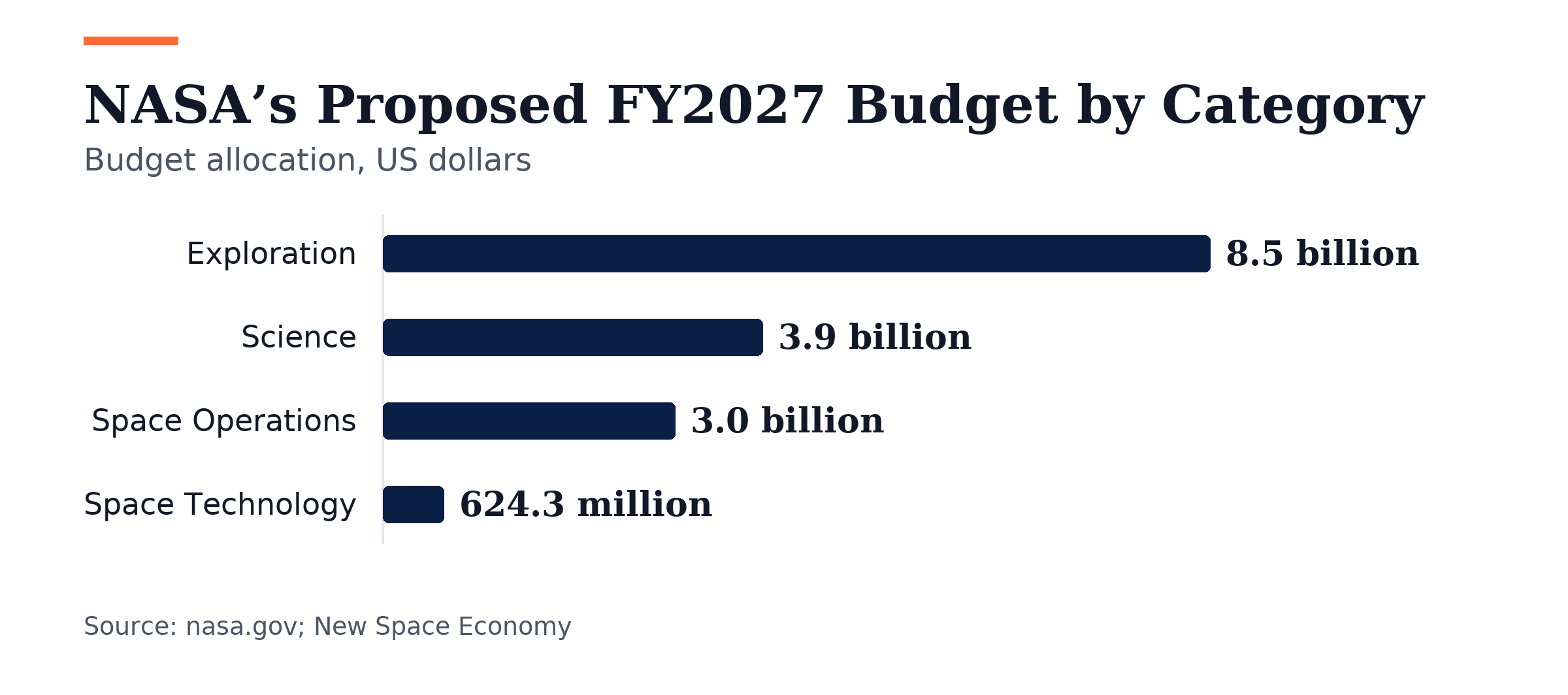
The FY2027 President’s Budget Request proposes deep cuts to civil space funding across all seven national priorities, with Workforce Development facing the largest reduction of $470 million, or 52%. This includes the elimination of NASA’s $143 million STEM Engagement program and $16.4 million in cuts to two Department of Education programs. Additionally, NASA’s overall FY2027 request proposes a $5.6 billion, or 23%, reduction from FY2026 levels, shifting funding toward Exploration, which would increase to $8.5 billion, while cutting Science to $3.9 billion, Space Technology to $624.3 million, and Space Operations to $3.0 billion. This request reflects a prioritization of exploration over scientific research and technology development, a shift that Congress is likely to reject, as seen in FY2026 where appropriations exceeded the PBR.
The White House and Congress remain out of sync on civil space funding, creating significant uncertainty for the FY2027 budget process. The Aerospace Corporation characterizes the current civil space budget as experiencing ‘tumultuous times,’ with the FY2027 request proposing cuts that Congress may reject. A Continuing Resolution is in place through December 11, 2026, while midterm elections loom, which may influence congressional decisions and add to the legislative uncertainty surrounding the final allocation of funds for the upcoming fiscal year.
As of October 2026, all 12 FY2027 appropriations bills have cleared the House Appropriations Committee, with three passed by the full House, but the Senate Appropriations Committee has not finalized any bills. This legislative gridlock, combined with the multiyear reconciliation funding of $9.995 billion allocated to NASA in FY2025 under Public Law 119-21, complicates direct fiscal comparisons and future planning. This reconciliation funding, distributed as $7.4 billion for Exploration, $1.6 billion for Space Operations, and $1 billion for infrastructure, operates on a multiyear track separate from annual appropriations and supports specific programs like Artemis and Gateway.




Join the discussion