Key facts
- NASA extended Perseverance’s mission to explore Jezero Crater’s rim through Dec. 31, 2028, following its original primary mission and a first extension approved in Oct. 2026.
- Perseverance has collected 29 rock and regolith samples from Jezero Crater’s floor, delta fan, and rim, spanning 4 billion years of Martian history, including potential biosignatures like those found at Cheyava Falls.
- ESA’s Space Rider reusable spacecraft prototype failed its Oct. 6, 2026, landing test during a helicopter drop, but ESA confirmed the project remains on schedule for future missions.
- Perseverance parks by mid-afternoon when driving toward the sun because glare in its navigation cameras obscures the view; teaching it to see past those artifacts would lengthen the working day for future rovers.
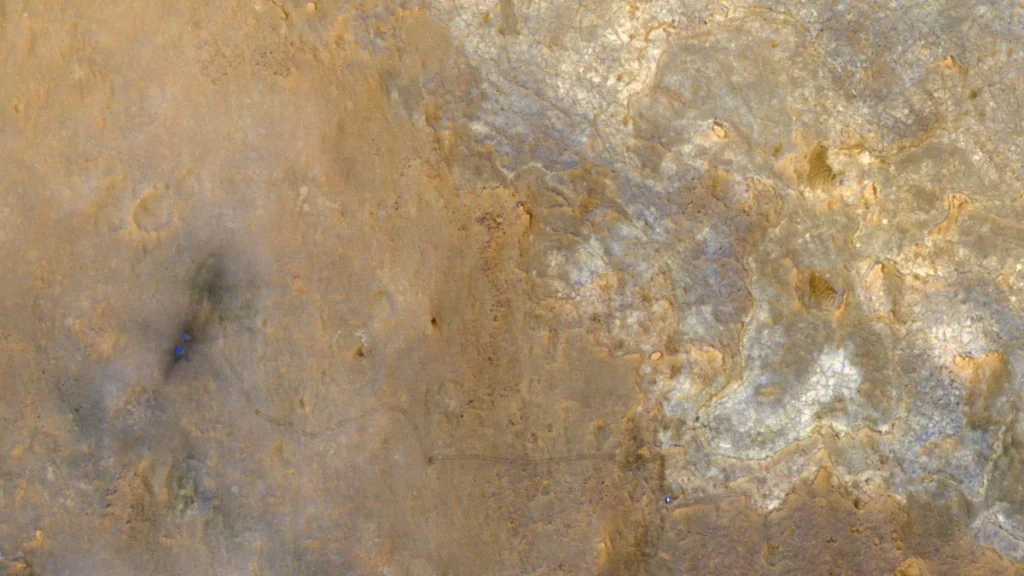
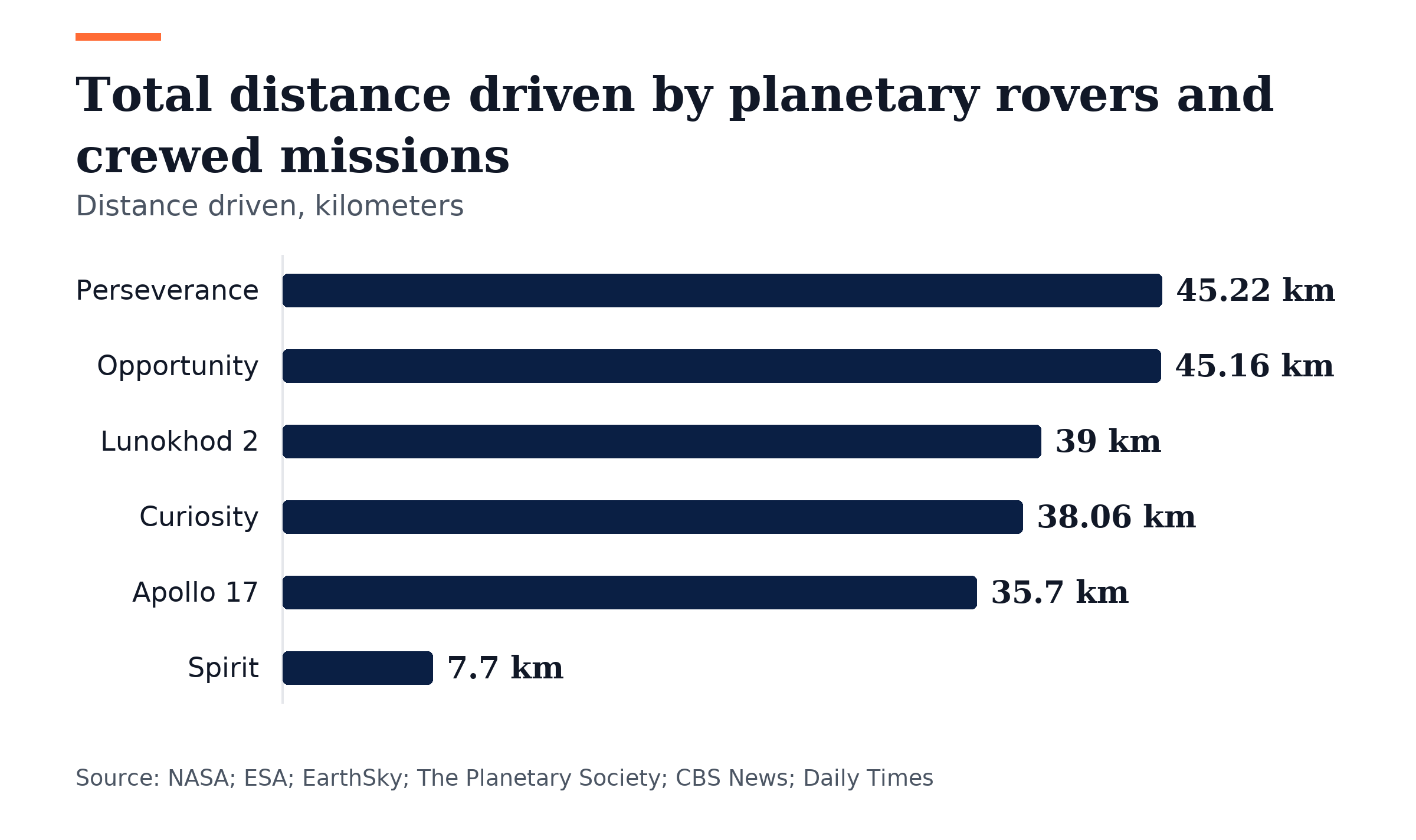
NASA’s Perseverance rover drove 45.22 kilometers on Mars on Oct. 11, 2026, passing the 45.16-kilometer record set by Opportunity in 2018.
The milestone came during the rover’s 2,006th sol on Mars while it explored the western rim of Jezero Crater. Perseverance’s AutoNav autonomous navigation system handles 600,000 terrain measurements each drive and charts hazards immediately, letting the rover cover 90% of its total distance without direct human input. Opportunity’s system managed only 5% without human help.
NASA extended Perseverance’s mission at Jezero Crater through Dec. 31, 2028, following an extension approved in October 2026. The original mission called for no more than 12.4 miles of driving, but Steven Lee of NASA’s Jet Propulsion Laboratory said the rover has “blown well past” that goal. Lee added that the rover’s systems remain operational and could keep functioning into the 2030s.
Perseverance is investigating Idubi on the crater’s western rim where researchers think ancient hydrothermal systems might have existed. Scientists estimate these rocks rank among the oldest ever examined on Mars, and Mars has no tectonic erosion to wear them down. The rover is studying them to learn about Mars’ geological past and whether it ever supported biology.
The rover has gathered 29 rock and regolith samples from the crater floor, a delta fan, and the rim. They cover 4 billion years of Martian history and include possible biosignatures similar to those found at Cheyava Falls. Separately, researchers have spotted a potential biosignature in reddish stone from 3.2 billion to 3.8 billion years ago and are checking whether it points to past life.
Perseverance reached the 45.22-kilometer mark in about five and a half years, while Opportunity needed about 15 years to set the earlier record. On Oct. 11, 2026, Perseverance and Curiosity were the only Mars rovers still moving on the surface, and their distances should keep rising.
Curiosity touched down in Gale Crater in 2012, is still active, and has covered more than 23.65 miles, or 38.06 kilometers. Spirit drove 4.8 miles before the Martian winter ended it in 2010. Opportunity worked for 5,111 sols and completed a marathon on another world in 2015. Sojourner traveled roughly 330 feet during its 83-sol mission in 1997.
Perseverance has also surpassed lunar driving marks. Gene Cernan and Harrison Schmitt of Apollo 17 drove 22.2 miles, or 35.7 kilometers, in 1972. Lunokhod 2, a Soviet rover, drove 24.2 miles, or 39 kilometers, in 1973.
The rover hit the mark while heading toward Idubi through Lac de Charmes, an area on the edge of Jezero Crater’s western rim. After Lac de Charmes, the rover will continue along the rim and head south during the extended mission toward Rainbow Falls. Rainbow Falls consists of a 328-foot-wide block of ancient crust lifted by the impact that formed Jezero.
AutoNav photographs the ground as it moves, constructs a three-dimensional hazard map, and charts a route between waypoints chosen by planners on Earth. On each look the rover works through 600,000 measurements, while Sojourner used only 20. Mark Maimone, Perseverance’s deputy team chief for robotic operations, said the rover chose its own path and that new software helps it steer less and roll more.
Maimone said the rover drives better now than at landing and that the team keeps refining its skills. When heading into the sun, the rover stops by mid-afternoon because glare blocks its navigation cameras. If it could see through those artifacts, future rovers could work longer each day.
NASA made the driving milestone public on Tuesday, Oct. 13, 2026. Steven Lee said the rover’s equipment and scientific instruments remained in excellent condition and that recent assessments indicated its systems could keep operating well into the 2030s. Lee said roughly 90% of the rover’s trips happen without direct human control, with AutoNav building maps from images and picking safe routes.
Hera took its first detailed pictures of the Didymos-Dimorphos asteroid pair on Oct. 18, 2026, from 1,280 kilometers away and saw them as separate bodies for the first time. The spacecraft belongs to ESA’s planetary defense effort and will examine what happened after NASA’s DART strike changed Dimorphos’ path. Sharper views of Dimorphos should arrive by Nov. 25, 2026, while Hera moves closer to both asteroids.
NASA’s NEO Surveyor telescope, set to launch in 2027, has finished putting together its 6-meter sunshade, which carries 864 solar cells able to generate as much as 2 kilowatts. The sunshade blocks sunlight, so the telescope can spot near-Earth objects hidden in the Sun’s glare. The goal is to find dangerous near-Earth objects before they become a threat.
The Space Rider reusable spacecraft prototype from ESA did not survive its Oct. 6, 2026, landing test during a helicopter drop. ESA said the project is still on schedule for future missions.
The Vera C. Rubin Observatory discovered 2026 ED138, a dwarf planet candidate 600 to 1,500 kilometers wide beyond Pluto’s orbit. That makes it the largest object spotted in that part of the Solar System. Data indicate 2026 ED138 is probably round, a quality that fits the dwarf planet definition.
Planetary Radio from The Planetary Society broadcast an episode during the week of Oct. 30, 2026, looking back at a 2021 talk with Vandi Verma, who leads robotic operations for Perseverance at NASA’s Jet Propulsion Laboratory. The program marked the driving record by showing how the self-driving system has handled most of the route.
Researchers used Perseverance information to build a timeline of Jezero Crater’s formation that splits its past into three big periods following the arrival of water. The timeline came after the rover landed in February 2021. In 2023, NASA stated that microbes might once have lived in Jezero Crater.
NASA first expected Perseverance to drive about 20 kilometers over the course of its mission. Teams are now testing mobility hardware for trips of 100 kilometers or longer. The rover’s plutonium-powered energy system keeps performing as expected.





Join the discussion