Key facts
- NASA astronaut Jessica Watkins packed the failed wrist joint from Canadarm2 into a SpaceX Dragon cargo spacecraft so engineers can analyze it on Earth.
- NASA and SpaceX moved the Dragon capsule's undocking from Nov. 18 to Nov. 20 after rough weather hit the California splashdown zones, and the craft later landed in the Pacific near Los Angeles on Nov. 21.
- The Canadarm2 wrist joint failed and was replaced with a spare during a spacewalk on June 30.
- NASA intends for Watkins and NASA astronaut Luke Delaney to capture Northrop Grumman's Cygnus XL cargo ship with Canadarm2 on Dec. 1.
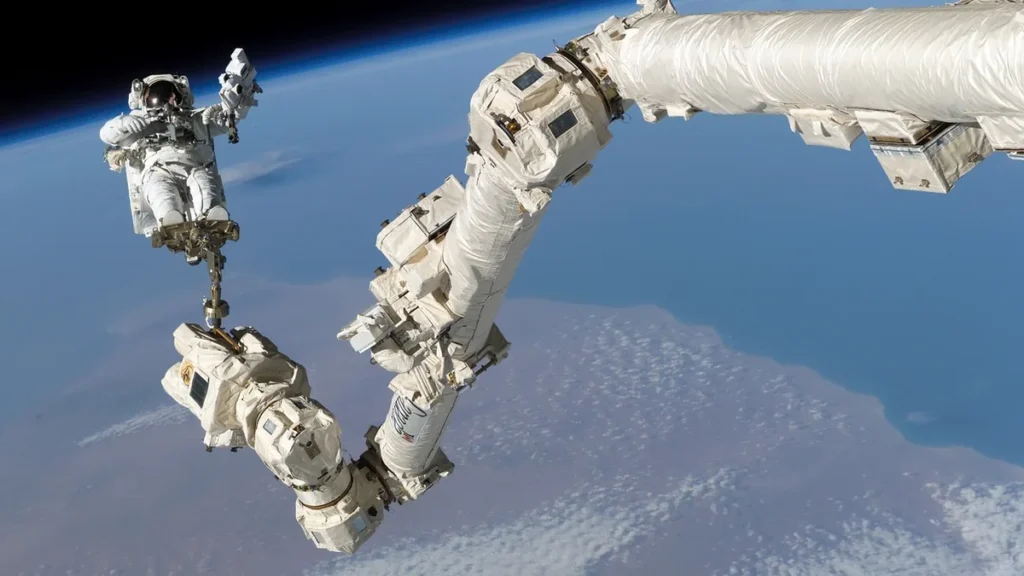
NASA astronaut Jessica Watkins packed the failed wrist joint from Canadarm2 into a SpaceX Dragon cargo spacecraft, so engineers can analyze it on Earth, and the capsule splashed down in the Pacific Ocean near Los Angeles on Nov. 21, SpaceQ Media Inc. reported.
After rough weather hit the California splashdown zones, NASA and SpaceX moved the Dragon capsule’s undocking from Nov. 18 to Nov. 20. SpaceQ Media Inc. reported, “The joint failed on Canadarm2 and was swapped for a spare during a June 30 spacewalk.” The schedule shift kept the cargo vehicle on its planned return path.
The agency intends for Watkins and NASA astronaut Luke Delaney to capture Northrop Grumman’s Cygnus XL cargo ship with Canadarm2 on Dec. 1. The Cygnus XL vehicle is set to launch no earlier than Nov. 29 aboard a SpaceX Falcon 9 with about 5,000 kilograms (11,000 pounds) of supplies and research.
While the arm prepares for that capture, station research continued through the week. Canadian Space Agency astronaut Joshua Kutryk provided a blood sample on Nov. 13 with assistance from Watkins, then processed it in a centrifuge and stored it in a science freezer for later use. Three days after the Nov. 13 blood draw, Kutryk performed tests using ACTIS, equipment that allows flight surgeons to monitor crew health from Earth.
The ACTIS testing followed the earlier sample collection and supports remote monitoring of crew health by doctors on the ground. On Nov. 18, Kutryk processed protein-crystal samples for a medical research project led by Japan’s space agency. Kutryk completed two exercise sessions on the E4D, a compact workout device in the Columbus module being tested to protect muscle and bone health for future Moon and Mars missions.
On Nov. 17, Kutryk inspected the hatch seals aboard the U.S. segment of the station and carried out more resistance training. NASA astronaut Luke Delaney collected thale cress cultivated in the Kibo laboratory’s plant-growth facility on Nov. 13 and prepared the samples in a glovebox for transport back to Earth. Menon exchanged sample cassettes and hard drives in a materials-processing unit previously used for pharmaceutical and microbiology tasks.
The unit had been used for recent pharmaceutical and microbiology research before the hardware swap. Watkins and Delaney participated on Nov. 16 and 17 in research on the effects of extended orbital stays on blood flow, using ultrasound to scan veins and taking blood pressure readings as ground-based doctors monitored in real time. Ground-based doctors monitored the crew members’ cardiovascular responses during the two-day study session. Menon defrosted and nourished human lung cells for research into growing lung tissue in weightlessness, with the goal of improving understanding of respiratory disease.
The cell culture work is intended to advance understanding of lung tissue development and respiratory illness in microgravity. Pyotr Dubrov, who served as station commander, and Anna Kikina, both Roscosmos cosmonauts, evaluated an acoustic breathing monitor and practiced docking procedures on the Zvezda module. This work was part of the Russian segment’s operations during the week alongside other station maintenance. Sergey Teteryatnikov, a Roscosmos cosmonaut, refreshed navigation software for the European robotic arm on the station and maintained cabin ventilation and water equipment.
The software update and life-support servicing supported the European robotic arm and station cabin systems. Menon received training on how to fly the station’s free-flying Astrobee robots. This robotics training occurred alongside other crew activities during the week. Jenni Gibbons, a Canadian Space Agency astronaut, traveled to Whitehorse, Yukon, on Nov. 17 and 18.
Roughly 300 students representing five Whitehorse-area schools, along with other community members, assembled on Nov. 18 to listen to Gibbons discuss Canada’s part in NASA’s Artemis program and Kutryk’s mission, according to the CSA. The visit included a public event where she discussed Canada’s participation in NASA’s Artemis program and Kutryk’s mission. SpaceQ reported beforehand that Kutryk would participate in the session from orbit in real time. The advance report preceded the Nov. 18 gathering where Gibbons discussed Kutryk’s flight.
Join the discussion