Key facts
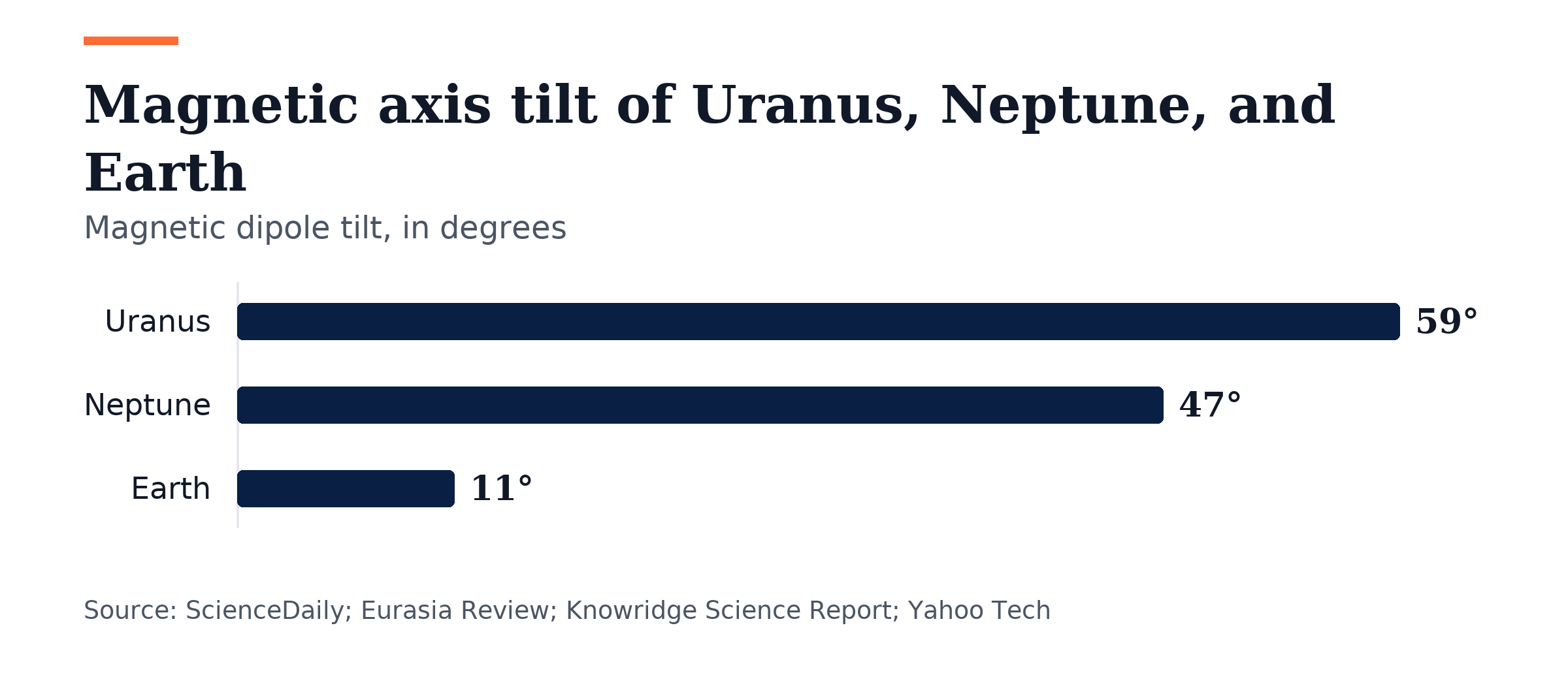
- Uranus's magnetic dipole tilts 59 degrees and Neptune's 47 degrees from their rotation axes, while Earth's main magnetic axis tilts only 11 degrees.
- Earth's magnetic tilt drifts by only about one degree over 50 years, so the modeled ice-giant shifts are far faster than anything seen on Earth, Chi Yan said.
- Uranus and Neptune have 14.5 and 17 times Earth's mass respectively, creating crushing conditions within their interiors.
- Voyager 2 flew past Uranus in January 1986 and Neptune in August 1989, and it remains the only spacecraft to have visited either ice giant.
Computer simulations led by Chi Yan of the University of Texas at Austin, with collaborators at the University of California, Los Angeles, Imperial College London, and Northumbria University, show that electrical conductivity rising with depth inside Uranus and Neptune can swing the planets’ magnetic tilts by tens of degrees within a few decades, according to research published 3 November 2026 in Communications Physics. The study, “Electrical conductivity structure drives anomalous and potentially time-varying magnetic fields at Uranus and Neptune,” appeared in Communications Physics, 2026; 9(1).
Uranus’s magnetic dipole tilts 59 degrees from its rotation axis and Neptune’s tilts 47 degrees, while Earth’s main magnetic axis tilts only 11 degrees. Uranus’s field is offset from its rotational axis and not centered on its core, extending about two-thirds of the distance to its core, while Neptune’s disordered field lies halfway from its core to its cloud tops. Neptune also has a quadrupolar component that muddles its defined north and south magnetic poles.
NASA’s Voyager 2 spacecraft passed Uranus during January 1986 and Neptune during August 1989 and remains the only spacecraft to have visited either ice giant. Those encounters showed that the planets have dramatically distorted and tilted magnetic fields compared with Earth’s orderly field. Because Voyager 2 gave only limited snapshots, researchers need more evidence before they can conclude that either planet’s magnetic field shifted by a specific amount after those flybys.
Deep inside Uranus and Neptune, extreme pressures and temperatures lead to water molecules splitting into ions, and the substance could grow more electrically conductive at greater depths, according to study lead author Chi Yan. They tested many possible internal structures and looked at how moving fluids, shifting temperatures, and magnetic forces interact as time passes. The study received funding from the University of Texas Institute for Geophysics in the Jackson School of Geosciences, along with NASA and the Science and Technology Facilities Council.
Chi Yan said, “Earth’s magnetic tilt drifts by only a degree or so over 50 years.” The shifts seen in the models outpace anything observed on Earth, he said. Earth’s field shows clear north and south poles that move slowly and reverse over long periods.
The simulations build on the idea that electrical conductivity increases with depth, and they generated large-scale magnetic features matching what Voyager 2 saw at both planets, the authors said. Within the models, the uneven magnetic fields changed by large amounts, even though the pace of change went up and down and could slow for a time. Magnetic-field structure changes together with fluid motion driven by convection and temperature inside the planets, and this linked evolution might still be continuing.
Those projected changes come from computer models, not confirmed observations, and the fields at both planets today could look different from the measurements taken by Voyager 2 during the 1980s. The strength and direction of the ice giants’ magnetic fields may have shifted over the decades since Voyager 2 flew by, yet only new measurements could reveal the size of any actual change. Researchers say observations poorly constrain the size of any shift in field strength or direction since the Voyager 2 flyby.
Scientists are studying detailed infrared JWST images of auroras at Uranus and Neptune. Those auroras form when charged particles from the Sun meet atmospheric gases, and they can show whether the magnetic poles have moved since Voyager 2. Tom Stallard of Northumbria University led the JWST observation campaign and co-wrote the new research paper with Chi Yan. The group intends to merge JWST auroral pictures, Voyager 2 magnetic-field data, and dynamo simulations to figure out the arrangement of the magnetic fields at the planets right now.
Making sense of these unusual fields can reveal how magnetic dynamos operate on planets and stars, because looking at unusual cases often shows how processes work across an entire group. A planetary dynamo happens when electrically conducting fluids move deep inside a planet and create a magnetic field. Uranus and Neptune have magnetic fields that tilt, show peaks, and differ from those of every other known planet.
Uranus and Neptune are each roughly four times the width of Earth, with masses of 14.5 times Earth’s mass for Uranus and 17 times for Neptune, respectively, creating crushing conditions within their interiors. Within those planets, water, ammonia and methane ices turn into ionic and superionic forms under crushing pressure and heat, and convection plus rotation also helps build their magnetic fields. Uranus leans about 97 degrees and essentially rolls around the Sun, and some think a long-lost Earth-sized planet knocked it sideways billions of years ago. Because Neptune has no such collision history, its similar magnetic skew suggests an underlying cause built into the nature of both ice giants.
NASA has made a new mission to Uranus in the early 2040s a priority. China’s Tianwen-4 mission will launch toward Jupiter in 2029 and will send a small probe on to Uranus using a gravitational slingshot. Gaining a full understanding of the deep interiors of Uranus and Neptune will demand new spacecraft missions, while better simulations and strong telescopes could help solve the puzzle for now.
The ionosphere is part of the upper atmosphere and holds electrically charged particles, and its behavior responds to magnetic activity, so it could provide clues about shifting magnetic conditions at the planets. Aurorae happen when charged particles from the solar wind hit a planet’s magnetic field, driving some of those particles into the atmosphere over the magnetic poles.




Join the discussion