Key facts
- Research published in Communications Physics says that shifts in deep-interior electrical conductivity at Uranus and Neptune may explain the planets' unusual magnetic fields and their possible evolution over time.
- Chi Yan of The University of Texas at Austin led the research with collaborators from the University of California Los Angeles, Imperial College London and Northumbria University.
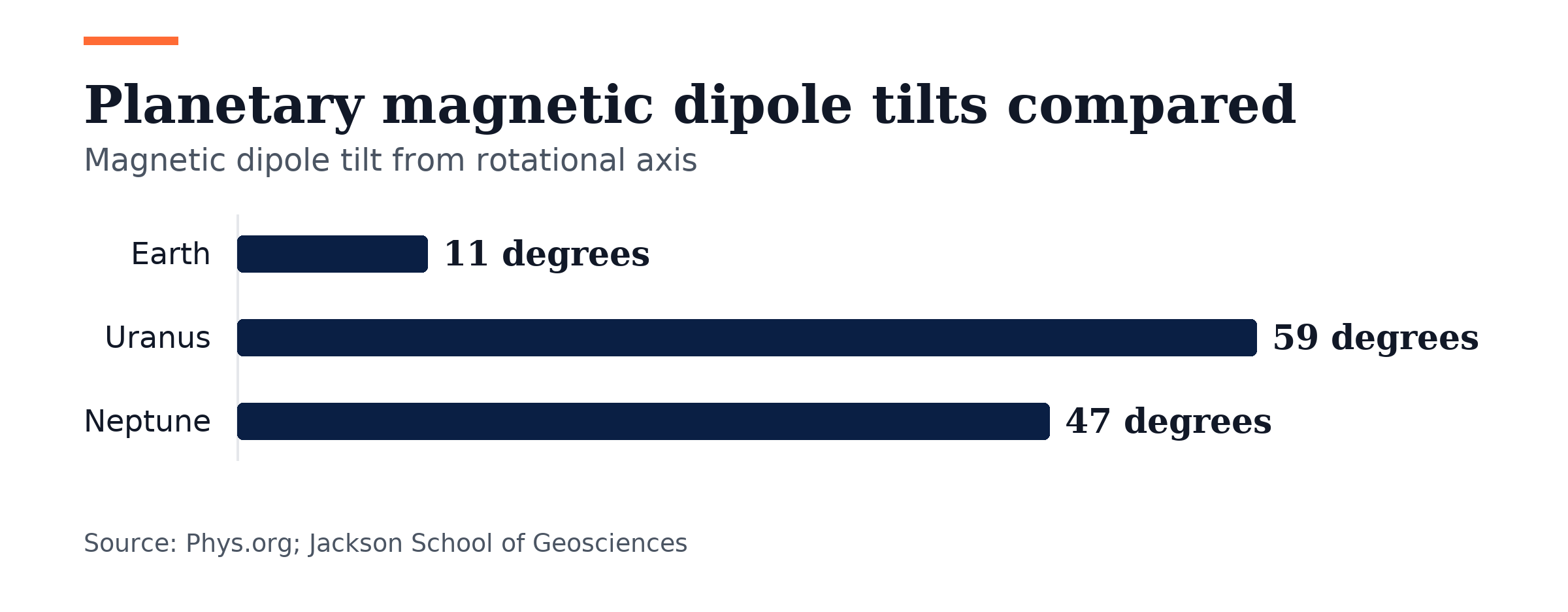
- Earth's magnetic dipole tilts only 11 degrees from its rotational axis, while Uranus' dipole tilts 59 degrees and Neptune's tilts 47 degrees.
- The team ran computer simulations assuming conductivity rises at depth and testing varied interior setups to model how fluid movement, heat and magnetic fields develop together to run the planets' dynamos.
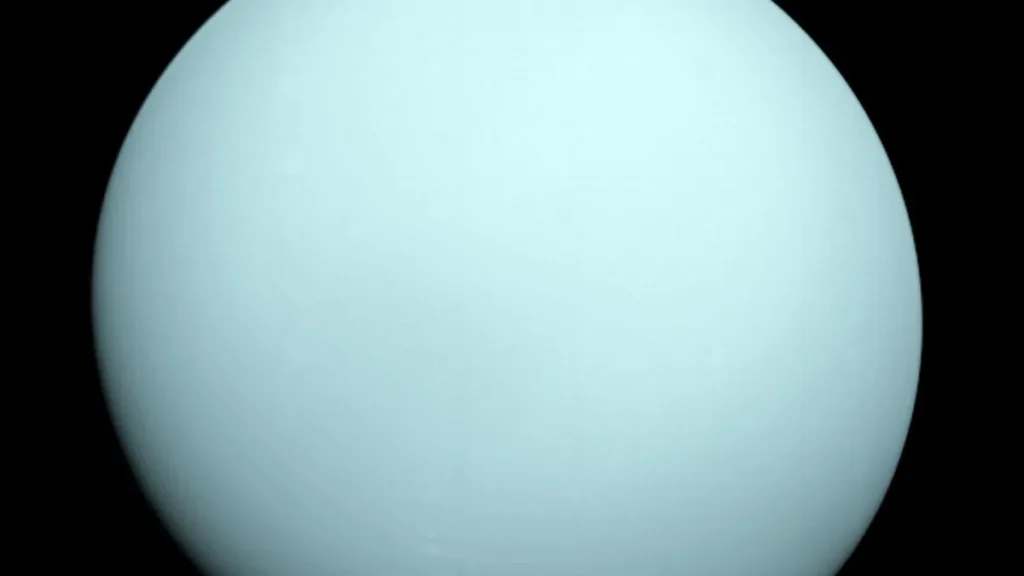
A research team led by Chi Yan, who is at the University of Texas at Austin, published a study in Communications Physics in 2026 proposing that shifts in electrical conductivity deep inside Uranus and Neptune explain the disordered magnetic fields Voyager 2 measured during the 1980s flybys. The paper titled Electrical conductivity structure drives anomalous and potentially time-varying magnetic fields at Uranus and Neptune was published in Communications Physics in 2026 and carries DOI 10.1038/s42005-026-02841-y. Chi Yan, a research associate with the UT Jackson School of Geosciences, is the study’s lead author, and the team includes researchers at University of California Los Angeles, Imperial College London and Northumbria University.
During the 1980s, Voyager 2 passed Uranus and Neptune and found magnetic fields that are highly disordered, unlike Earth’s clear poles. Earth’s magnetic dipole tilts just 11 degrees away from its rotational axis. Uranus tilts 59 degrees, and Neptune tilts 47 degrees. The ice giants Uranus and Neptune are about four times wider than our planet and consist of water, ammonia and methane plus hydrogen, helium and rocky material, though their exact composition is unknown.
A dynamo is the process by which electrically conducting fluids moving deep inside a planet generate magnetic fields. Below Earth’s surface, the outer core is liquid metal surrounding solid rock. Convection of molten iron shaped by Earth’s rotation creates a bar-magnet-like field with strong north and south poles that makes compasses align north-south. A study published in Communications Physics says that changes in deep-interior electrical conductivity at Uranus and Neptune may explain the planets’ unusual magnetic fields and their possible evolution over time.
Yan says the large size and geochemical composition of the planets could produce the tilted magnetic fields. “Under these conditions, which can cause water molecules to break apart into ions, the material may become increasingly electrically conductive with depth,” Chi Yan said.
The team built computer models that assume conductivity rises with depth. These simulations test varied interior setups to show how fluid movement, heat and magnetic fields develop together to run the planets’ dynamos. The models show the magnetic fields at Uranus and Neptune could change within decades and might look different now than during the Voyager 2 flybys. Yan says Earth’s magnetic tilt moves about one degree over 50 years, but the ice giants can shift by tens of degrees within decades in some stretches and barely move in others.
Researchers are studying high-resolution infrared JWST images of auroral emissions from Uranus and Neptune. JWST captures infrared light from auroral emissions generated when solar particles strike atmospheric gases, offering a possible diagnostic of present-day dipole orientation. Tom Stallard, a Northumbria University professor who led the JWST observation campaign and reviewed the paper, says aurora shape and ionosphere patterns provide a way to understand changes in the magnetic fields.
The group plans to merge JWST auroral data, Voyager 2 magnetic readings and dynamo simulations to estimate the present configuration of the planets’ magnetic fields. The researchers say properly understanding the planets’ interiors requires more missions to Uranus and Neptune.
Voyager 2 is the only spacecraft to visit Uranus and Neptune. It flew past Jupiter, Saturn, Uranus and Neptune after launching on a Titan III rocket almost 49 years before Aug. 11, 2026. Voyager 2 entered interstellar space on Dec. 10, 2018. Voyager 2 uses radioisotope thermoelectric generators to turn heat from decaying plutonium into electricity and loses about four watts of power each year.



Join the discussion