
This is a new development in a story we reported earlier: Amazon Leo to launch 40 satellites on ULA Vulcan rocket.
Key facts
- United Launch Alliance's new heavy-lift Vulcan rocket suffered its first total mission failure on November 15, 2026, when an anomaly about 10 minutes into flight destroyed a payload of 40 Amazon Leo internet satellites.
- The Vulcan rocket launched from Cape Canaveral's pad 41, also designated Space Launch Complex 41, at 12:40 p.m. EST on November 15, 2026.
- ULA's November 15, 2026 Vulcan failure was the company's first outright rocket loss since its formation in 2006 as a Boeing and Lockheed Martin partnership.
- The November 15 mission marked just the fifth Vulcan flight overall and the first Vulcan launch in nine months.
United Launch Alliance’s Vulcan rocket suffered a total mission failure on November 15, 2026, when an anomaly about 10 minutes into flight destroyed 40 Amazon Leo internet satellites at Cape Canaveral Space Force Station.
The 214-foot-tall vehicle lifted off from pad 41 at 12:40 p.m. EST and flew northeast. It generated 3.8 million pounds of thrust using two methane-burning BE-4 engines and six solid-fuel boosters from Northrop Grumman. Launch came at the close of the window after controllers held the countdown at T-minus 20 seconds for an unexplained technical issue.
Launch controllers stopped the countdown, holding at T-minus 20 seconds over an unexplained rocket issue, then moved to the end of the window, fixed the problem, and launched. The strap-on boosters worked normally during the climb, pushing the vehicle away from the thick lower atmosphere before burnout and separation at about one minute 40 seconds after liftoff. The Vulcan Centaur upper stage was scheduled to burn for 12 minutes 15 seconds after stage separation, but something went wrong, and ULA provided no additional details immediately.
ULA said it does not have enough data to determine what caused the anomaly. The company will work with its customer and other groups to find the cause and choose corrective steps, releasing more information as it becomes available.
The company promised full transparency with customers and said they will see into the inquiry, which depends on rigorous methods and corrective action. The company said it fell short of mission success and plans to return to flight as soon as possible, with more updates when information becomes available.
The failure marked ULA’s first outright rocket loss since the company’s 2006 founding by Boeing and Lockheed Martin. This was the fifth Vulcan flight, and the first Vulcan launch in nine months. The Vulcan is replacing ULA’s fleet of Atlas 5 rockets, and ULA operates the vehicle. Engineering teams must study telemetry and apply fixes for what caused the mishap, which could ground the rocket for a significant period.
Northrop Grumman and ULA had been working on nozzle problems for strap-on solid-fuel boosters from earlier flights in 2024 and February 2026. Mark Peller, ULA’s chief executive, said investigators had identified three credible causes and taken positive steps to mitigate each one, in comments to Aviation Week & Space Technology magazine. The U.S. Space Force suspended Vulcan launches carrying national security payloads while it completed analysis, but allowed commercial flights to proceed.
Amazon’s first Vulcan purchase covered 38 launches, and this November 15 mission was the inaugural one in that block, which would have brought the number launched so far to 436. The constellation needs more than 3,300 Leo satellites to be complete, and is designed to rival Elon Musk’s Starlink and other space-based internet providers. ULA had already used Atlas 5 rockets for eight LEO, or low Earth orbit, flights.
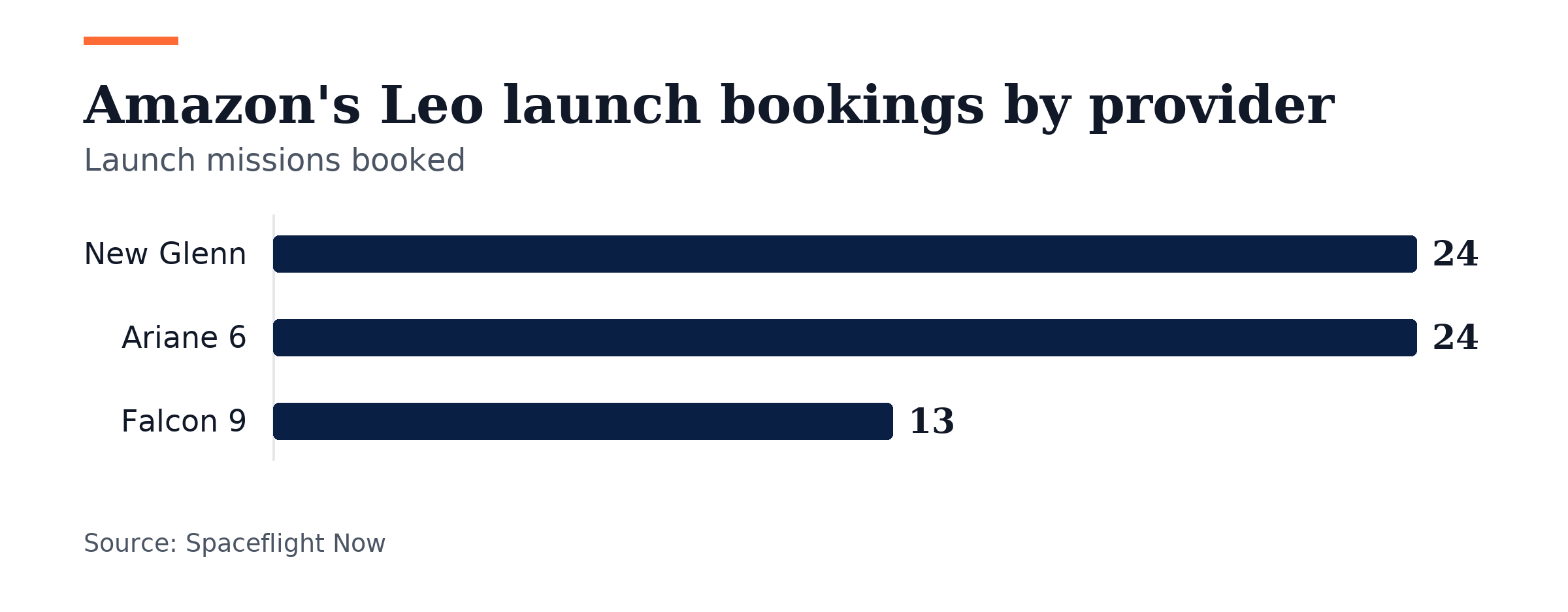
For its Leo satellites, Amazon has reserved 24 Blue Origin New Glenn missions, 24 European Ariane 6 flights, and 13 SpaceX Falcon 9 launches. Amazon’s Leo satellites cannot fly on Vulcan again until ULA’s investigation ends, and the company is also waiting for Blue Origin to return New Glenn to flight following a catastrophic explosion on the pad in May.
Blue Origin’s New Glenn exploded on the pad in May because of an oxygen valve problem in one of its seven BE-4 first-stage engines. Blue Origin builds the BE-4 engine that powers the Vulcan’s first stage, and Blue Origin engineers had fixed the engines flown on Sunday.
Mark Peller, ULA’s chief executive, said Blue Origin designed an improvement for the BE-4 oxygen valve problem and fitted a retrofit kit to the Vulcan’s engines. “They were down at our facilities probably a couple months ago and implemented that retrofit kit on the engines on this upcoming mission,” Peller said. Peller said Blue Origin engineers were probably at ULA facilities a couple of months before the mission and put the retrofit kit in place, working with ULA to process its engine inventory. The boosters worked normally on Sunday.
NASA Administrator Jared Isaacman posted on social media platform X that Artemis, Moon Base initiatives, and the nation need ULA, and he offered NASA help with the investigation and remediation effort. Isaacman said he appreciated ULA for quickly keeping the public informed, and he said NASA is available to help with the investigation.




Join the discussion