Key facts
- According to Astronomy Magazine's night-sky column for Saturday, November 28, 2026, Saturn appears as a bright naked-eye object throughout the evening.
- Around 8 P.M. local time on November 28, 2026, Saturn stands high in the south, next to the Circlet of Pisces on its left side and above Cetus the Whale.
- Saturn's moon Iapetus passes north of the planet on November 28, 2026, and stays visible there for several nights afterward, making it simpler to spot.
- Iapetus glows at 11th magnitude on November 28, 2026.
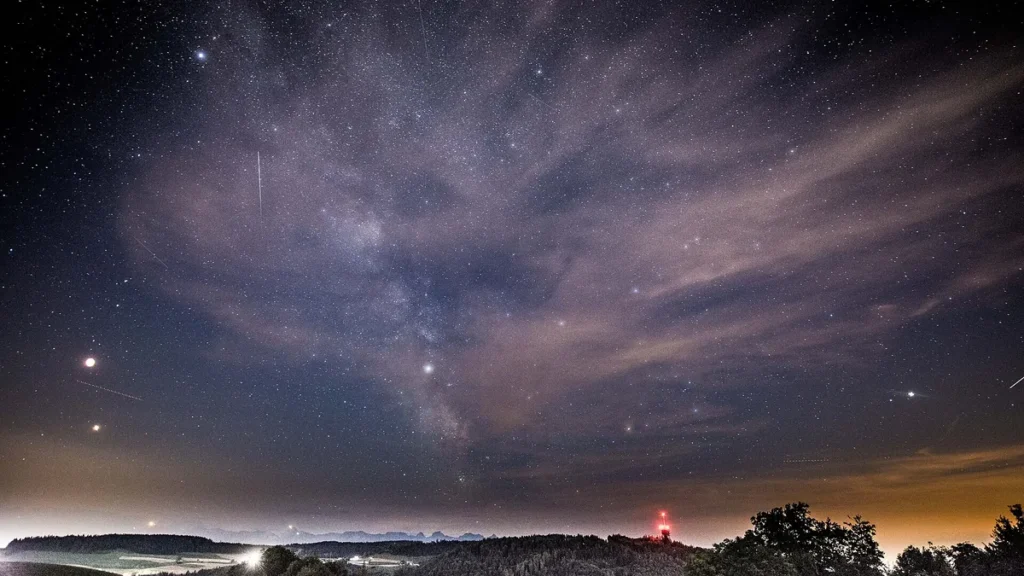
In the evening sky on Saturday, November 28, 2026, “Saturn remains a bright naked-eye object all evening, setting around 2 A.M. local time,” Astronomy Magazine’s night-sky column says.
The column reports that Saturn stands high in the south on November 28, 2026, around 8 P.M. local time, with the Circlet of Pisces to its left and Cetus the Whale below.
For a place at 40° N 90° W on November 28, 2026, the column reports sunset at 4:36 P.M. local time, so Saturn is already visible as darkness falls, and sunrise at 7:00 A.M. local time, which closes the dark observing window. The moon rises at 9:10 P.M. local time, so the early evening sky stays free of moonlight, and moonset comes at 11:09 A.M. local time. At 10 P.M. local time, the moon sits in a waning gibbous phase with 73% illumination.
The column reports that on November 28, 2026, Iapetus passes north of the planet and remains visible there for several nights, making the moon easier to spot. The moon glows at 11th magnitude, so a telescope is required to see it. Once Saturn is centered in the eyepiece, viewers should look about 2 arcminutes northeast to find Iapetus, and the close offset keeps the moon near the planet in the view.
The column describes Iapetus as strange and two-faced, and says its place north of the planet these nights helps viewers tell it apart from Saturn’s glare. By November 30, 2026, Iapetus will stand due north of Saturn after traveling westward and reaching inferior conjunction over the next few nights. The moon is heading west toward its western elongation in late December, when it will glow about one magnitude brighter while remaining far from Saturn, so these nights are the better time to see the moon close to Saturn.
The column reports that on November 28, 2026, viewers who can spot 11th-magnitude Iapetus can also see four brighter satellites: Dione, Rhea, and Tethys closer to the planet at 10th magnitude, plus Titan at mid-8th magnitude about 3 arcminutes to the west. Titan ranks as Saturn’s largest and brightest moon and is visible in any size scope, often even in binoculars.
The column reports that Titan is moving eastward toward Saturn and will pass south of the planet on December 2, 2026. On November 28, 2026, because Dione, Rhea, and Tethys circle closer and faster, their positions change over several hours as the moons trade places and cross in front of the planet or pass behind it.
The column reports that Dione disappears behind Saturn’s southwestern limb during an occultation (when one object passes in front of another and hides it) on November 29, 2026, around 12:20 A.M. EST. For time zones farther west, the event is still late on November 28.



Join the discussion