Key facts
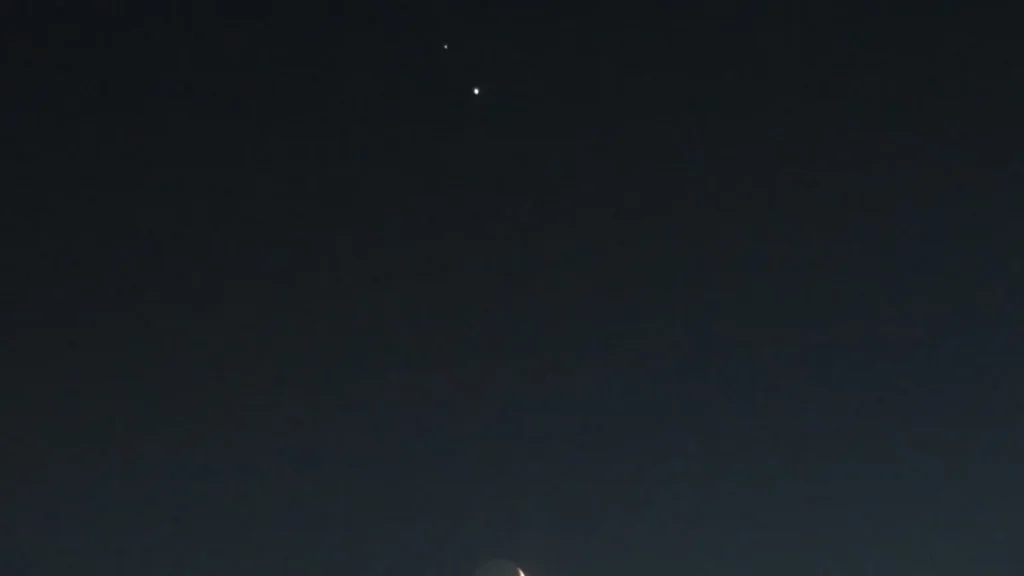
- On the evening of Nov. 20, the Moon and Saturn appear close together in the sky after sunset as a naked-eye conjunction.
- The Moon-Saturn gap is roughly three middle fingers at arm's length.
- Moonlight will make fainter stars harder to see.
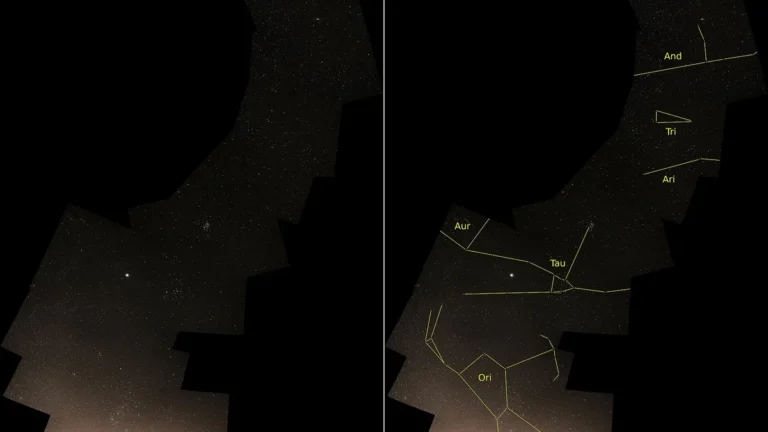
- Algenib, Markab, Alpheratz and Scheat form a diamond pattern above the lunar disk.
Space.com says the Moon and Saturn will appear close together in the evening sky on Nov. 20 as a naked-eye conjunction. A conjunction is when two sky objects appear close together in the sky as seen from Earth. The viewing guide describes the pairing as a spectacular naked-eye display with the stars of the Great Square of Pegasus twinkling nearby.
Sky-tonight.com places the closest separation between Saturn and the Moon on 20 November 2026 at 20:06. The separation measures roughly 6.06 degrees. Both objects sit above the horizon at that moment. The pairing remains observable.
The same listing notes that other Saturn–Moon approaches in late 2026 and 2027 happen below the horizon or during daylight. Sky-tonight.com tracks Saturn–Moon close approaches through 2027.
For viewers in the U.S., Saturn’s steady light appears a little over 5 degrees from the 82%-lit Moon in the southeastern sky after sunset. Space.com gives this separation as a reference for the post-sunset pairing on Nov. 20.
The Moon-Saturn gap is roughly three middle fingers at arm’s length. Space.com provides this hand-span comparison to help observers judge the distance in the sky. Moonlight will make fainter stars harder to see. The bright lunar disk reduces visibility of nearby dim stars even while brighter stars remain visible.
Algenib, Markab, Alpheratz and Scheat form a diamond pattern above the lunar disk. These stars trace the Great Square of Pegasus asterism in the November sky, according to Space.com.
The pair appears in the southeastern sky after sunset. The closest separation arrives at 20:06 on 20 November 2026, when both objects sit above the horizon. A naked-eye view means seeing the objects without a telescope.
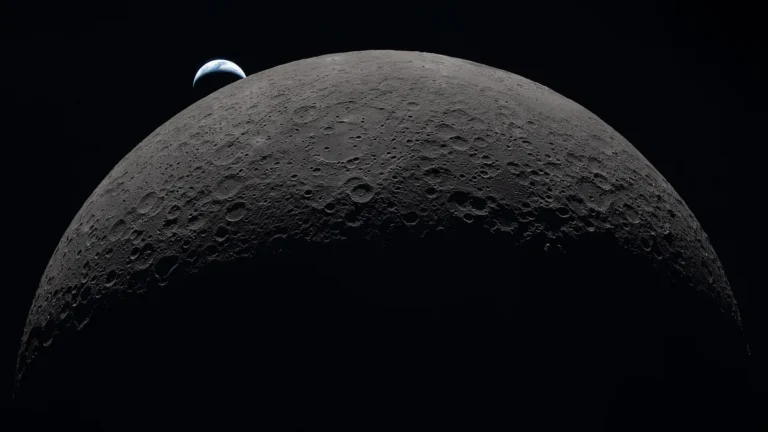
In a 6-inch telescope, the Moon is a spectacular target as the terminator line between night and day creeps closer to its western edge. The terminator is the line dividing the sunlit part of the Moon from the dark part.
Gassendi Crater measures 110 km across near Mare Humorum, and its eastern rim and central peaks cast intense shadows inside. Space.com identifies this crater as a specific telescopic target on the Moon during the Nov. 20 observing window.
A telescope view of Saturn shows details and subtle cloud variations on the gas giant, plus its iconic ring system. Space.com directs observers to move their telescopes from the Moon to Saturn for planetary detail on the evening of Nov. 20.
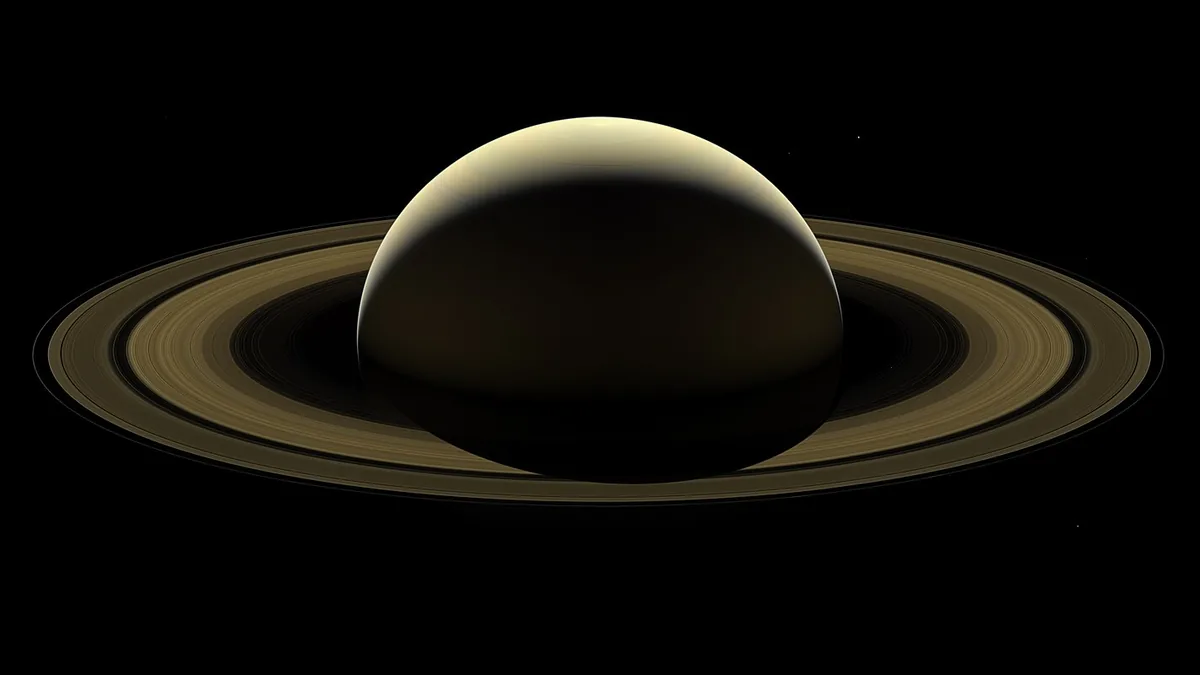
Saturn’s rings are gradually becoming more visible after the ring plane crossing in March 2025. A ring plane crossing happens when Saturn’s rings turn edge-on as seen from Earth.
If conditions allow, starlike points around Saturn’s disk are the moons Titan, Dione, Tethys, Rhea and Iapetus. Space.com notes these moons may be visible around Saturn during telescope viewing on Nov. 20.
Sky-tonight.com lists the next Saturn–Moon closest approach on 18 December 2026 at 04:39, at roughly 6.17 degrees separation, when both objects will be below the horizon and unobservable. The same source offers an observing opportunity earlier on 18 December 2026 at 00:13, with the pair separated by about 7.4 degrees. Sky-tonight.com schedules the Saturn–Moon closest approach on 14 January 2027 at 13:31, with a separation of roughly 6.31 degrees during daylight, making observation difficult.
The listing notes an observing opportunity later that day at 18:42, when the separation will be about 7 degrees. Sky-tonight.com places the Saturn–Moon closest approach on 10 February 2027 at 23:15, at roughly 6.4 degrees separation, with both objects below the horizon and unobservable. The same source offers an observing opportunity earlier on 10 February 2027 at 20:36, with the pair separated by about 7.2 degrees.
Sky-tonight.com dates the Saturn–Moon closest approach on 1 June 2027 at 06:39, at roughly 7.09 degrees separation during daylight, making observation difficult. The source lists an observing opportunity earlier that day at 03:25, when the separation will be about 6.8 degrees. Sky-tonight.com lists an observable Saturn–Moon closest approach on 15 October 2027 at 18:20, with the pair separated by roughly 7.65 degrees and both objects above the horizon.
Sky-tonight.com marks this approach as viewable because the pair will be positioned above the horizon at the moment of closest separation. Sky-tonight.com lists this Nov. 20 approach among several Saturn–Moon close approaches.


Join the discussion