
Key facts
- In one simulation, one side produced 3.9 millimeters per second of deflection velocity while another produced 0.8 millimeters per second, nearly fivefold.
- Moore and colleagues built a new algorithm over 1,600 times faster than older models that computers could not handle.
- Moore combined Sandia's ALEGRA code for high-energy Z machine experiments with SPARTA, a Monte Carlo code for slowly evolving forces such as satellite drag from the solar wind.
- Moore started work on accurate full-scale predictions following a Sandia Z machine experiment that first showed X-rays can deflect a small asteroid sample.
Sandia National Laboratories physicist Nathan Moore and colleagues published a new asteroid-deflection model in the journal Icarus on 24-Oct-2026, showing that an asteroid’s irregular shape changes how hard an X-ray burst pushes it and how fast the body spins. Most asteroid-deflection research simplified the math by treating asteroids as spheres, even though spherical asteroids do not exist. Nathan Moore said researchers chose spheres because they made the math easier, while real asteroids come in odd, lumpy shapes. Their shapes and compositions differ according to their parent bodies because asteroids lack enough mass to round themselves the way planets do. Moore’s team built an algorithm more than 1,600 times faster than older models that computers could not handle, combining Sandia’s ALEGRA code for high-energy Z machine experiments with SPARTA, a Monte Carlo code that uses repeated random sampling for slowly evolving forces such as satellite drag from the solar wind. The method models full three-dimensional asteroid topography, or surface shape, without adding unacceptably high computational cost or losing accuracy.
The researchers say the result is the most accurate asteroid deflection model to date because it pairs realistic shapes with detailed mathematics. The work grew out of a Sandia Z machine experiment that first showed X-rays can deflect a small asteroid sample. Nathan Moore said, “I started wondering how to scale up the calculation to more accurately predict deflection of a full-scale asteroid.” Sandia’s Laboratory Directed Research and Development program funded the research, a detail that makes the targeting choices more concrete. A stand-off X-ray mitigation scenario means detonating a nuclear weapon close to an asteroid to bombard it with radiation rather than obliterate it, changing its course if done soon enough and correctly. An X-ray pulse strikes one side, vaporization creates most thrust, and an internal shock wave, a pressure wave moving through the body, travels through the asteroid before the fracturing ejects chunks from the far side and sides.
In space, a nuclear explosion produces no atmospheric shock wave, only radiation released in a powerful pulse. Bursts detonated far from an asteroid’s surface could deflect it with less disruption to its original structure and allow more controlled steering than surface explosions. Breaking up an asteroid’s original structure could increase Earth’s danger by producing a swarm of debris, some of which might hit the planet. Planners therefore aim to push the asteroid with a nuclear burst rather than break it into smaller pieces that could remain deadly. By calculating surface vaporization, the simulation determines how hard an asteroid is pushed, how fast it rotates, and how much of its surface might break up. The program produces a heat map showing how much material vaporizes across the surface, then calculates the resulting push, changes in rotation, and possible breakup of surface rocks.
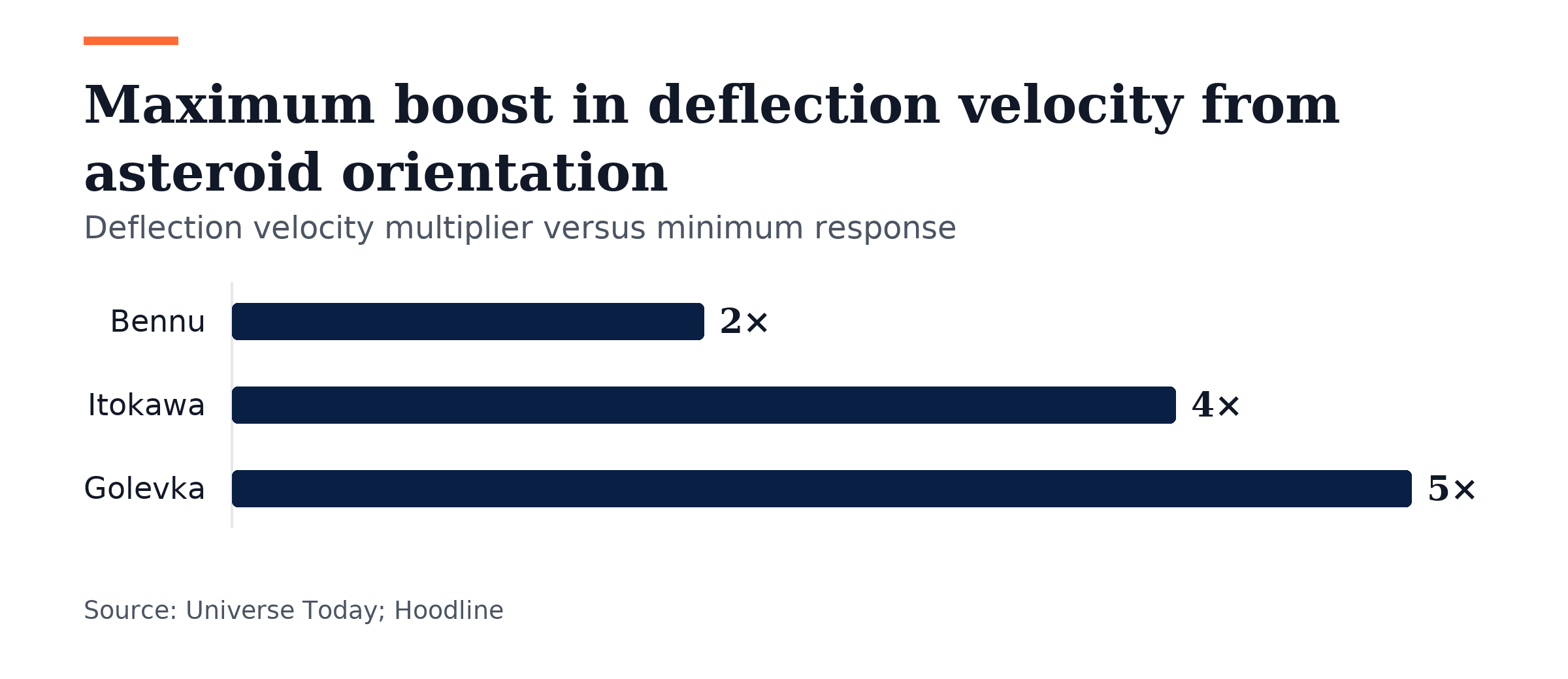
Researchers can apply the simulation to any asteroid mapped during a spacecraft flyby and calculate explosion size, distance, and exposed surface ahead of time. Researchers modeled deflection for Bennu, Itokawa, and Golevka using both near-field and far-field radiation, and the study includes images of Itokawa and Bennu plus a computer model of Golevka to show how different their shapes are. Orientation at intercept can raise deflection velocity by up to nearly 2× for Bennu, 4× for Itokawa, and 5× for Golevka versus each body’s minimum response. The authors write that deflection and disruption depend strongly on topography, especially when an incoming near-Earth object’s shape is unknown and its orientation at intercept is uncontrolled. In one simulation, one side produced 3.9 millimeters per second of deflection velocity while another produced 0.8 millimeters per second, nearly fivefold; these figures describe the change in linear speed after the simulated X-ray burst, not the asteroid’s overall traveling speed. For a different asteroid, rotational speed change after deflection varied by a factor of 17 between irradiation directions.
The reports say this shows push and spin response are distinct outcomes that planners must evaluate when modeling the same object under different irradiation angles. Quantifying how well pulsed radiation, or radiation released in short powerful bursts, deflects near-Earth objects, meaning asteroids and comets whose orbits bring them near Earth, is difficult because the result depends critically on surface topography, which is often unknown. A real mission would need sufficiently accurate knowledge of an asteroid’s shape from all sides, and humans might not have time to gather that information. It remains difficult to place an explosive at the proper distance and on the proper side of an asteroid in motion. The authors say planners can still use their work to make estimates, which is far better than nothing. In theory, planners could upload information about an asteroid, calculate the explosive strength, distance, and direction of a blast, and then carry it out.
The model works as a planning aid, yet putting the chosen scenario into practice demands work beyond the simulation itself. Detailed pre-detonation topographic data from spacecraft imagery or altimetry, which measures surface height, could improve deflection model accuracy for an incoming near-Earth object. The authors suggest this as an alternative to relying on estimates, alongside the possibility of asteroid-mapping spacecraft standing ready in space. The model treats surface rock breakup but cannot yet accurately predict whole-asteroid body breakup. Predicting whole-asteroid breakup will take more research and investment in better modeling tools because an X-ray blast has many effects that might interact.
Heating, escaping material, and structural damage can interact, making a complete calculation demanding even with faster simulations. The research reduces guesswork for avoiding doomsday, which Moore described as encouraging. Moore said, “Our new algorithm is over 1,600 times faster, which was critical to this breakthrough.” Moore said, “Pick the right side and you win.” Moore said, “Guess wrong and it could be a bad day.” NASA’s DART spacecraft hit Dimorphos in the Didymos system on Sept. 26, 2022, cutting the asteroid moon’s orbit around Didymos by 32 minutes.
A basic kinetic impactor, a spacecraft that strikes an asteroid to push it off course, is likely the favored method for asteroid deflection, and DART altered Dimorphos’ velocity somewhat, early enough to produce a large position change over years. Given enough time, a dangerous asteroid is a near-certainty to head directly for collision with Earth, and scientists are actively studying ways to knock an asteroid off course. The researchers describe this as the motivation behind NASA’s DART and ESA’s Hera mission and deflection concepts including nuclear stand-off bursts. The researchers say the more pertinent problem is an asteroid or comet on a collision course with Earth that is not discovered soon enough for a kinetic impactor to effectively change its trajectory. The authors argue that intercepting a near-Earth object or comet late might only work with the greater energy concentration from detonating a pulsed energy device, described as a nuclear weapon, an option of last resort for disruption or deflection when an object is not discovered soon enough. ESA’s Hera mission will study the aftermath of the DART impact and provide follow-up data on another asteroid system and deflection technique.
A NASA graphic recorded more than 1,400 potentially hazardous asteroids in early 2013, and the potentially hazardous label describes size and orbits near Earth’s orbit, not an expectation of impact. Continued observation and tracking of potentially hazardous asteroids can refine their orbits and improve predictions of future close approaches and impact probabilities. NASA coordinates the International Asteroid Warning Network, a worldwide group of asteroid astronomers and modelers that supports international responses to near-Earth-object threats. The United Nations Office for Outer Space Affairs says the Space Mission Planning Advisory Group lays out frameworks, timelines, and options for response activities. These coordination roles are not evidence that Sandia’s model is an approved mission. These results come from computer simulations rather than an actual asteroid deflection test.
Science News reported lab experiments in which X-rays heated free-falling mock asteroids, creating vapor that pushed them away, and simulations suggested the method could deflect some asteroids up to about 4 kilometers wide. Putting atomic weapons in space would be extremely difficult in the fractured geopolitical world, though it remains a possibility, perhaps the only one. Asteroid-mapping spacecraft could wait in space for deployment, pair with nuclear-carrying disruptor spacecraft, or merge into a single craft.

Join the discussion