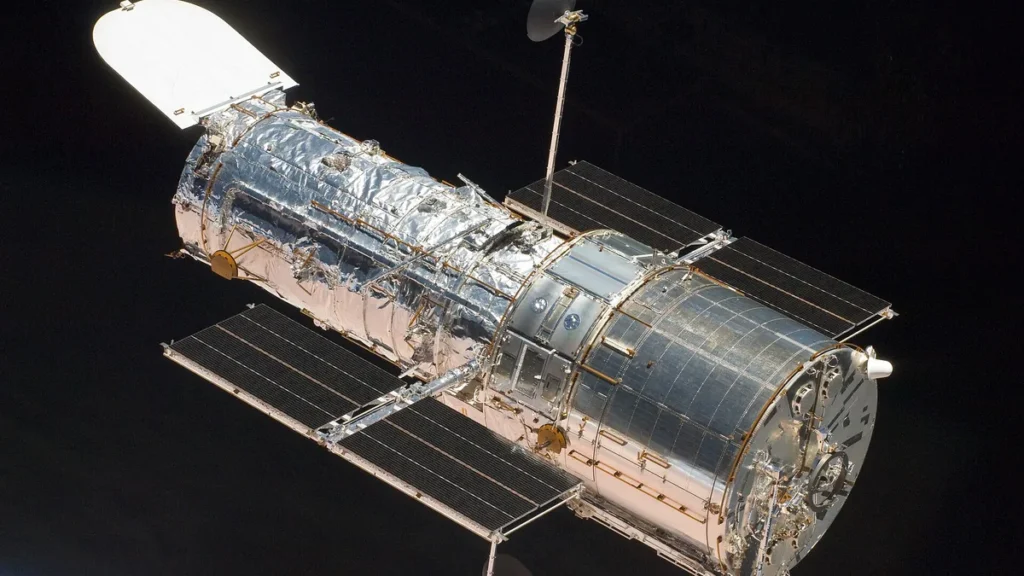
A group at Northwestern University created a software tool called FLIP, short for Physics-based Learning for Imaging Planets. The technique constructs a digital twin of the James Webb Space Telescope that models and removes starlight, making it easier to spot faint planets. The findings were published in Nature on Nov. 4, 2026, in a paper titled “Imaging exoplanets below the telescope stability limit.” According to the researchers, FLIP increases sensitivity for detecting dim exoplanets by a factor of 2 to 15 compared with traditional image-processing methods.
The approach targets worlds obscured by leftover starlight after the telescope’s coronagraphs have done their work. The team combined physics-based modeling with optimization tools like those used in machine-learning training, though they did not use artificial intelligence to identify planets.
FLIP builds a virtual replica of the James Webb Space Telescope that simulates how starlight moves through the instrument’s mirrors and detectors. The software then adjusts millions of parameters to match actual observations down to nanometer-scale imperfections, after which it subtracts the modeled glare. By reproducing the unwanted starlight with high precision, the software can remove it and expose faint worlds. Instead of borrowing glare from other stellar measurements, the technique simulates the telescope’s own starlight.
The method operates on the residual starlight that remains after JWST’s coronagraphs have blocked most of the star’s light.
For two decades, astronomers have suppressed starlight by observing a separate reference star and subtracting its image from the target observation. This reference-star method has dominated exoplanet imaging, but telescope instability limits it. Small discrepancies from temperature shifts, mirror growth or shrinkage at the picometer level, and cryocooler motor shaking produce leftover glare that can conceal faint planets. JWST’s fine guidance sensors and its five-layer sunshield improve the telescope’s stability, yet small thermal changes can still shift JWST mirrors by a picometer, and cryocooler motors can cause the mirrors to vibrate, leaving smudges of starlight that obscure smaller planets.
JWST employs coronagraphs inside its NIRCam and MIRI instruments to block most starlight, producing an effect like an artificial eclipse. Standard coronagraphs on JWST block starlight yet leave behind residual glare that demands image processing. More glare still escapes through and creates a hazy pattern that hides planets. These coronagraphic features have enabled JWST to study debris disks and bright objects including quasars, but blocking the star by itself is not enough because scattered starlight persists.
Planets are about a million times dimmer than the stars they orbit, and even quite luminous young giant worlds can be 100,000 times dimmer than the stars they circle. The most massive planets can still be over 10,000 times dimmer than the stars they revolve around, and their light disappears into the glare. Such a drastic difference in brightness is what makes starlight suppression essential for direct imaging, and why tiny nanometer-scale movements or tilts in the telescope can alter the glare pattern sufficiently to conceal a world. This brightness difference highlights the challenge of direct imaging, a challenge that the new FLIP tool works to address by modeling the telescope’s own starlight instead of subtracting glare from other stars.
The researchers applied FLIP to JWST data for three stars: HIP 65426 and 51 Eridani, which both host known planets, and TYC 5899, which has no known planetary companions. In every case, FLIP delivered better results than standard image-processing methods. The 51 Eridani data dated back two years from the time of the reanalysis, and carbon dioxide in the planet’s atmosphere absorbs infrared light at the wavelength JWST employs, which makes the planet’s signal appear even weaker.
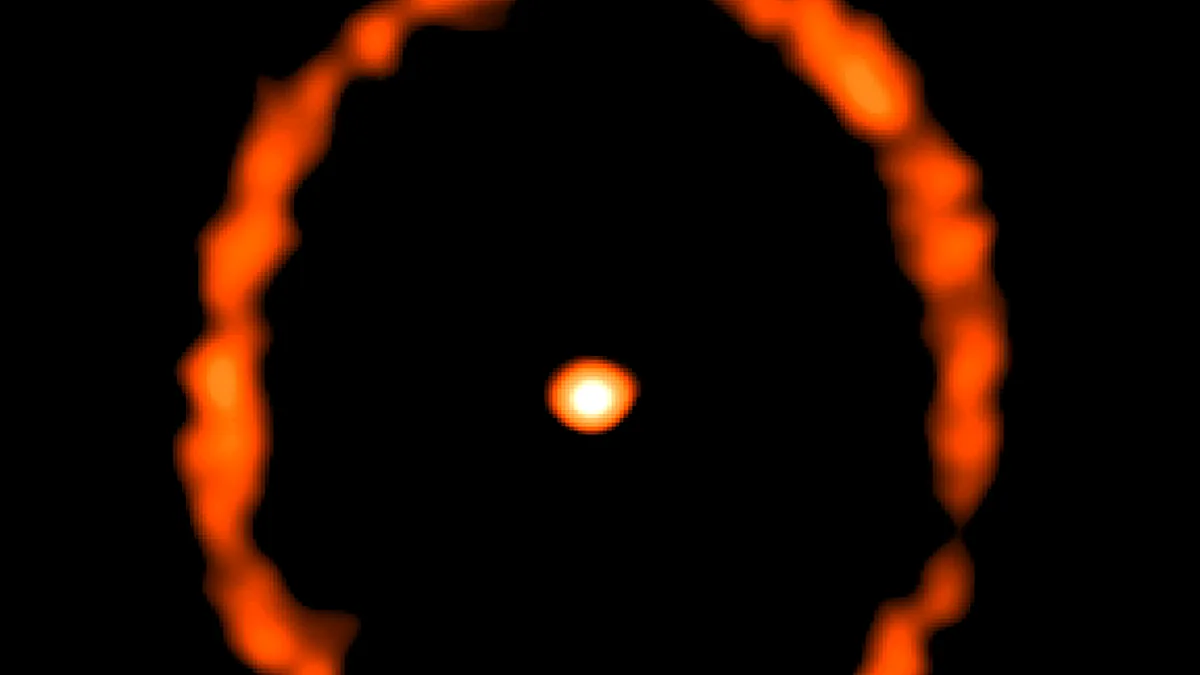
On 51 Eridani, the method revealed a previously known giant exoplanet at the 4.3-micron infrared wavelength used to study carbon dioxide in planetary atmospheres, with a detection above 5 sigma. At 4.3 microns, JWST observations placed the planet’s signal in an especially faint regime because carbon dioxide absorbs infrared light at that wavelength. FLIP reconstructed the unwanted starlight with enough accuracy to subtract it and bring the planet into view. Ground-based telescopes had found 51 Eridani b before JWST observed it, but conventional processing could not distinguish it from residual glare at that wavelength.
At present, JWST can spot planets about the size of Saturn orbiting their stars at distances beyond Pluto’s orbit around our sun. To directly image Earth-sized worlds would demand a telescope 100 to 1,000 times more stable than JWST, a standard not yet reached even in laboratory settings. Ferrer-Chavez pointed out this stability gap, explaining that JWST’s 6.5-meter mirror bends, temperatures fluctuate, and stars land slightly off-center between observations, which leaves smudges of starlight that obscure smaller planets.
To capture images of Earth-like planets about 10 billion times dimmer than their stars, the Habitable Worlds Observatory would need to keep its optics steady to within a trillionth of a meter, roughly 100 to 1,000 times more stable than JWST. The Habitable Worlds Observatory is planned for launch in the 2040s and is designed to directly image Earth-like planets orbiting sun-like stars. The observatory may require optical stability at the picometer scale, about 100 to 1,000 times more stable than JWST, a performance level not yet realized even in laboratory environments.
FLIP might lower the engineering demands on NASA’s planned Habitable Worlds Observatory by partly relaxing the ultrastability requirement and shrinking the error budget for image post-processing. That could make the future observatory more tractable to design and build. FLIP provides a software-based approach to compensate for small telescope flaws instead of depending only on hardware stability.
Rodrigo Ferrer-Chavez, a PhD student in astronomy at Northwestern’s Weinberg College of Arts and Sciences, led the study, with Jason Wang, an assistant professor of physics and astronomy at Weinberg, serving as co-author. K.L. Bouman also joined the author list. Ferrer-Chavez and Wang are members of Northwestern’s Center for Interdisciplinary Exploration and Research in Astrophysics, or CIERA. The paper carries the citation “Ferrer-Chavez, R., Wang, J.J., Bouman, K.L. et al.
Imaging exoplanets below the telescope stability limit. Nature 659, 58–62 (2026).”
Funding for the research came from the Space Telescope Science Institute under award number JWST-AR-07942, the Sloan Foundation under award number FG-2025-24976, and the National Science Foundation under award number PHY-2525568. The Northwestern-led team drew on researchers from CIERA, the university’s Center for Interdisciplinary Exploration and Research in Astrophysics.


Join the discussion