Key facts
- The DESI Collaboration's arXiv analysis puts the Milky Way's total mass at 1.19 trillion times the mass of the sun with about 11% uncertainty, the most precise estimate yet.
- Astronomers estimate galactic mass by tracking stars and satellite galaxies moving under its gravity; faster motion at a fixed distance requires more mass to hold the object in place.
- Most of the Milky Way's mass cannot be explained by visible stars and gas, and measurements based on stellar and satellite motions have produced estimates that differ widely.
- DESI analyzed more than 10,000 distant stars from its first three years of observation, roughly 30,000 to 310,000 light-years from the center, combined with Gaia motion data.
The DESI Collaboration posted an analysis on the arXiv preprint server on Nov. 17, 2026, estimating the galaxy’s total mass at roughly 1.19 trillion times the mass of the sun with about 11% uncertainty, the team’s most precise figure yet.
The figure covers total mass, including both dark and ordinary matter, and is listed as DESI DR2 Results III: The Mass of the Milky Way (2026), DOI 10.48550/arxiv.2611.05518. For material inside 260,000 light-years of the galactic center, uncertainty falls to about 8%.
Astronomers weigh a galaxy by watching stars and satellite galaxies move under its gravity; at a fixed distance, faster motion requires more mass to hold an object in place. Visible stars and gas cannot explain most of the Milky Way’s mass, and measurements built on stellar and satellite motions have produced estimates that differ widely. Older work weighed the galaxy using stars in the sparse outer halo, where invisible dark matter dominates, along with stellar streams ripped from smaller objects and tight clusters and satellites.
DESI’s analysis drew on more than 10,000 distant stars from the instrument’s first three years of observation, located roughly 30,000 to 310,000 light-years from the galactic center, and paired them with motion data from the Gaia space telescope. The sample comes from two kinds of aging stars whose predictable brightness makes them useful as distance markers.
The team applied four modeling approaches to both stellar populations and validated each one with mock surveys of six simulated galaxies viewed from four vantage points. The fake observations included realistic measurement errors and gaps in sky coverage, allowing the researchers to correct biases, including biases shared across methods. These mock tests let researchers validate each method before applying it to real data.
Earlier approaches examined halo stars, streams, clusters, and satellites, while newer disk-rotation models point to smaller masses than studies based on distant objects. Those older studies seldom tested methods at once and seldom accounted for the way gravity realistically distorts galaxies or for the limits of wide surveys.
Each of the four DESI methods assumed the galaxy was perfectly round and in a steady state, and the mock tests show future models should allow a less spherical and more disturbed Milky Way. The team cautions that a high result might point to a massive, extended halo but does not settle the dispute over whether the galaxy has a massive extended halo.
The team hopes to sharpen estimates of the outer halo’s mass by adding more distant stars and further Gaia measurements to the existing sample. DESI observations will also soon be public for independent analysis, letting other teams check the work.
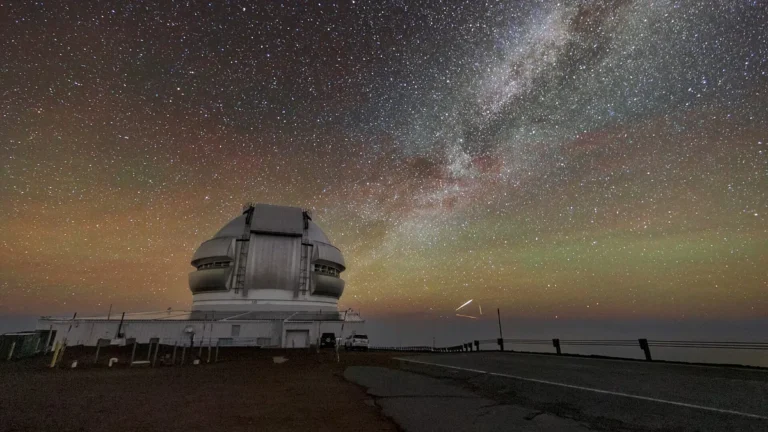
DESI is managed by the Department of Energy’s Lawrence Berkeley National Laboratory, and construction and operations funding came from the DOE Office of Science. The instrument rides on the Mayall telescope, a 4-meter instrument at Kitt Peak National Observatory in Arizona supported by the U.S. National Science Foundation. DESI observes from I’oligam Du’ag, also called Kitt Peak, a mountain sacred to the Tohono O’odham Nation, and the collaboration says it is honored to work there.
Data collection began in May 2021, and DESI finished its original sky survey ahead of schedule on April 14, 2026, producing the most extensive high-resolution map of the universe yet. The instrument will keep observing through 2028, expanding its coverage beyond the original footprint.
The survey counted more than 47 million galaxies and quasars and 20 million stars, exceeding the original five-year goal of 34 million galaxies and quasars. The collaboration includes more than 900 researchers and over 70 institutions, with 300 Ph.D. students among the researchers. UC Santa Cruz says the instrument far surpassed the collaboration’s original goals over its five-year sky survey.
Alexie Leauthaud of UC Santa Cruz co-leads the DESI science collaboration as one of two co-spokespersons, and Michael Levi directs the project at Berkeley Lab. “DESI’s five-year survey has been spectacularly successful,” said Michael Levi, DESI director and a scientist at Berkeley Lab.
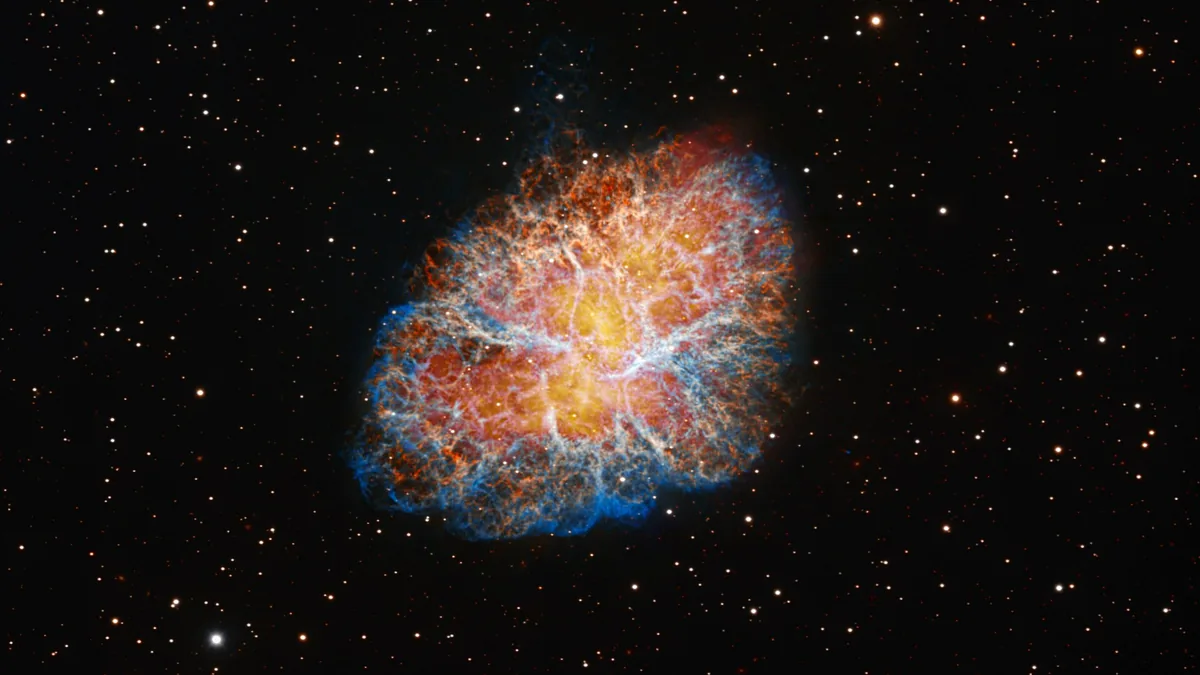
On April 14, 2026, DESI aimed 5,000 robotic fiber-positioners at a field near the Little Dipper, capturing targets roughly once every 20 minutes to complete observing all regions in the original map. The COVID-19 pandemic halted final testing in 2020, and the Contreras Fire burned over Kitt Peak in 2022 without damaging the telescope, even as monsoons and mudslides slowed recovery.
DESI uses robotic positioners to line up optical fibers within 10 microns of accuracy, and ten spectrographs split each object’s light into colors to measure its position, velocity, and chemical composition. Nightly, about 80 gigabytes of data flow through ESnet to supercomputers at Berkeley Lab’s NERSC center for initial processing.
The instrument carried out five Bright-Time Survey passes and seven Dark-Time Survey passes, together covering roughly two-thirds of the northern sky. Bright-Time work occurs when moonlight blocks views of faint, distant objects. Dark-Time observations are made when the sky is darker and better suited to those faint targets.
DESI plans to grow map coverage by about 20 percent, from 14,000 square degrees to 17,000 square degrees. The extended map will cover difficult regions nearer the Milky Way’s plane, where bright nearby stars block the view of distant objects, plus southern sky areas, where extra atmosphere makes observation difficult.
Returning to already mapped areas, DESI will observe more distant, faint luminous red galaxies, building a tighter, more detailed map of areas already covered. Knowing DESI would keep operating past its original plan, researchers started mixing fresh observations into the ongoing survey to save telescope time and keep the instrument from idling.
Dark energy accounts for about 70% of the universe and drives its accelerating expansion. Researchers used a comparison of how galaxies cluster now versus in the past to trace dark energy’s effects over 11 billion years of cosmic history. Determining whether dark energy is constant or changing over time is central to the mission.
Data from DESI’s first three years showed that dark energy might change rather than remain a fixed cosmological constant, and the full five-year data set will check whether that signal grows or fades. DESI expects the first dark-energy results from its complete five-year dataset in 2027. If confirmed, evolving dark energy would mark a major shift in thinking about the universe and its fate, which depends on the balance between matter and dark energy.
UC Santa Cruz professor Alexie Leauthaud, a DESI co-spokesperson, said dark energy dominates the universe, and researchers still do not know what it is. Scientists continue analyzing data from the survey’s first three years, and scientists plan papers for later this year.
Researchers plan to study nearby dwarf galaxies and stellar streams—bands of stars pulled from smaller galaxies by the Milky Way’s gravity—to learn more about dark matter. This invisible form of matter accounts for most of the universe’s mass and has never been directly detected.
Support comes from the DOE Office of Science and NERSC, together with the U.S. National Science Foundation, Britain’s Science and Technology Facilities Council, plus the Gordon and Betty Moore Foundation. France’s CEA, Mexico’s SECIHTI, Spain’s science ministry, DESI member institutions, and the Heising-Simons Foundation also support the project.



Join the discussion