Key facts
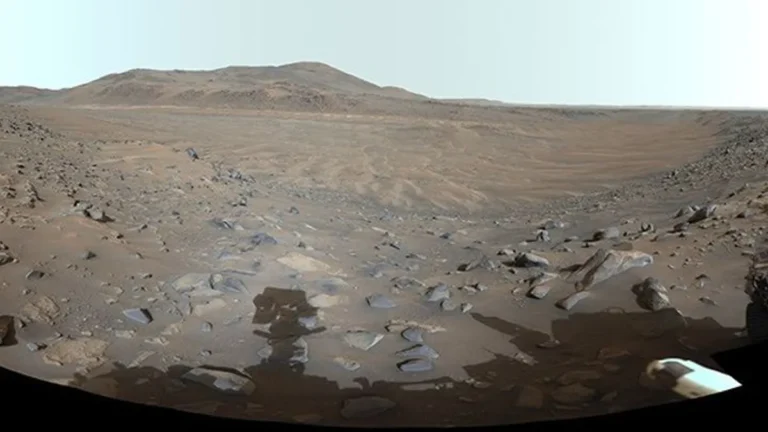
- Perseverance investigated Idubi, which the NASA blog places at its southern border and Science.Report locates west of Jezero's crater rim.
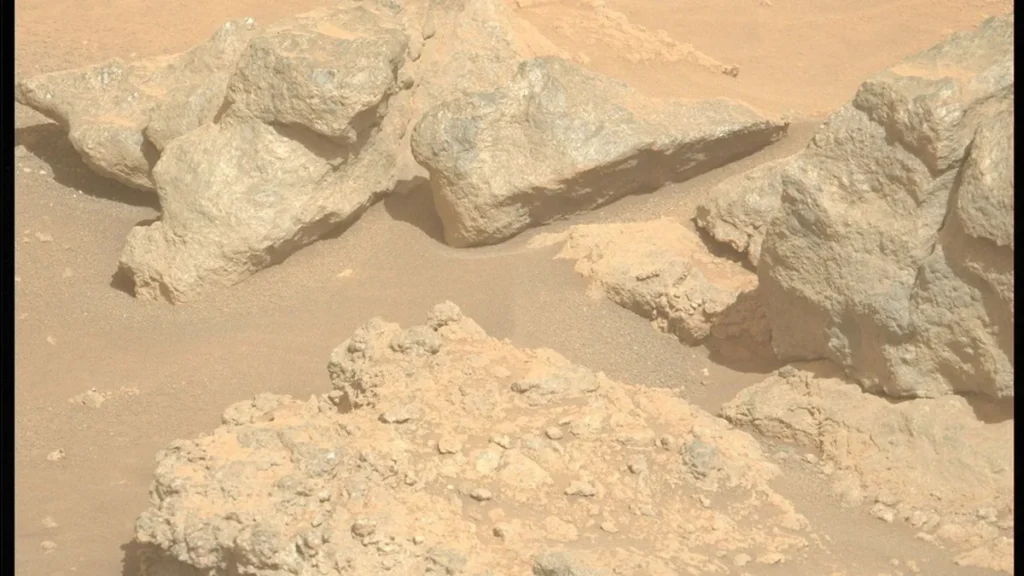
- The rover photographed a contact between distinct rock units at a target named Tinga during its traverse at Idubi.
- The higher-standing dark rocks at Tinga could belong to the nearby olivine-bearing Idubi unit extending onto the plains beyond Jezero's crater rim, or they could be breccia baked by contact with hot Idubi rocks.
- Further in situ investigation is needed to determine how the higher-standing rocks at the Tinga contact relate to the broader Idubi unit.
Perseverance photographed a contact between distinct rock units at a target named Tinga on Oct. 19, 2026, during a traverse of Idubi at Jezero’s southern edge.
Idubi sits at Jezero’s southern border, west of the crater rim, in an area of valleys and ridges called Lac de Charmes. Hundreds of pale boulders there drew the science team after the rover spent months crossing that region in September 2026. NASA’s blog describes Idubi as an olivine-rich outcrop whose contact could tell regional history, while Science.Report calls it one of the oldest rock areas encountered.
Once upon a time, NASA's Mars 2020 rover investigated the southern border of "Idubi," an outcrop composed primarily of an igneous mineral geologists call olivine.
Margaret Deahn, Ph.D. candidate at Purdue University, NASA Science
At Tinga, the lowermost unit is likely a polymict breccia made of angular clasts from many rock types, a texture that generally forms through violent processes such as an impact. The Tinga breccia may have resulted from an impact similar to the one that created Jezero crater, or from Jezero itself, though the link remains tentative.
Higher-standing dark rocks above the breccia could belong to the nearby olivine-bearing Idubi unit extending onto the plains beyond the rim, or they could be breccia baked by contact with hot Idubi rocks. The team needs further in situ investigation to connect those rocks to the broader Idubi unit.
Science.Report described a light-toned boulder at Idubi as producing the rover’s most unusual rock texture so far, but no sample. On Sept. 1, 2026, at Sol 1967 and 16:18:01 local mean solar time, the SHERLOC WATSON camera on the arm turret took a close image of the exposed surface at Badger Peak. NASA released that account on Sept. 28, separating the capture date from the public reporting date. The image documents only the exposed surface and cannot verify mineral makeup or confirm that one process formed the full texture.
The abrasion revealed a sharply contrasting light-and-dark pattern unlike anything Perseverance had seen, separating surface texture evidence from detailed composition. After the drill failed on the exceptionally hard material, the team searched for another boulder of comparable appearance that might be soft enough to collect; as of late September 2026 that search remained open without a confirmed target. NASA described Idubi as exceptionally productive by late September 2026.
A driving algorithm built around a processor once tied to Ingenuity Helicopter communications enabled longer, more accurate drives between outcrops. By 2026 the rover had traveled about 28 miles across Jezero, with a planned operational driving capability of at least 60 miles. It also stopped at Gardenia, an outcrop that could be breccia, though that interpretation remains provisional pending detailed examination.

Margin Unit rocks on Jezero’s inner edge, initially expected to be lake sediments, are instead interpreted as igneous and may have interacted with water at least three times, including an ancient hot-water episode. The findings show the rock record preserves volcanism stages plus later burial and fluid-circulation changes rather than one uninterrupted lake history. Rover investigations indicate igneous rocks cooled from lava or magma and impactite rocks came from violent impacts, with some rocks showing signs of both processes. Those Margin Unit findings do not establish that the Idubi boulder originated the same way.
At Jezero, at least three water-rock interaction episodes suggest crustal alteration at different temperatures and times, relevant to habitability but not proof of past life. NASA and planetary researchers keep emphasizing that mineral evidence must be separated from biological interpretation.
Olivine is a group of minerals associated with volcanic activity and is a silicate with varying magnesium and iron, while carbonates contain a carbonate ion and typically form through carbon dioxide and liquid water interaction, making them astrobiology targets for ancient Mars habitability. Jezero is believed to be an ancient river delta that collected olivines, carbonates and organic molecules, and with no plate tectonics, billion-year-old formations remain intact. Dr. Adrian Brown discussed these mineral links in a Feb. 9, 2021, talk during a four-part lecture series marking the Perseverance landing.
Jezero was chosen as the Mars 2020 landing site after a five-year search from over 60 potential locations. Purdue’s Briony Horgan, an associate professor of planetary science and Perseverance science team member, helped select Jezero, led the mineralogy study behind the selection, and helped design the rover’s scientific camera. Perseverance launched on July 30, 2020, bound for Jezero Crater, and the mission searches for signs of past life, particularly ancient microbes that may have lived in Mars’ rivers, lakes and swamps billions of years ago.
Distinguishing rock histories at Idubi and Lac de Charmes requires repeated observations and successful sampling rather than a pattern alone, because an abrasion patch is not equivalent to laboratory analysis of a returned specimen. A deliberately exposed abrasion patch lets the rover examine material under dust and weathering, showing texture and supporting closer readings, but it does not equal lab analysis of a returned sample. The mission’s strongest result is a better geological map showing where evidence lies and which targets deserve another attempt, while Lac de Charmes provides valuable geological evidence rather than a finished account of early Mars.
Tinga records distinct geologic events just outside Jezero’s crater rim, and the rover will continue revealing Jezero’s origin story and geologic history.



Join the discussion