Key facts
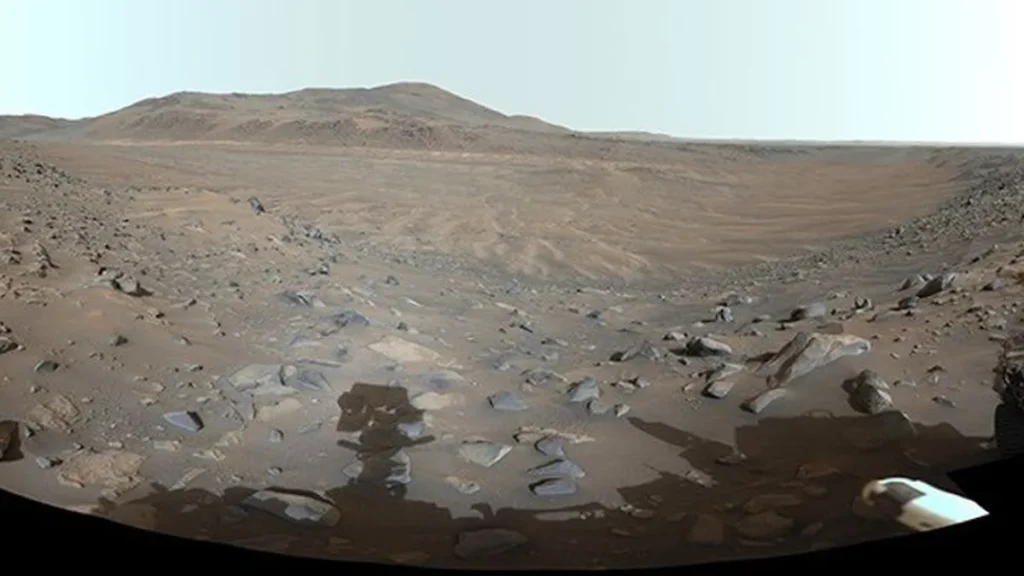
- The panorama combined 217 pictures taken by Perseverance's Mastcam-Z instrument on May 20, 2024, during the 1,155th Martian sol of the mission.
- Billions of years ago, a river channel at Neretva Vallis fed fresh water into Jezero Crater.
- NASA Science published a 360-degree mosaic of Neretva Vallis in Jezero Crater on Mars on October 26, 2026.
- The image is an enhanced-color edition created by processing color bands to boost contrast and highlight color differences.
On Oct. 26, 2026, NASA Science released a 360-degree mosaic showing Neretva Vallis inside Mars’ Jezero Crater.
The view appears on the agency’s photojournal site. A description there calls the place Neretva Vallis within Mars‘ Jezero Crater. That page labels the mosaic an enhanced-color view and connects it to the Perseverance rover mission.
For the panorama, 217 pictures came from Perseverance’s Mastcam-Z instrument on May 20, 2024, in mission sol 1,155. NASA Science says the pictures date from the 1,155th Martian day. The source calls the result a 360-degree look at Jezero Crater’s Neretva Vallis site.
Currently the mosaic shows Neretva Vallis as a wind-swept, dusty vista. The source contrasts the current dusty look with the site’s ancient past. The source says that billions of years ago a river channel at that location carried fresh water into Jezero Crater.
The source calls the modern dusty corridor a remnant of an ancient waterway. It ties the channel to fresh water entering the crater.
The image is an enhanced-color edition built from processed color bands. The processing boosts contrast and brings out color differences. The page says the view is not natural color and says processing adjusted it to make color differences stand out more.
Mastcam-Z operations come from Arizona State University. The source calls the university the lead institution for running the camera system. It additionally names partner organizations that helped build and test the hardware.
Arizona State University works with Malin Space Science Systems of San Diego on design, fabrication, testing, and operation. Malin Space Science Systems is the San Diego collaborator. The work covers the full camera lifecycle from design through operation.
The university also works with the Niels Bohr Institute at the University of Copenhagen on calibration target design, fabrication, and testing. The institute sits at the University of Copenhagen. Its role covers calibration targets but not the cameras themselves.
The Jet Propulsion Laboratory built the Perseverance rover and still runs its mission operations. Caltech manages the laboratory for NASA. The source credits the laboratory with building the rover and running operations.



Join the discussion